

 Samira El-Khalil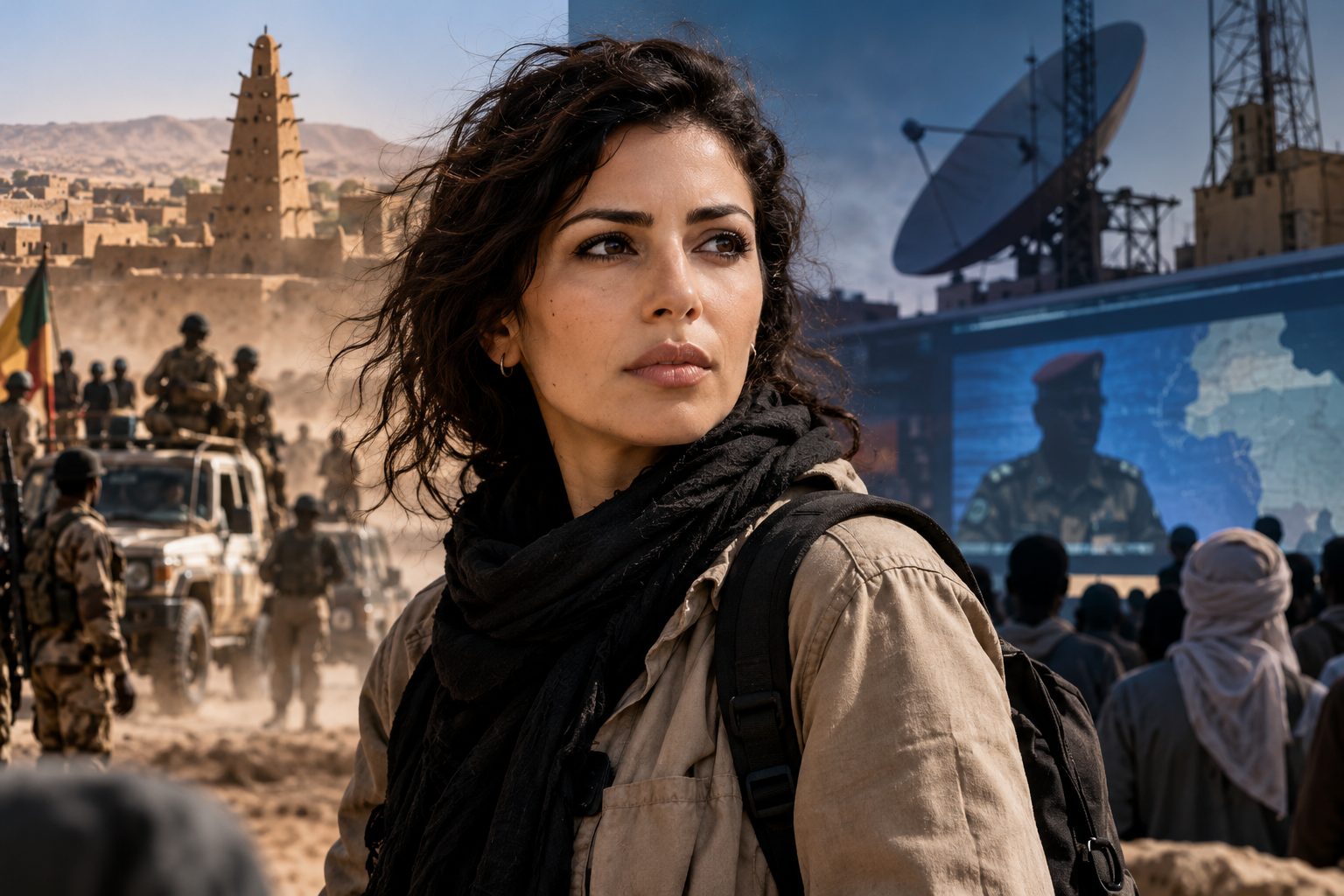
Bamako, Mali
In the Sahel, power is increasingly exercised through two overlapping struggles. One concerns territory, roads, villages and military presence. The other moves through television studios, encrypted channels, official communiqués and shrinking newsrooms. The first can be mapped more easily; the second is harder to measure, yet it may prove just as consequential.
Mali, Burkina Faso and Niger have built a new political architecture around the Alliance of Sahel States, presenting military rule as a response to years of insecurity and external dependency. That argument resonates because frustration with previous governments and foreign interventions did not emerge from nowhere. Yet armed groups linked to al-Qaeda and the Islamic State remain active across large areas, while many communities continue to live with displacement, disrupted trade and periodic violence.
This gap between political promise and territorial control helps explain why information has become so valuable. Tafouk TV, broadcasting from Bamako with Russian-linked support and cooperation with state media from Moscow, is part of a broader effort to construct a shared informational space across the three military-led states. Its language emphasizes sovereignty, dignity, resistance to Western pressure and the recovery of national agency, themes that are effective precisely because they connect with experiences already familiar to many people in the region.
Narratives rarely become powerful by inventing emotions from nothing. They become persuasive when they attach themselves to recognizable history, and colonial memory remains politically alive across the Sahel, particularly in relation to France. French military involvement and diplomatic influence became increasingly unpopular as insecurity persisted, creating space for other actors to present themselves as alternatives rather than simply outsiders.
Russia entered this environment not as the origin of anti-Western sentiment, but as an actor capable of operating within it. What followed was more than a shift in diplomatic alignment. It also became a reorganization of political memory in which France could be framed as the failed former colonial power, Russia as a partner willing to cooperate with fewer political conditions, and military governments as institutions reclaiming sovereignty after decades of external interference.
Each part of that narrative contains enough historical truth to remain persuasive. The difficulty appears when criticism of the new order becomes harder to express and when official communication begins to occupy more space than independent scrutiny. Journalists across the region increasingly operate under pressure, while foreign broadcasters have faced restrictions and local outlets have encountered suspensions, intimidation and political constraints.
Security reporting is especially sensitive because battlefield reversals, civilian casualties and allegations of abuses can challenge official narratives of restored authority. Governments have legitimate reasons to confront hostile information campaigns, particularly when armed groups themselves use propaganda strategically. Yet when the state becomes both the principal narrator and the institution being narrated, the space for independent verification narrows considerably.
Russia’s role adds another layer to this environment. Africa Corps and the networks that preceded it provided military support after relationships with Western partners deteriorated, but their influence cannot be understood only through troop deployments. Information ecosystems, political symbolism and narratives of anti-colonial alignment increasingly operate alongside conventional security cooperation.
This produces a contradiction that is difficult to ignore. Governments that speak most forcefully about sovereignty are also relying on foreign military and informational support, even if that support comes from actors different from those previously dominant in the region. The contradiction does not invalidate their claims, but it makes sovereignty itself less straightforward than the slogans surrounding it suggest.
The security environment remains the most difficult test. If violence declines and public authority expands, official narratives will gain credibility through visible outcomes. If insecurity persists while independent media contract, the region may move toward a more ambiguous political condition in which governments become better at explaining events than at controlling them.
That possibility matters because propaganda rarely replaces reality completely. More often, it reorganizes attention around selected parts of it while other elements gradually become harder to see. The Sahel’s current struggle is therefore not only about who controls territory, but also about who defines failure, who names legitimacy and whose version of memory becomes politically usable.
Control of territory may determine who governs today, while control of memory may influence who is believed tomorrow. In fragile political systems, those two forms of power increasingly travel together.
Samira El-Khalil | North Africa & Sahel Correspondent, Phoenix24 | Political Violence, Disinformation & Memory Politics