

 Phoenix 24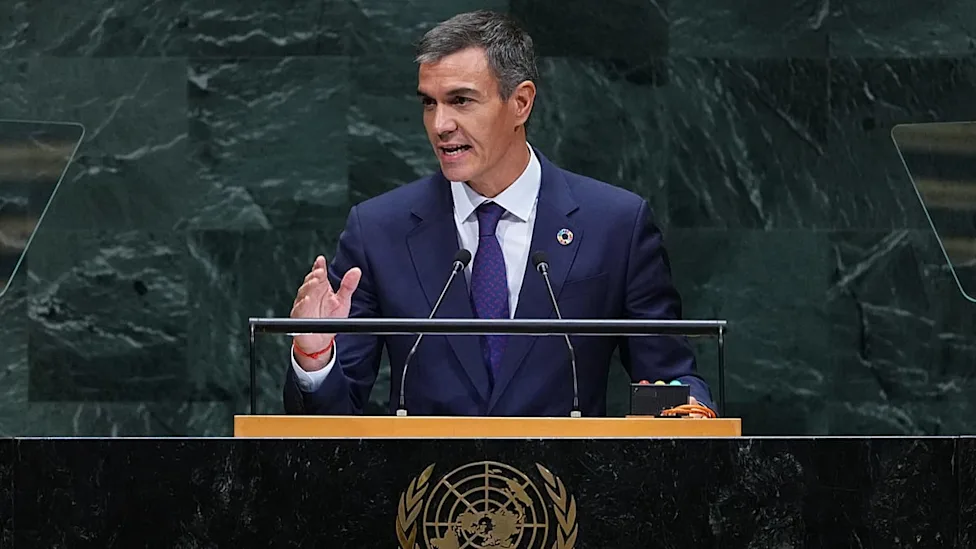
Spain’s prime minister links global governance with a domestic migration crisis.
New York, United States.
Spanish Prime Minister Pedro Sánchez used his address to the 81st United Nations General Assembly to defend multilateral cooperation while warning against what he described as increasingly influential “selfish, ignorant and cruel” reactionary forces. Speaking on September 23, Sánchez argued that international institutions are being weakened at a moment when wars, technological disruption and geopolitical competition require stronger collective mechanisms. His language was politically forceful, although he did not explicitly identify individual leaders when making those accusations.
Sánchez said the developments he has observed during his eight years in government had changed his understanding of international politics. He accused unspecified political forces of launching illegal wars, harming civilians, degrading the environment and working against the institutions represented by the United Nations. Euronews interpreted parts of the speech as implicitly directed toward leaders including Donald Trump, Benjamin Netanyahu and Vladimir Putin, but that attribution was the outlet’s interpretation rather than an explicit identification by Sánchez.
The Spanish leader proposed institutional reforms that included changing the composition of the UN Security Council to improve regional representation, strengthening international justice mechanisms and renewing nuclear non-proliferation efforts. He also called for stricter governance of artificial intelligence and social media. Sánchez presented these measures as necessary to preserve the effectiveness and legitimacy of multilateral institutions.
His speech also addressed defense policy. Sánchez reiterated Spain’s opposition to increasing military expenditure to 5% of gross domestic product, separating Madrid’s position from demands previously promoted by Washington within NATO. He framed Spain’s approach as part of a broader commitment to opposing wars of aggression, referring to conflicts involving Ukraine, Lebanon and Iran.
Another major element of the address concerned the succession of UN Secretary-General António Guterres. Sánchez argued that the organization should select a Latin American woman, noting that all nine UN secretaries-general since the institution’s creation have been men. Several Latin American figures are currently associated with the succession debate, although the selection process remains open.
The prime minister also brought Spain’s migration crisis in Ceuta to the General Assembly. Approximately 80,000 people crossed irregularly from Morocco during the crisis that began in late July, creating substantial pressure on the autonomous city. Sánchez acknowledged that Ceuta was experiencing difficult circumstances but praised what he called the population’s “decency” and rejection of treating migrants as enemies.
His account remains politically contested inside Spain. Ceuta President Juan Jesús Vivas has accused the central government of failing to respond adequately to warnings before the mass arrivals, while Sánchez has acknowledged failures in Moroccan border controls and requested explanations from Rabat.
The UN speech therefore connected two different political arenas: the future of international governance and Spain’s immediate challenge of managing migration, security and humanitarian obligations in Ceuta.
Análisis que trasciende al poder. / Analysis that transcends power.