

 Phoenix 24
Red-carpet fashion collides with archaeology and contested ownership.
London | July 2026
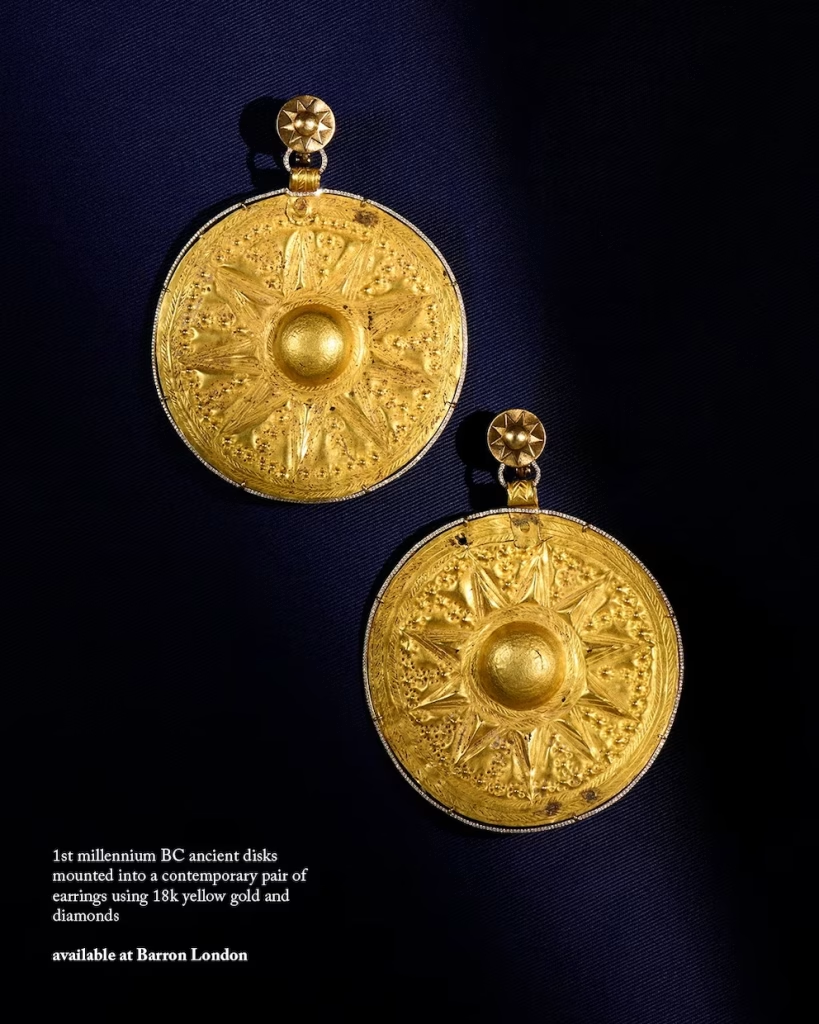
Zendaya’s appearance during the promotional campaign for Christopher Nolan’s The Odyssey has generated an international debate after the actress wore earrings incorporating two Iranian gold discs believed to be approximately 3,000 years old.
The circular ornaments accompanied a white Jacquemus dress and a classically inspired headpiece designed to evoke Athena, the Greek goddess portrayed by Zendaya in the film. What initially appeared to be another carefully constructed example of thematic red-carpet fashion soon became a wider discussion about archaeology, preservation and the ethical limits of transforming ancient objects into luxury accessories.

The gold discs have been associated with the Ziwiye treasure, an important collection of gold, silver and ivory objects discovered near Saqqez in northwestern Iran during the late 1940s. The pieces are generally connected with the artistic traditions of the ancient Near East and are believed to date from approximately the eighth or seventh century BCE.
Their decorative design resembles a rosette or solar motif frequently found across the region during that period. Some interpretations connect the symbol with Shamash, the Mesopotamian solar deity, while others suggest that the discs may originally have been attached to ceremonial clothing or another ornamental object.
Their precise original purpose cannot be established with certainty. The Ziwiye discovery occurred without controlled archaeological excavation, and many objects were reportedly removed, divided and sold before specialists could properly record their position and historical context.
That absence of documentation has followed the treasure for decades. Without reliable excavation records, researchers cannot reconstruct exactly where each object was found, what other pieces surrounded it or how the complete assemblage functioned.
Objects attributed to Ziwiye eventually entered private collections and major museums around the world. Their dispersal illustrates a recurring problem in archaeology: once an artefact is separated from its original context, part of its historical meaning becomes permanently difficult—or impossible—to recover.

The two discs worn by Zendaya were incorporated into a contemporary design by London jeweller Glenn Spiro. They were mounted in 18-karat yellow gold, surrounded by diamonds and included in a collection combining historic materials with modern high jewellery.
Barron London later acquired the earrings and provided them for Zendaya’s appearance. The company has stated that the ancient elements were secured through a simple claw-based structure intended to avoid drilling, cutting or otherwise altering the original discs.
That explanation addresses concerns about physical damage but does not resolve the broader ethical controversy.
Critics argue that authentic archaeological objects should remain in museums, research institutions or their countries of origin rather than circulate as privately owned fashion pieces. For them, using the discs as earrings transforms cultural heritage into personal ornamentation and removes the objects further from their historical meaning.
Others have questioned their provenance and asked whether sufficient documentation exists to establish how the pieces left Iran, entered the international market and eventually became part of a commercial jewellery collection.
The available information has not established that Zendaya, her stylist or the current jewellery company participated in illegal conduct. The controversy instead concerns the wider history of antiquities trading, the fragmented documentation surrounding the Ziwiye treasure and the responsibilities of present-day owners.

Supporters of the design offer a different interpretation. They argue that integrating ancient objects into contemporary jewellery can bring neglected history before a much larger public, provided the pieces are legally owned, carefully preserved and not physically damaged.
Barron London has defended the earrings as a means of encouraging conversations about Iranian artistic and cultural history. The company has said it welcomes discussion about provenance, preservation and the value society assigns to objects from the ancient world.
The debate therefore extends beyond Zendaya’s individual choice. It raises a fundamental question about whether cultural heritage can legitimately operate at the intersection of private property, luxury commerce, artistic reinterpretation and public education.
Museums themselves frequently display ancient jewellery, coins, ceremonial objects and fragments removed from their original settings. The distinction raised by critics is that institutional exhibition is expected to include conservation standards, scholarly interpretation and public access, while private fashion use may prioritize exclusivity and spectacle.
Yet museums are not free from controversy. Many institutions continue facing demands to return objects acquired during colonial expansion, military occupation or periods when archaeological materials were exported under unequal legal and political conditions.
The Ziwiye discs exist within this complicated environment. Their uncertain excavation history makes it difficult to reconstruct a complete chain of ownership, while their presence in a contemporary jewellery design intensifies attention on questions that have remained unresolved for decades.
Zendaya and her longtime stylist, Law Roach, had not publicly addressed the criticism when the controversy gained international attention. Their silence does not establish indifference, responsibility or agreement with either side of the debate.
The actress may also have worn the earrings without receiving a complete explanation of their archaeological background. Luxury accessories used for major promotional appearances are commonly selected through collaborations among stylists, fashion houses, jewellers and publicity teams.
Regardless of who made the final decision, Zendaya’s global visibility transformed two small gold objects into the center of an unusually large discussion about cultural memory.
The incident demonstrates how fashion can revive public interest in ancient history while simultaneously exposing the unequal and frequently obscure routes through which historical objects travel.
A red carpet can provide visibility, but visibility alone does not answer questions of ownership, preservation or belonging.
Zendaya’s earrings have survived for nearly three millennia. The controversy surrounding them reveals that the past is never simply worn—it is interpreted, commercialized and contested in the present.
Phoenix24 | Culture that questions ownership and preserves memory. Cultura que cuestiona la propiedad y preserva la memoria.