

 Phoenix 24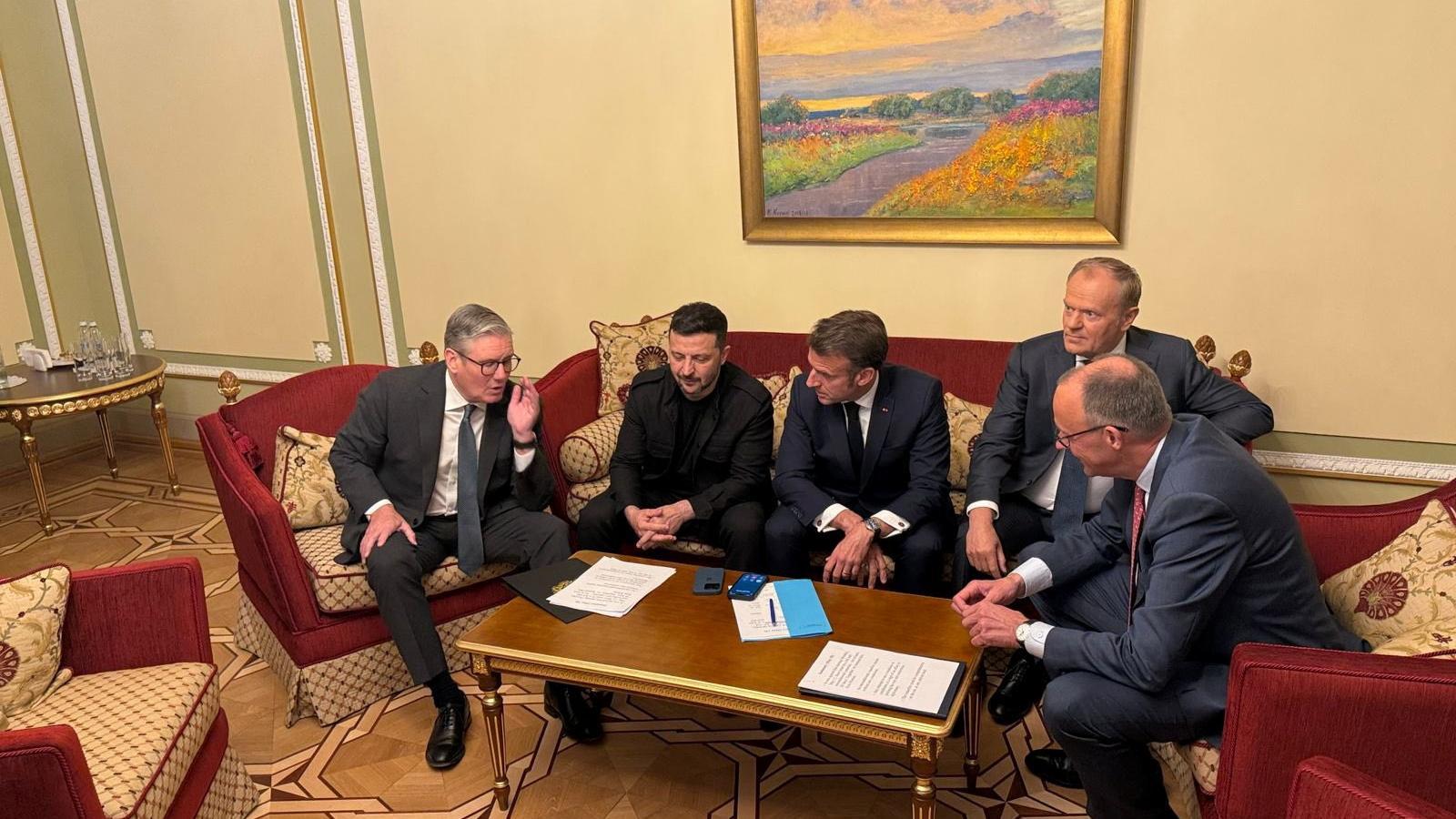
In the shadow of looming high-level talks between Washington and Moscow, Ukraine seeks to ensure that peace does not come at the cost of its sovereignty.
Kyiv–Brussels, August 10, 2025 – Ukrainian President Volodymyr Zelensky has called for a “fair end” to the war with Russia, framing peace as inseparable from justice. His statement followed an extraordinary show of unity from key European allies, who reiterated that no settlement should be imposed without Ukraine’s direct involvement. The coordinated message comes at a critical moment: just days before a planned summit between former U.S. President Donald Trump and Russian President Vladimir Putin in Alaska — a meeting to which Ukraine has not been invited.
The joint declaration, endorsed by leaders from France, Italy, Germany, Poland, the United Kingdom, Finland, and the European Commission, underscores a red line: any peace agreement must respect Ukraine’s sovereignty and territorial integrity. European officials openly warned that proposals suggesting the exchange of Ukrainian territory for peace risk legitimizing Russian aggression and undermining the entire post–Cold War security order in Europe.
Zelensky’s appeal aligns with the diplomatic principle “Nothing about Ukraine without Ukraine,” a maxim deeply rooted in the country’s modern foreign policy since the 2014 annexation of Crimea. By invoking it now, Kyiv seeks to preempt any negotiation in which its fate is decided by external powers without its consent. For European leaders, the principle is not symbolic rhetoric but a safeguard against the erosion of international law.
The Alaska summit, set for August 15, has sparked unease across NATO and the European Union. Diplomats fear it could produce a bilateral understanding between Washington and Moscow that sidelines both Kyiv and Brussels. Analysts at the European Council on Foreign Relations warn that excluding Ukraine could embolden Russia to push for a de facto recognition of its territorial gains in Donetsk, Luhansk, Kherson, and Zaporizhzhia — regions whose annexation has been widely condemned by the UN General Assembly.
Zelensky, speaking after a series of bilateral calls with European leaders, emphasized that peace is not merely the absence of war. “A ceasefire without justice,” he warned, “is only a pause before the next war.” This framing echoes historical lessons from the Balkans and the Caucasus, where premature settlements often led to renewed conflict within a decade. Security experts point to those precedents as a cautionary tale for Ukraine, especially if Russian troops remain in occupied areas without binding withdrawal guarantees.
The European endorsement goes beyond diplomatic solidarity. Behind closed doors, discussions have reportedly included the expansion of military assistance, long-term reconstruction funding, and security guarantees that could include air defense integration with NATO systems. German and Polish officials are said to be pushing for a formal commitment to keep military aid flowing into 2026, regardless of shifts in U.S. policy after the upcoming American elections.
Public sentiment in Europe remains broadly supportive of Ukraine, but recent polls indicate growing concern over the war’s economic toll. Inflationary pressures, energy price volatility, and the strain on EU budgets have created fertile ground for political actors advocating for a “pragmatic” settlement with Russia. This makes Zelensky’s push for a “fair peace” not only a geopolitical stance but also a counter-narrative aimed at European publics who may be growing weary of the conflict.
Three potential scenarios are now under discussion among strategic analysts:
First, the Alaska meeting results in a framework that bypasses Ukraine, potentially forcing Kyiv into a defensive diplomatic position.
Second, European pressure succeeds in securing Ukraine a seat at future negotiations, enabling a settlement that includes territorial restitution, security guarantees, and international oversight.
Third, the talks collapse without agreement, prolonging the war but preserving Ukraine’s position in the diplomatic arena.
For Kyiv, the stakes are existential. Accepting a settlement on unfavorable terms could fracture domestic political unity and erode public trust in the government’s ability to defend the nation’s core interests. For Europe, the outcome will serve as a litmus test for its ability to defend the principles of sovereignty and territorial integrity in an era of resurgent great-power politics.
The coming weeks will reveal whether the “Nothing about Ukraine without Ukraine” doctrine holds firm, or whether realpolitik will override principles in the name of ending a war that has reshaped Europe’s security architecture. As Zelensky has made clear, Ukraine will not accept peace at any price — and the decisions taken in the next month may define the country’s geopolitical trajectory for decades to come.
Produced by Phoenix24 with verified international information and independent analysis, this report reflects our commitment to quality journalism and geopolitical responsibility.
Elaborado por Phoenix24 con información internacional verificada y análisis independiente; este reportaje refleja nuestro compromiso con el periodismo de calidad y la responsabilidad geopolítica.