

 Mario López Ayala, PhD
A football star, a television personality, and a wave of speculation blur the line between private life and public spectacle.
Rio de Janeiro, October 2025
In a country where footballers are icons and celebrity gossip is a national pastime, few stories capture public attention as intensely as the latest speculation surrounding Real Madrid star Vinícius Júnior and Brazilian television presenter Virginia Fonseca. Over the past several weeks, rumors of a romantic connection between the 25-year-old forward and the media personality have spread rapidly across Brazilian media, igniting online debates, tabloid headlines, and intense scrutiny from fans on both sides of the Atlantic.
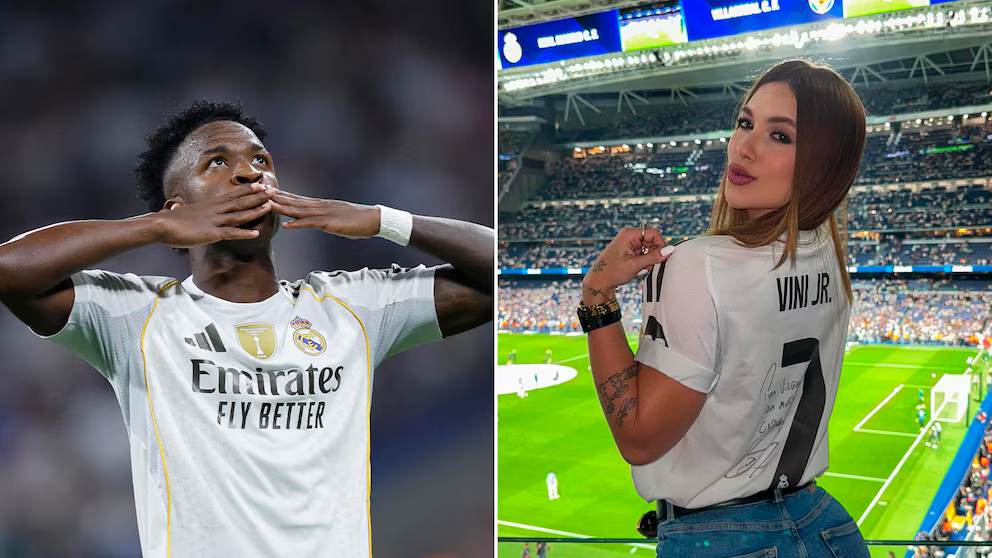
The story first gained momentum when Fonseca was seen attending a Real Madrid home match at the Santiago Bernabéu, where Vinícius scored twice. Observers noted that she celebrated both goals enthusiastically while wearing a Madrid shirt emblazoned with his number, and social media users immediately began speculating that the gesture was more than simple support. Adding fuel to the speculation were several posts on Fonseca’s social media accounts containing phrases like “Big Seven” and references to Madrid nights, which followers interpreted as coded messages aimed at the Brazilian star.
It did not take long for Brazilian tabloids and Spanish sports media to pick up on the story. Reports surfaced claiming that Fonseca had stayed in one of Vinícius’s properties during previous visits to Madrid, and paparazzi images showed her leaving a private entrance associated with the footballer’s residence. Another piece of evidence cited by gossip outlets was Vinícius’s goal celebration that included a kiss directed toward the stands, which many interpreted as a public display of affection aimed at her.

Fonseca, a well-known presenter and influencer with millions of followers, was previously married to singer Zé Felipe, with whom she shares two children. Her divorce, finalized earlier this year, became a trending topic in Brazil and further intensified media interest in her personal life. Vinícius, for his part, has kept his romantic relationships largely private since rising to global fame with Real Madrid. His off-pitch discretion contrasts sharply with the current wave of speculation, which appears to have breached the carefully maintained boundary between his professional and personal spheres.

Neither party has publicly confirmed nor denied the rumors. Fonseca’s press team issued a brief statement saying that she “does not comment on matters related to her personal life” and that her recent visits to Europe were “strictly private and related to professional opportunities.” Vinícius’s representatives declined to comment altogether, adding another layer of intrigue to a story that thrives on ambiguity.
Despite the absence of official confirmation, Brazilian entertainment programs have dedicated significant airtime to dissecting every detail of the alleged relationship. Television talk shows have debated the significance of social media interactions, celebrity columnists have published timelines of the pair’s known whereabouts, and fans have flooded online forums with speculation. On X, formerly Twitter, the hashtag #ViniciusVirginia trended for three consecutive days, and fan-created content imagining the pair as a couple has racked up millions of views.

The cultural resonance of the story speaks to a broader phenomenon in Brazilian public life. Footballers, singers, and television personalities are not just entertainers but symbols around which collective narratives are built. Relationships between figures from these worlds attract enormous public interest because they embody a fusion of two of Brazil’s most powerful cultural forces: sport and entertainment. The result is a cycle of speculation and attention that often makes it difficult for celebrities to maintain personal boundaries.
Sociologists who study media and celebrity culture in Latin America note that such high-profile relationships function as a kind of public theatre, reflecting broader societal fascinations with status, glamour, and identity. In this sense, the story of Vinícius and Fonseca — real or imagined — transcends gossip and becomes part of a national conversation about aspiration, fame, and the negotiation of private life under public scrutiny.
For Vinícius, the timing of the speculation adds an additional dimension. On the pitch, he is experiencing one of the best seasons of his career, leading Real Madrid’s attack with decisive goals in La Liga and the Champions League. His performances have solidified his place among the elite forwards in world football and positioned him as a potential Ballon d’Or candidate. Off the pitch, however, this sudden media spotlight could prove a distraction as the season enters its decisive phase.
Fonseca, meanwhile, continues to expand her media profile, hosting a prime-time television program and launching new business ventures. While the speculation about her personal life has boosted her visibility, it has also raised questions about privacy and the ethics of celebrity journalism in Brazil. Critics argue that the relentless attention risks overshadowing her professional achievements, reducing a multifaceted public figure to the subject of gossip columns and paparazzi photos.
The coming weeks are likely to reveal whether the speculation has any basis in reality or whether it will fade as quickly as it began. Until then, every public appearance, every social media post, and every offhand remark from either Vinícius or Fonseca will be scrutinized for hidden meaning. For now, the absence of denial is enough to keep the story alive and the public fascinated.
Regardless of the outcome, the saga illustrates how the boundaries between sport, media, and personal life continue to blur in the digital age. In Brazil’s celebrity ecosystem, where narratives move at the speed of a trending hashtag, private relationships can quickly become public spectacles. And as the Vinícius-Fonseca saga shows, sometimes the mere suggestion of a romance is enough to capture a nation’s imagination.
The visible and the hidden, in context. / Lo visible y lo oculto, en contexto.