

 Phoenix 24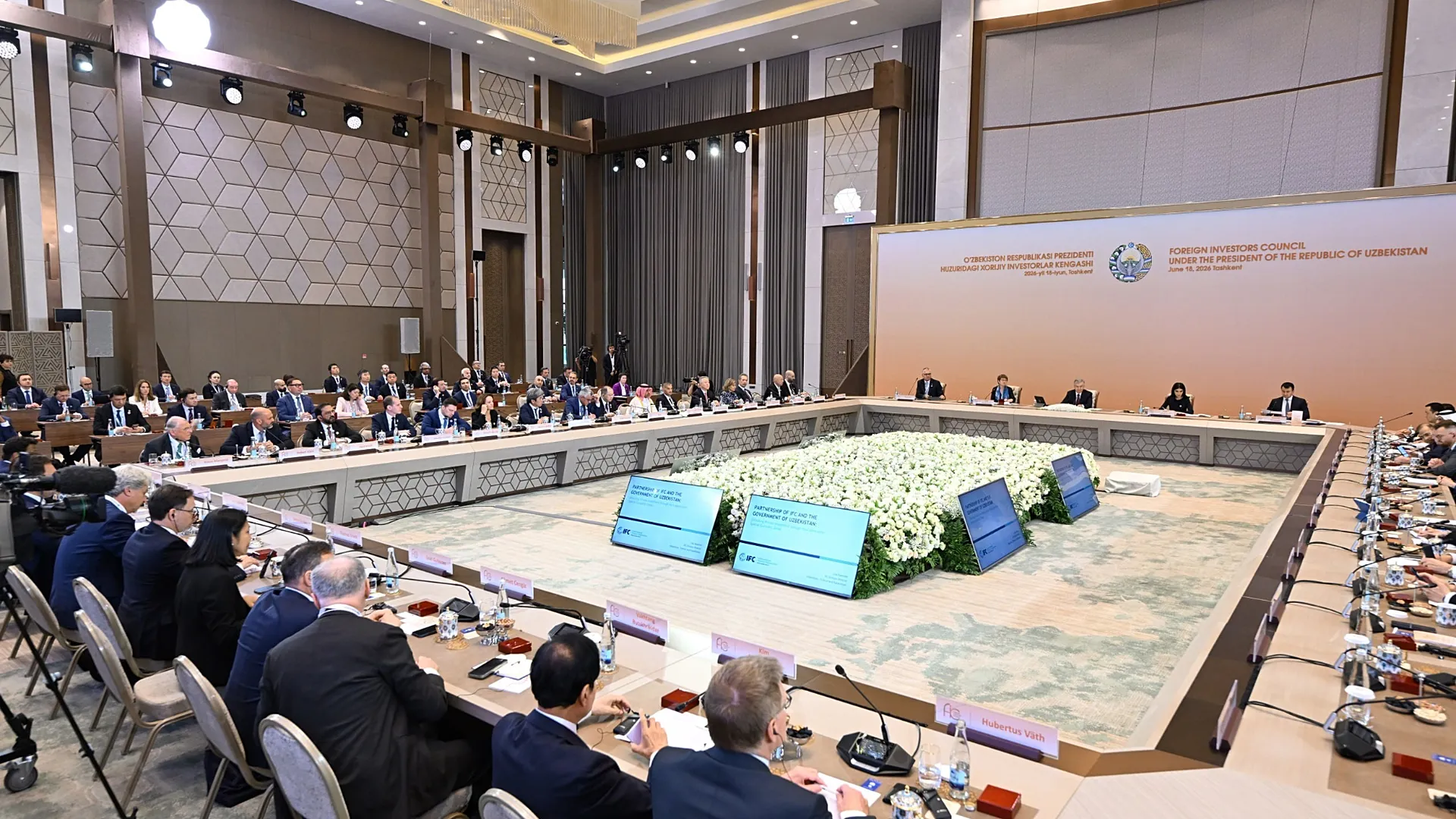
Foreign capital is now helping shape national policy.
TASHKENT, Uzbekistan | June 2026
Uzbekistan will transform 120 recommendations submitted by foreign investors into an official roadmap for economic reform after the conclusion of the Tashkent International Investment Forum. The proposals cover banking, energy, artificial intelligence, capital markets and corporate governance, placing private-sector concerns directly inside the government’s policy process. Officials said implementation will be monitored and progress reported directly to President Shavkat Mirziyoyev. The initiative reflects Uzbekistan’s effort to convert international interest into structural changes capable of attracting long-term capital.
The recommendations were presented during a meeting of the Foreign Investors Council, which brought together multinational companies, development banks and financial institutions attending the three-day forum. Mirziyoyev said previous proposals from investors had already influenced tax legislation, financial regulation and reporting requirements for international companies. The government now wants to formalize that dialogue by linking investor feedback to measurable reforms. This approach gives foreign businesses a larger role in defining the conditions under which they are prepared to operate.
The Foreign Investors Council has expanded rapidly during the past year. Its membership increased from 54 to 85 companies representing 23 sectors of the Uzbek economy. Its executive committee includes representatives from the European Bank for Reconstruction and Development, the Asian Development Bank and the International Finance Corporation. Their participation gives the council both financial influence and experience in designing reforms across emerging markets.
Among the most ambitious proposals is the creation of the Tashkent International Financial Center. The government is preparing a constitutional law that would establish its legal framework and define the rules governing financial activity inside the new institution. Uzbekistan hopes the center will attract international banks, investment funds and professional services while strengthening the domestic capital market. Its credibility, however, will depend on whether investors receive predictable regulation and enforceable legal protection.
Uzbekistan has also begun the process of joining the OECD Declaration on International Investment and Multinational Enterprises. Alignment with the declaration would move the country closer to widely recognized standards on responsible business conduct, transparency and investor treatment. The government sees international certification as a way to reduce perceptions of political and regulatory risk. Membership alone will not guarantee investment, but it could improve confidence if accompanied by consistent implementation.
Development banks used the forum to expand their cooperation with Uzbekistan. Mirziyoyev and European Bank for Reconstruction and Development President Odile Renaud-Basso reviewed a portfolio worth more than seven billion dollars. The scale of that cooperation makes Uzbekistan the institution’s largest partner in Central Asia. New agreements cover sustainable transport, railway digitalization, entrepreneurship, housing finance and support for the country’s start-up ecosystem.
The Uzbek president also met Dilma Rousseff, president of the New Development Bank, to discuss projects involving energy, water management, transport infrastructure and private-sector development. The bank expressed interest in financing environmentally focused initiatives and regional transport corridors. These areas are strategically important for a landlocked country seeking stronger connections with Asian and European markets. Better infrastructure could reduce trade costs while strengthening Uzbekistan’s role as a regional transit hub.
Legal certainty remained one of the most persistent concerns raised during the discussions. International investors acknowledged the progress of recent reforms but warned that frequent legislative changes continue to undermine predictability. European Union Special Representative for Central Asia Eduards Stiprais said many complaints from companies involve unstable regulations and uncertainty about how rules will be applied. He also emphasized that independent courts and effective legal protections remain essential to investor confidence.
The proposed financial center could help address some of those concerns if it introduces specialized courts, transparent commercial rules and reliable dispute-resolution mechanisms. Investors need confidence that contracts will remain enforceable when political priorities or regulations change. They also require the ability to recover capital and transfer profits without arbitrary restrictions. Without those safeguards, ambitious projects and public commitments may fail to produce sustained financial participation.
Capital-market development and privatization were also central to the forum. London Stock Exchange Chief Executive Julia Hoggett said international investors evaluate emerging economies through economic stability, regulatory consistency and legal guarantees. Their central concern is whether money invested in a market can later be recovered under clear conditions. Uzbekistan’s reform program has improved perceptions, but trust will depend on whether institutions perform reliably over time.
A stronger capital market could reduce Uzbekistan’s dependence on state financing and conventional bank loans. Public listings, corporate bonds and transparent privatizations would provide companies with new sources of capital while creating opportunities for international investors. These mechanisms also require improved financial reporting, minority shareholder protection and corporate governance. The 120 recommendations are therefore expected to influence not only government policy but also how Uzbek companies are managed.
Artificial intelligence emerged as another priority for future growth. Investors argued that Uzbekistan must move beyond adopting digital tools and build the infrastructure required to support an AI-driven economy. This includes data centers, reliable energy, advanced telecommunications and a workforce trained in engineering and data science. The country must also develop rules governing data use, cybersecurity and intellectual property.
Benedict Macon-Cooney stressed that companies should treat data as a competitive asset and governments should regard it as a strategic national resource. That perspective places data infrastructure alongside roads, electricity and financial systems as a foundation of economic development. Uzbekistan’s young population and expanding digital sector could provide an advantage if education and investment policies evolve quickly enough. Failure to build supporting systems, however, could leave the country dependent on foreign platforms and imported technology.
The forum demonstrated that international investors are no longer acting only as sources of financing. They are increasingly influencing the institutional reforms they consider necessary before committing capital. Uzbekistan appears willing to use that expertise, but the arrangement creates a demanding test of state capacity. Recommendations must now be converted into laws, administrative procedures and enforceable protections rather than remaining conference declarations.
The 120-proposal roadmap represents an attempt to organize Uzbekistan’s economic opening around practical investor demands. Its success will depend on legal stability, institutional accountability and the government’s willingness to accept external scrutiny. Tashkent has already attracted significant interest by presenting itself as one of Central Asia’s most active reformers. The next phase will reveal whether that interest can be transformed into durable investment, competitive markets and broader economic growth.
Más allá de la noticia, el patrón. / Beyond the news, the pattern.