

 Phoenix 24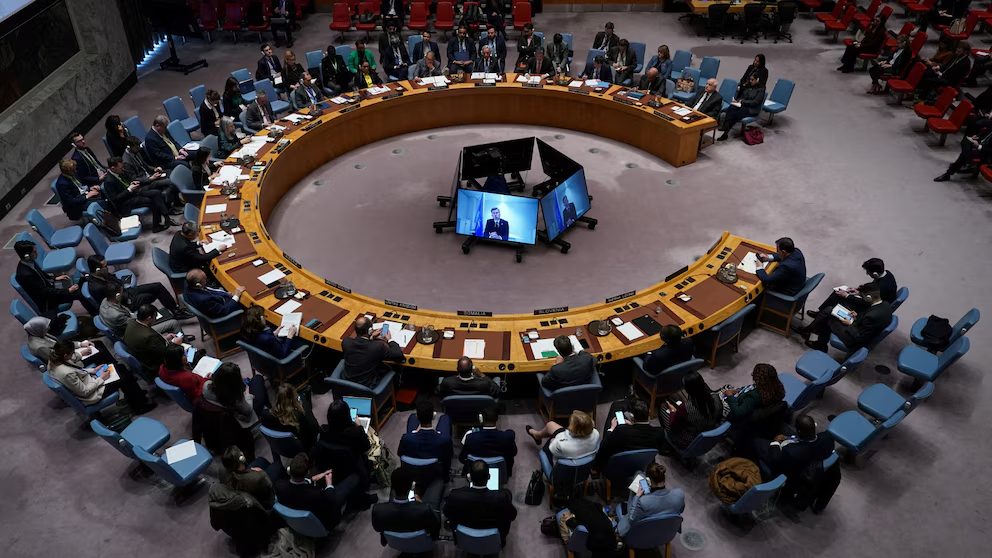
The first international pact against online crime reshapes the balance between freedom, surveillance, and sovereignty in the information age.
Hanoi, October 2025.
For the first time in its history, the United Nations has approved a treaty dedicated exclusively to combating cybercrime. Representatives from nearly seventy nations gathered in Vietnam’s capital to sign the UN Convention on Cybercrime, a legally binding accord that seeks to establish a unified framework for investigating, prosecuting, and preventing digital offenses. The agreement—negotiated for years within the UN Office on Drugs and Crime—aims to replace the patchwork of regional accords that have long governed the pursuit of hackers, online fraud, espionage, and attacks on critical infrastructure.
The UN Secretary-General described the treaty as “a collective legal shield against borderless threats.” Unlike previous regional pacts, this convention obliges signatory states to enact national legislation defining cyber offenses, from unauthorized access and data manipulation to the malicious use of artificial intelligence.
The signing in Hanoi symbolizes a broader acknowledgment that digital security has become a matter of statecraft. Analysts at the Lowy Institute in Sydney called the treaty “a milestone for cooperation between developed and emerging economies.” In Brussels, the European Council hailed it as a long-awaited step toward legal harmonization and cross-border judicial collaboration. In Washington, U.S. officials stressed that success will depend on balancing security with privacy and free-speech protections—an especially sensitive debate in the United States.

The document also mandates the creation of national rapid-response units to share digital evidence and coordinate cross-border tracking operations. Interpol and Europol have announced a permanent coordination center in Singapore to issue alerts on ransomware, data theft, and sabotage of financial systems. In Latin America, justice ministers from Chile, Mexico, and Brazil said the convention could finally strengthen cooperation against online fraud, extortion, and identity theft that overwhelm their domestic law-enforcement capacity.
Still, not everyone celebrates the breakthrough. Human-rights organizations warn that the treaty’s broad scope could enable governments to expand surveillance powers if oversight remains weak. In Geneva, the UN Human Rights Office reiterated that the fight against cybercrime must not become a pretext for censorship or indiscriminate monitoring. In Tokyo, analysts from the Asian Institute of Digital Policy cautioned that authoritarian states could use the cooperation framework to justify repression of dissent or illicit data collection without judicial review.
The question of digital sovereignty lies at the core. For European democracies, the convention is an opportunity to project ethical standards across cyberspace. For Asian powers such as China and Russia, it embodies their model of “sovereign cybersecurity,” where state control over information is paramount. In Africa, experts at Nairobi’s Center for Technological Innovation welcomed the treaty’s commitment to provide developing countries with technical assistance to build cyber-defense capacity.
Beyond geopolitics, the convention presents formidable technical and financial challenges. Each state must adapt its domestic laws, train prosecutors and judges in digital forensics, and build infrastructure capable of preserving electronic evidence with full chain-of-custody integrity. Economists at the World Bank estimate that adopting countries could reduce cybercrime losses by up to twenty percent by 2030, though the initial implementation cost will be steep and unevenly distributed.
The treaty does not solve all the dilemmas of cyberspace, yet it establishes a new principle of shared responsibility. Every government that ratifies it will be accountable for protecting its networks and cooperating in global investigations. Ultimately, the issue is not technical but political: who governs the digital realm? The signing in Hanoi does not close that debate—it merely begins it.
The UN has drawn the line. From now on, cybersecurity will no longer be a technical concern but a domain of sovereignty, diplomacy, and justice. In this new landscape of power, those who master digital defense will also define the limits of freedom.
Information that anticipates futures. / Información que anticipa futuros.