

 Phoenix 24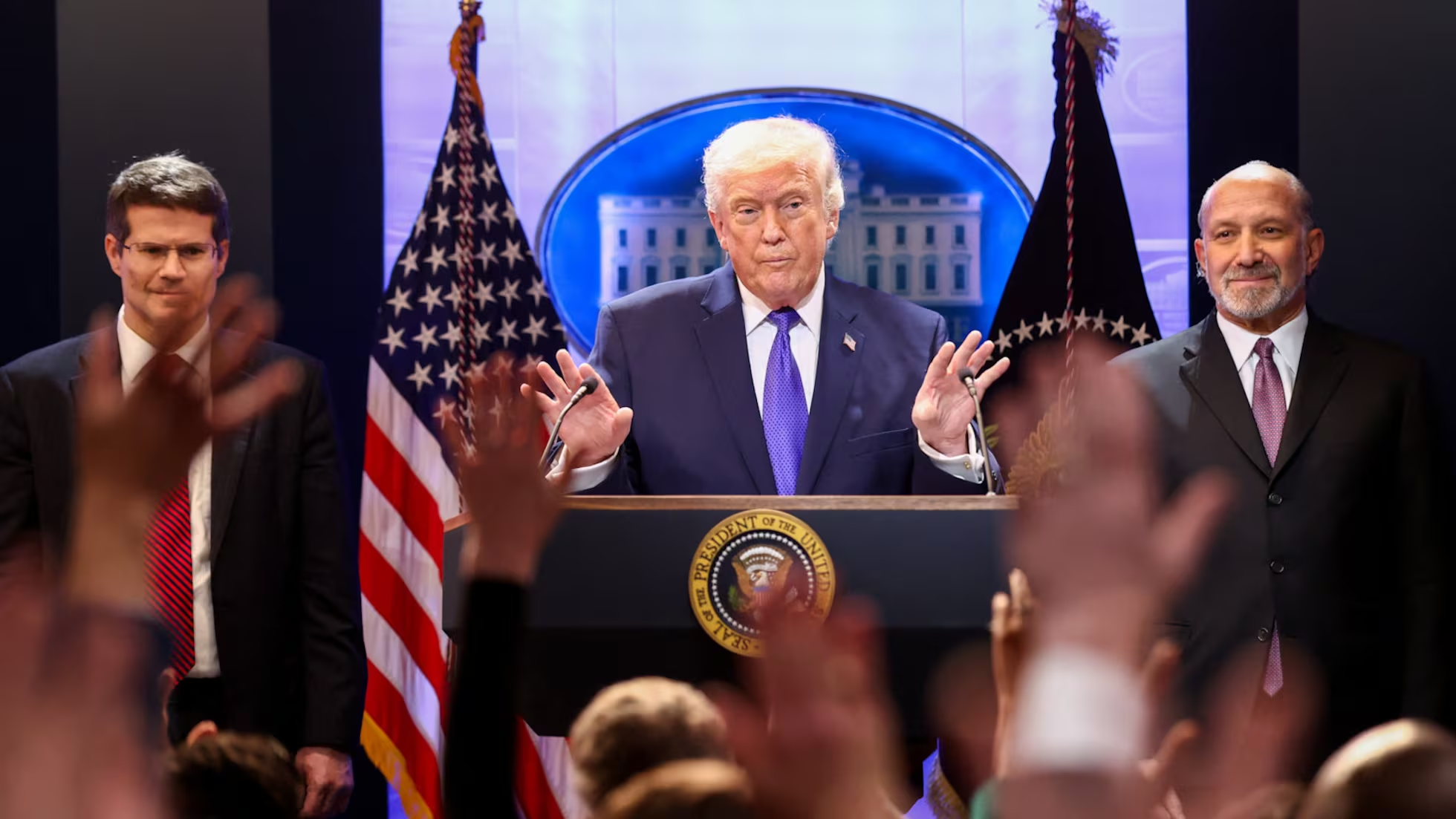
Executive trade power meets its legal ceiling.
Washington, February 2026.
The United States Supreme Court has struck down President Donald Trump’s sweeping global tariffs, delivering a ruling that reads like a power map, not a trade memo. The justices held, by a 6–3 vote, that the administration exceeded the authority it claimed under emergency economic powers to impose broad import duties. In practical terms, the Court treated the tariff program as a form of taxation that cannot be manufactured through expansive executive interpretation. The decision immediately reorders expectations for markets, allies, and domestic industry because it narrows the fastest lane for trade escalation. It also broadcasts a deeper message: emergency language cannot quietly become a permanent fiscal instrument.
The legal dispute turned on the International Emergency Economic Powers Act, a statute historically associated with targeted measures such as sanctions and asset restrictions, rather than generalized import taxes. The majority drew a line between regulating commerce and imposing a nationwide tariff schedule that functions as a revenue tool. Chief Justice John Roberts framed the conflict around constitutional design, emphasizing that Congress holds the power to tax and that delegations of authority must be read with discipline. That reasoning matters because it limits not only one policy, but an entire governing style built on stretching old statutes for new purposes. The dissent warned that the decision risks destabilizing trade policy in moments when speed is politically valuable, while also flagging the administrative chaos that could follow.
Trump responded with public anger and a promise to re route the strategy through other legal channels. That is the immediate political reality: the Court did not outlaw tariffs as a concept, it blocked a particular route to impose them at scale. Alternative tools exist, but they tend to be slower, more procedural, and easier to challenge on narrower grounds, which raises the cost of using trade as an instant lever. The practical consequence is a shift from a single blunt instrument to a patchwork of more technical measures, each with its own timeline and litigation risk. For businesses, the uncertainty does not vanish, it changes shape. For diplomats, the question becomes whether the next move is predictable enough to negotiate around.
The most combustible issue is what happens to money already collected. Reporting has placed tariff revenue since April 2, 2025 at roughly 240 billion dollars, a figure that turns a legal ruling into a fiscal problem with real balance sheet implications. Capital Economics has estimated that potential refunds could reach about 120 billion dollars, roughly half a percent of United States output, if courts compel reimbursement. Separately, Penn Wharton has suggested that more than 175 billion dollars in revenue could be exposed to refund claims depending on how cases unfold. The scale is not just accounting drama; it determines whether companies see relief, whether consumers see price changes, and whether the Treasury faces a politically awkward payback cycle.
This refund dimension is also why the ruling carries operational risk beyond the headline. Even if liability is recognized, processing returns is slow, and the litigation path is unlikely to be clean. Importers will argue that duties were unlawfully imposed and therefore must be repaid, while the government will look for procedural defenses, timing constraints, or legislative fixes. The dissent’s warning about a coming “mess” was not rhetorical flourish; it captured the reality that unwinding a tariff regime is harder than announcing one. The deeper lesson is that fast executive action often externalizes complexity into the future, where courts, agencies, and businesses must absorb it. In that sense, the decision shifts costs from the front end to the back end of policy.
Markets reacted with measured relief, which is telling. Initial gains in major United States indices signaled that investors prefer legal constraint to tariff improvisation, but the rally did not imply confidence that trade tension is finished. Traders appear to be pricing a lower probability of an immediate universal tariff shock, while keeping a premium for policy volatility through other routes. The effect spreads beyond the United States because tariffs operate as a global tax on supply chains, not a local talking point. When the world’s largest consumer market changes its import pricing logic, capital allocation shifts across manufacturing, logistics, and commodity flows. The Court’s decision therefore functions as an institutional stabilizer, even as politics remains unstable.
Europe’s response was cautious, not celebratory, and that caution reveals the strategic layer. The European Commission said it was analyzing the ruling and seeking clarity on what Washington intends to do next, because stability matters more than symbolism for firms managing contracts and inventories. The decision also casts a shadow over the EU–United States trade understanding reached last summer, which included a baseline 15 percent tariff framework on many EU exports alongside broader commitments on energy purchases and investment. If tariffs already paid are now deemed unlawful, the assumptions behind such arrangements become vulnerable to legal and political renegotiation. The risk is not only new tariffs, but the credibility of any tariff baseline that can be overturned after the fact. That is a governance problem, not a bilateral dispute.
Global business institutions framed the moment as a warning against improvisational trade authority. The International Chamber of Commerce emphasized legal certainty as a prerequisite for cross border commerce, underscoring that firms can adapt to protectionism more easily than to unpredictability. The United States Chamber of Commerce welcomed the ruling and highlighted the burden on small and midsize importers, pointing to supply chain disruption and price pressures as practical consequences of the tariff regime. These statements matter because they signal a coalition that is not purely partisan: corporate planners, trade dependent sectors, and legal institutionalists all converge around the demand for rule based policy. In a high friction global economy, predictability becomes a competitive advantage. Courts, in this view, are not simply referees, they are part of the infrastructure of trust.
The larger pattern is a struggle over speed. Modern politics rewards leaders who can act instantly, while modern economies punish systems that change rules overnight. Emergency powers offer velocity, but they also bypass the slower legitimacy machine that turns policy into durable expectation. By narrowing emergency tariff authority, the Supreme Court forces trade strategy back into arenas where evidence, procedure, and congressional accountability matter, whether Congress chooses to exercise that role or not. Allies gain a temporary reduction in tail risk, but not a guarantee, because the tariff impulse can survive through other tools. The ruling is therefore less a conclusion than a redistribution of leverage across institutions.
Hechos que no se doblan. / Facts that do not bend.