

 Ren Takahashi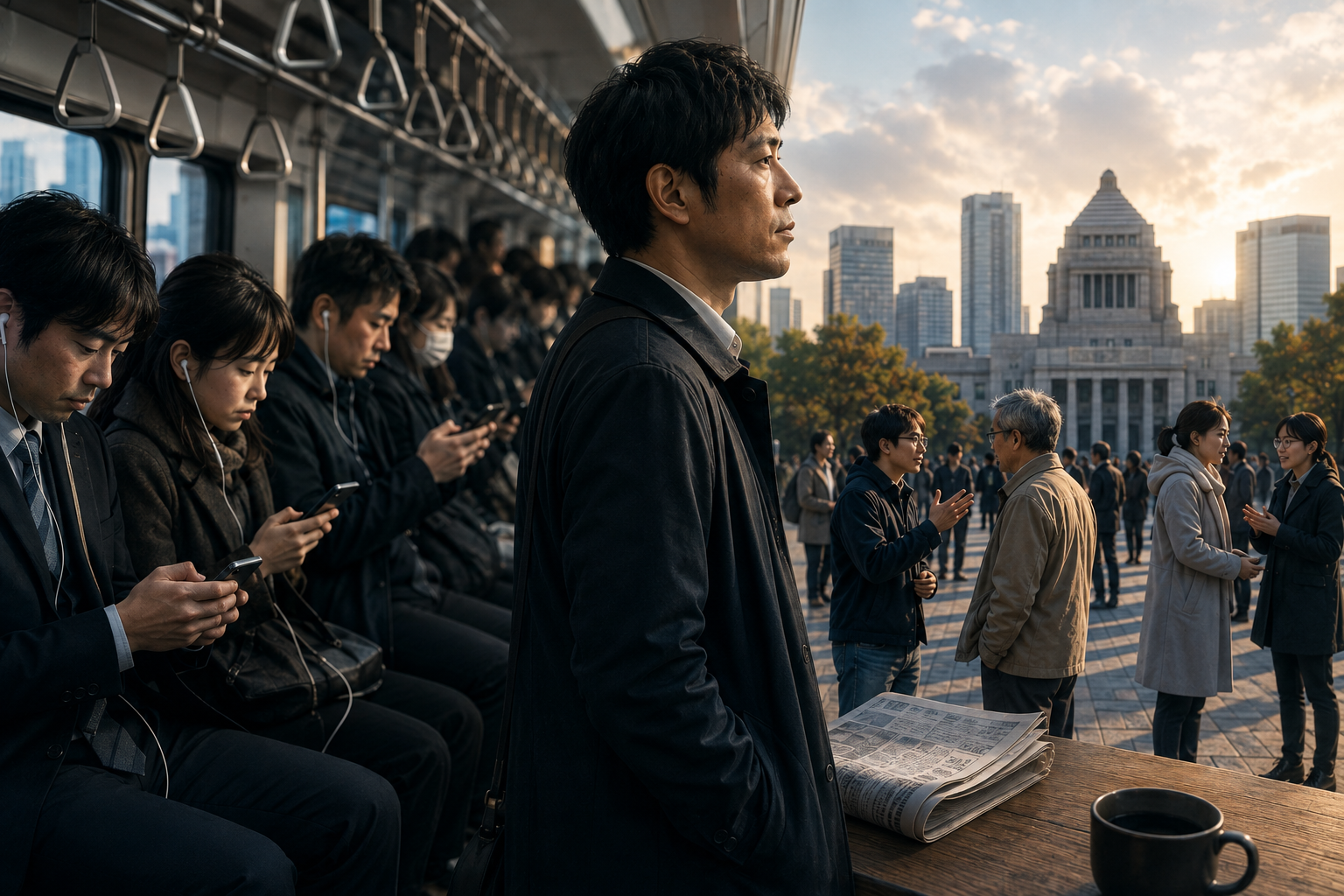
How Freedom Changes Long Before It Disappears
The man standing beside me on the Yamanote Line never looked at another passenger. During the twenty-minute journey, his attention moved only twice—once toward the train doors, and once toward the screen of his phone. Nothing about the scene was unusual. Around us, hundreds of commuters shared the same quiet choreography. Heads lowered. Earphones on. Faces illuminated by personalized streams of information that no one else would ever see. Tokyo has become remarkably efficient at moving millions of people through a single morning. It has also become remarkably efficient at allowing those millions to experience entirely different versions of the same day.
Democracy is often described through institutions. Constitutions, elections and independent courts remain essential because they establish the rules under which political life operates. Yet democratic culture has always depended on something less visible. It depends on the countless moments in which strangers unexpectedly encounter ideas they did not choose, opinions they did not anticipate and realities that challenge their own assumptions. A newspaper left on a café table. A debate overheard on public television. A conversation with someone whose experiences refuse to fit neatly within familiar categories. These interruptions once formed part of ordinary civic life. Increasingly, they compete with systems designed to minimize surprise.
Personalization has become one of the defining achievements of the digital economy. It helps us discover music we enjoy, restaurants we are likely to visit and books we might never have found alone. The same logic now influences the information environments surrounding democratic societies. Recommendation engines rarely tell citizens what to believe. They do something quieter. They learn what holds attention and gently offer more of it. The process feels almost invisible because it unfolds one suggestion at a time. No single recommendation changes a worldview. Thousands of them might gradually shape the boundaries of curiosity itself.
Perhaps this explains why contemporary democracies feel increasingly polarized despite unprecedented access to information. The challenge is not necessarily the absence of facts. It is the absence of shared encounters with those facts. Two people may follow the same election, witness the same international crisis and still inhabit remarkably different public realities because the systems mediating their attention have become profoundly individualized. Democratic disagreement has always been healthy. Democratic isolation is something else. A society cannot deliberate if its citizens no longer begin from even a partially shared understanding of the questions before them.
Japan offers an unusual perspective on this transformation because change often arrives here without announcing itself. Technologies become ordinary before they become controversial. Social habits evolve through quiet adaptation rather than dramatic rupture. The result is a society where continuity and transformation frequently coexist. Cameras appear without attracting attention. Digital services expand without provoking anxiety. Convenience rarely feels ideological. Yet that very normality deserves reflection. Democracies are not weakened only by the institutions they lose. They are also reshaped by the routines they no longer notice.
Perhaps this is why conversations about artificial intelligence often miss the deeper question. We ask whether machines will replace workers, writers or teachers. We ask how quickly algorithms will improve. Less frequently do we ask what happens when they become the principal editors of everyday experience. Not because they censor information, but because they organize its sequence, its frequency and, eventually, its familiarity. Attention has always been a political resource. It is now becoming an infrastructural one.
I sometimes think back to that morning on the Yamanote Line. Nothing appeared extraordinary. The train arrived on time. The passengers remained courteous. The city functioned exactly as expected. Democracy rarely changes through spectacular moments. More often, it adjusts itself within ordinary mornings that seem too familiar to remember. The question is not whether technology will redefine public life. In many ways, it already has. The more enduring question is whether citizens can still recognize those changes while they are happening—or only after they have become part of the landscape.
Ren Takahashi (高橋 蓮) is a Japanese journalist and global opinion editor at Phoenix24. He specializes in Asian geopolitics, digital democracy, and cross-cultural analysis. Educated at Keio University, LSE, and UBC.