

 Aleksi Laaksonen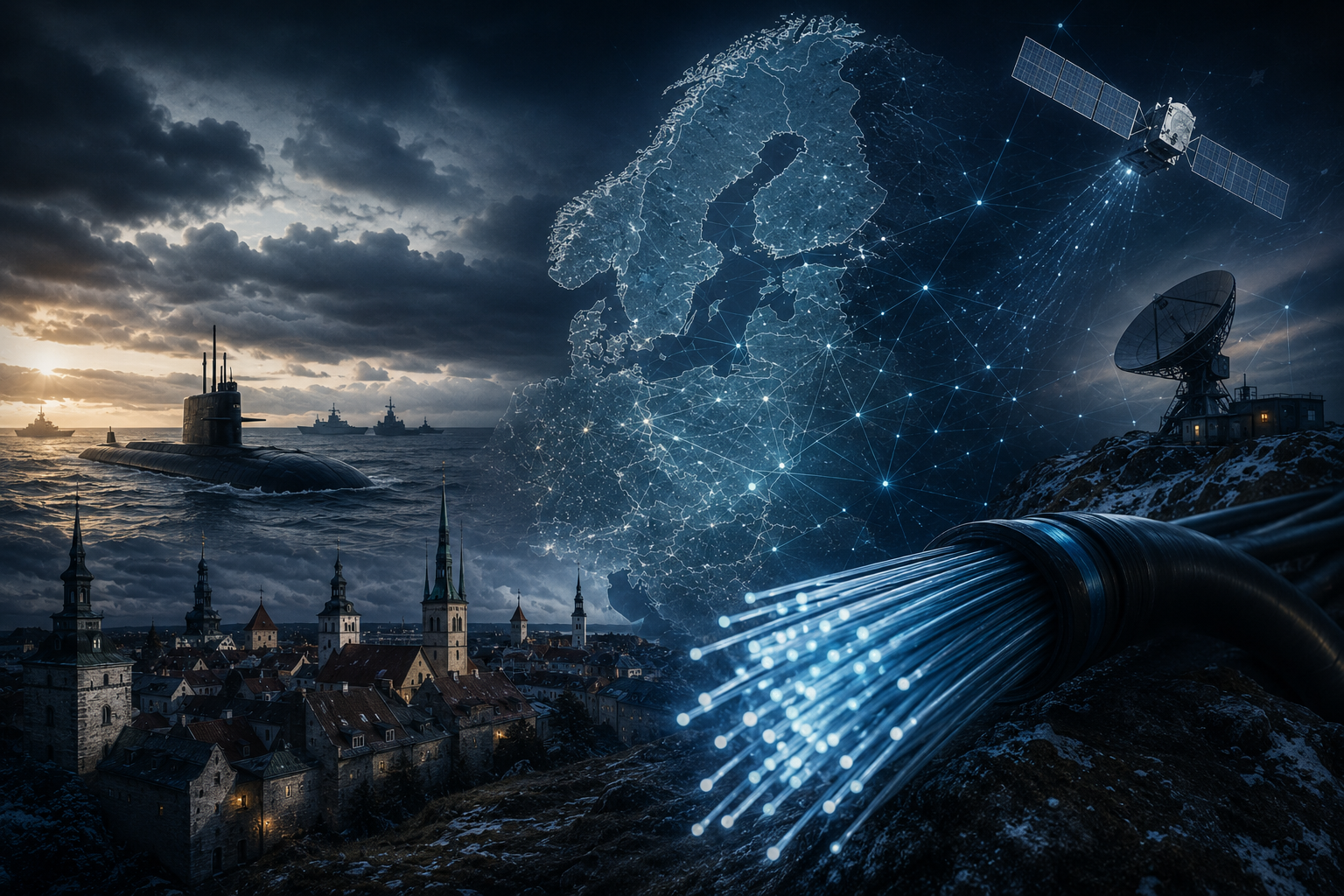
Europe’s next frontline may not announce itself.
Helsinki, May 2026. The Baltic region has become a difficult object to describe because it is no longer only a region. It is a corridor, a sensor field, a political membrane and, increasingly, a test site for the nervous system of European security. What once appeared on strategic maps as a northern maritime space between Scandinavia and Eastern Europe now functions as something less visible and more decisive: a digital frontier where NATO, Russia and the European Union measure each other without always naming the confrontation.
This is not the old geography of power. The ports still matter, the airspace still matters, the troop deployments still matter, but they no longer explain the whole picture. A fiber-optic cable under the Baltic Sea may carry more strategic consequence than a military parade. A satellite link, a data center, a compromised municipal system or a manipulated public narrative can reveal the condition of European defense more precisely than a formal communiqué.
The war in Ukraine accelerated this perception, but it did not create it. Estonia understood the lesson early, after the 2007 cyberattacks that turned a highly digitized society into a warning for the rest of Europe. Tallinn’s later role in NATO’s cyber doctrine did not emerge from abstraction; it emerged from institutional memory. The Baltic states learned that digital vulnerability is never merely technical. It is political, psychological and administrative at the same time.
That is why the Baltic code matters. It is not a single doctrine, nor a secret architecture hidden inside NATO planning rooms. It is the pattern by which hybrid pressure moves across open societies: first through uncertainty, then through friction, then through fatigue. The objective is rarely immediate collapse. More often, it is corrosion.
Europe still struggles to speak clearly about this condition. Brussels invokes digital sovereignty with growing confidence, but sovereignty without infrastructure remains a disciplined form of dependence. Cloud systems, semiconductor chains, platform governance and critical software ecosystems continue to expose a contradiction at the center of the European project. The continent wants autonomy, but much of its digital operating environment remains structured elsewhere.
Northern Europe sharpens that contradiction because it concentrates several pressures at once. Finland’s accession to NATO changed the geometry of the alliance’s northern flank, while Sweden’s integration tightened the strategic continuity of the Nordic-Baltic space. The Arctic sits just beyond this map, no longer remote, no longer silent. Energy routes, undersea infrastructure, military logistics and digital communications now converge in a zone that was once treated as peripheral.
Russia understands the value of this ambiguity. Moscow does not need constant escalation to produce strategic effects. It can work through suspicion, disruption and plausible deniability. A damaged cable, an unexplained maritime incident, a cyber intrusion or a disinformation wave can generate uncertainty without triggering the legal clarity of war. In that grey space, democratic systems are forced to defend themselves while still debating what exactly happened.
This is the uncomfortable lesson of hybrid conflict. Its success depends less on spectacular destruction than on the slow weakening of confidence. Institutions remain standing, elections continue, markets open, parliaments debate, but the informational ground underneath them becomes unstable. Citizens begin to suspect the systems that protect them. Governments begin to overcorrect. Public trust becomes the real infrastructure under attack.
Artificial intelligence intensifies this problem without simplifying it. It gives hostile actors speed, volume and adaptive precision, but it also gives democratic states new tools for detection, modeling and resilience. The danger is not that AI will replace cyber strategy. The danger is that it will make strategic ambiguity cheaper, faster and harder to attribute. A society can be targeted before it fully understands the shape of the operation.
Digital sovereignty, then, cannot be reduced to a procurement agenda. It is not only about European chips, secure clouds or regulatory frameworks, although all of them matter. It is about whether democratic societies can preserve openness without becoming operationally naïve. The hardest question is not how to build stronger systems, but how to defend trust without turning democracy into a permanent security exception.
The Baltic region is becoming a laboratory for that question. Estonia brings institutional memory. Finland brings preparedness culture. Sweden brings technological depth. NATO brings deterrence. The European Union brings regulatory ambition. None of these elements is sufficient alone, and perhaps that is precisely the point. Resilience in the North is not a single shield. It is an ecosystem of habits, redundancies and imperfect coordination.
The future of European security may therefore be decided less by grand declarations than by the quieter architecture of continuity. Can hospitals function during a cyberattack? Can citizens distinguish crisis from manipulation? Can governments communicate uncertainty without losing authority? Can alliances protect infrastructure that is civilian, military, commercial and symbolic at the same time?
There is no final answer in the Baltic code. That is what makes it strategically important. It does not promise a clean victory or a completed doctrine. It reveals a Europe learning, under pressure, that sovereignty in the digital age is not possession. It is endurance.
Aleksi Laaksonen, Finnish cybersecurity and NATO analyst at Phoenix24. Specialist in Nordic governance, EU digital sovereignty, and the NATO–Russia deterrence frontier.