

 Phoenix 24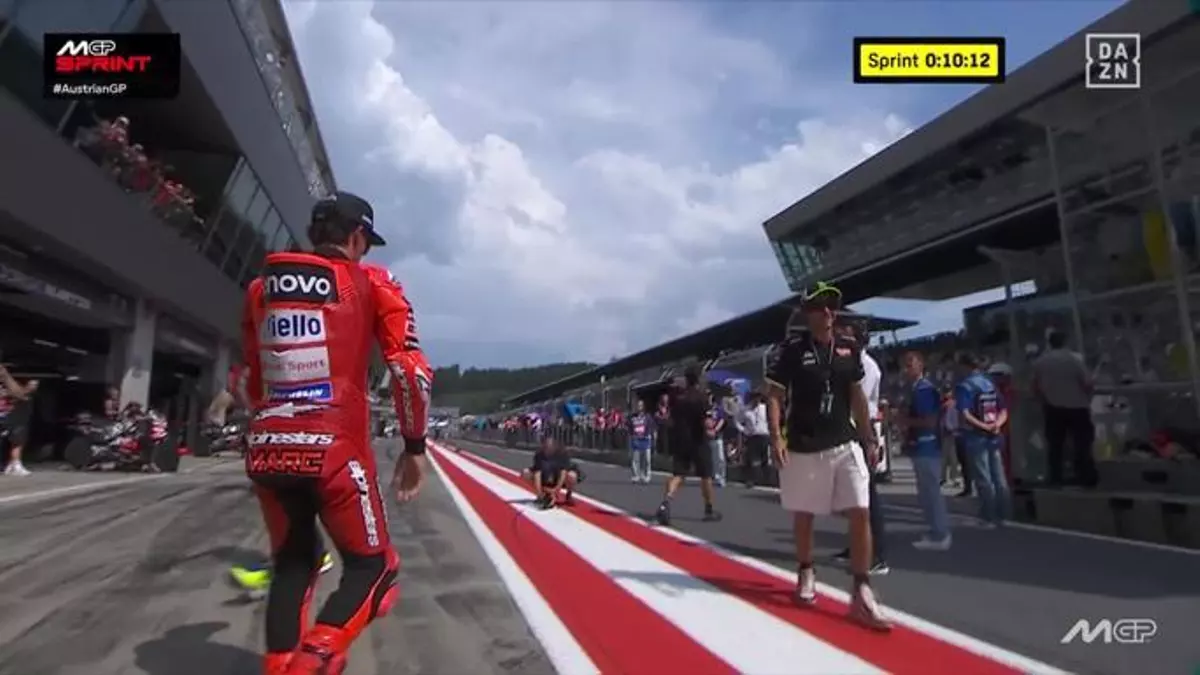
A brief, wordless encounter in the paddock turns into a mirror of the sport itself—where legacies collide, influence migrates from the saddle to the pit wall, and the balance of power keeps moving.
Spielberg, August 2025
They passed within arm’s reach and never truly saw each other. Marc Márquez walked through the paddock with the coiled focus of a rider who lives on the edge of the possible; Valentino Rossi moved in the opposite direction with the ease of a man whose legend now wears a team jacket. No handshake, no nod, not even the ritual half-smile that paddock etiquette sometimes demands. The silence between them felt louder than the warm-up laps—an old rivalry condensed into a glance that never happened. It was a tiny moment, immediately viral, and yet it carried the density of a decade: the controversies, the titles, the bruised pride, the parallel empires.
The scene matters because it surfaces two truths about the present state of MotoGP. First, Márquez has shifted from phenomenon to institution; he rides not only for points but for place in history, and the paddock bows—whether in admiration or resistance—to the gravity of that pursuit. Second, Rossi’s influence has migrated without diminishing: less helmet, more headset; fewer risks at the apex, greater leverage in the ecosystem that develops riders, sets narratives, and competes for sponsorship and talent. One rules the timing sheets on Saturdays and Sundays, the other rules the week from an office above the garage. When their paths crossed and neither broke stride, it felt like watching two continents drift—no collision, but an undeniable tectonic pull.
The rivalry has always been more than statistics. It is a grammar of gestures, a politics of space on track and off it. Even when separated by different machinery and different missions, each remains the other’s necessary mirror. Márquez’s aggressive precision gains meaning against the memory of Rossi’s charismatic craft; Rossi’s cultural capital glows brighter when refracted by the glare of a rider who insists on remaking the record book in real time. That is why a non-moment becomes a moment: because MotoGP is as much about how champions inhabit power as it is about how they accumulate points.
Inside the garages, technicians measure tenths and tire wear, but the larger calculus is strategic. The sprint era has amplified risk and reward, compressing weekends into a theater where momentum can turn in a heartbeat. Consistency, once a measured virtue across long campaigns, now needs spikes of brilliance delivered on command. In that arena, Márquez has recovered the gift that once made him inevitable: converting chaos into advantage. Rossi, meanwhile, channels his instinct into structure, working through riders and staff who grew up tracing his lines on the walls of their bedrooms. The meeting that wasn’t—two men moving past each other—signals how close those worlds still are, and how far apart they must remain to keep their power intact.
There is, inevitably, a politics to all this. Fans don’t merely choose favorites; they choose eras. Every podium shifts an argument on social media, every camera cut feeds the canon. Sponsors, broadcasters, and manufacturers read these micro-dramas as signals: who sets the tone, who draws the crowd, who can carry a project through mechanical uncertainty and managerial drift. In that sense, the Austrian Sprint weekend offered more than lap charts. It offered a reminder that influence has different speeds. The rider’s is immediate and brutal; the team owner’s is cumulative and patient. Both, however, rely on aura—the impression that when you are present, the story belongs to you.
What follows from an avoided glance? Perhaps nothing measurable on Sunday afternoon. And yet the paddock felt charged, as if the air itself recognized that greatness is a conversation that never really ends. If current trajectories hold, Márquez will continue to bend results toward his will, stitching together weekends where others unravel. Rossi will continue to shape the future just behind the curtain, acquiring talent and translating experience into competitive rituals. A disruption could arrive if injuries, development stumbles, or a resurgence from rival camps upset the order—MotoGP has a habit of springing such ambushes. Or the board could tilt if a new generation—raised on sprints, data, and fearless racecraft—forces both legends to renegotiate their roles, on track and in the corridors where futures are decided.
For now, the image remains: two giants crossing in the narrowest of spaces, holding fast to their own orbits. It was only a few seconds, and it will be replayed for years—because sometimes, in MotoGP, the loudest statement is the one nobody makes.
Bajo los más altos estándares de verificación y ética periodística, Phoenix24 elaboró este artículo con información vigente y análisis independiente desde una perspectiva geopolítica integral.
Under the highest standards of verification and journalistic ethics, Phoenix24 prepared this article with up-to-date information and independent analysis from a comprehensive geopolitical perspective.