

 Phoenix 24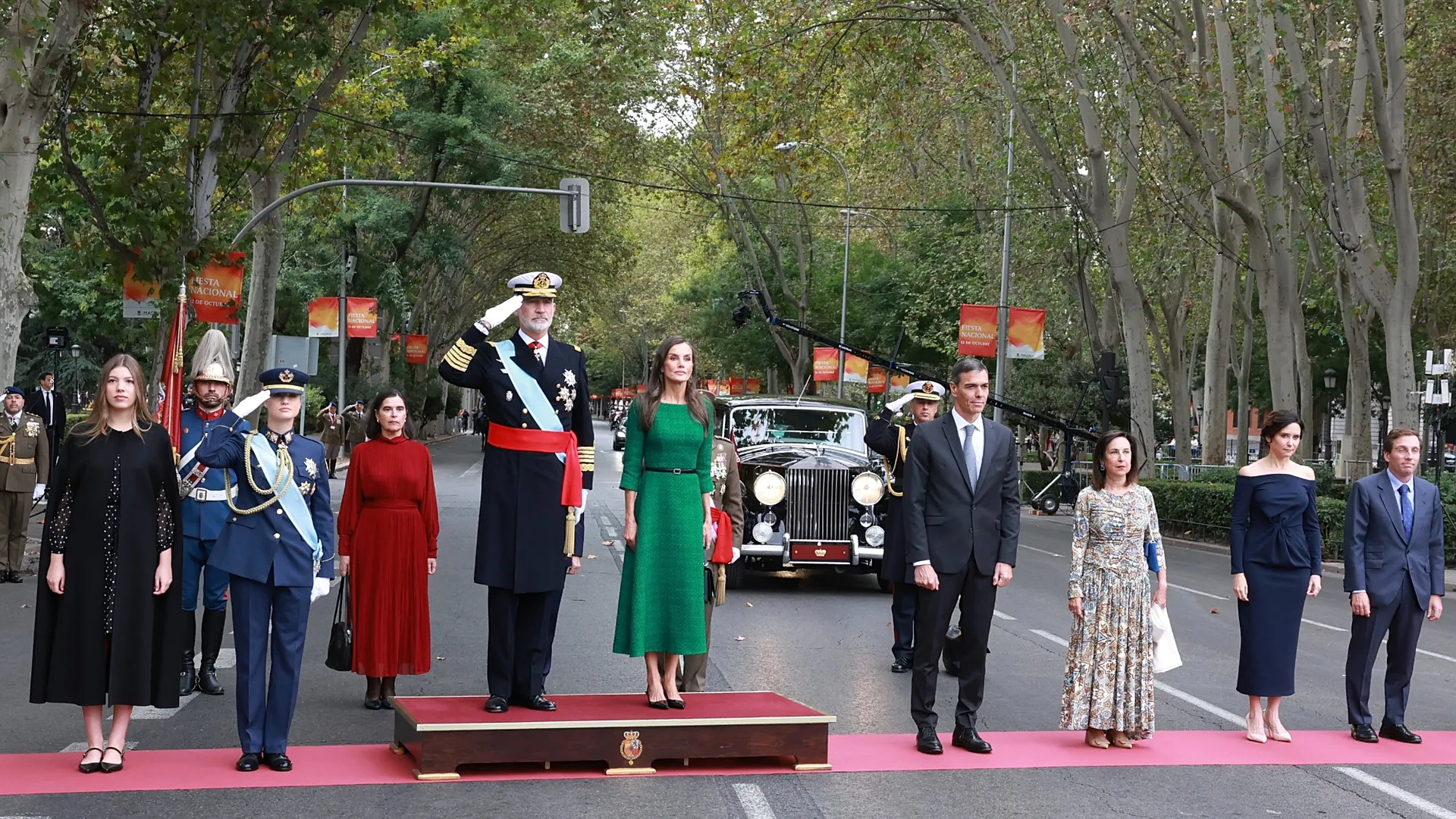
The national celebration turned into a political thermometer as applause clashed with shouts of rejection.
Madrid, October 2025. The morning of Spain’s National Day unfolded under clear skies and a script of ceremonial order until the arrival of the Prime Minister shifted the tone. What began as isolated whistles soon grew into a collective murmur that accompanied his walk to the official stand. The military music continued, but the background noise revealed a discontent that protocol could not silence.
The scene took place in Plaza de Cánovas del Castillo, where thousands of citizens gathered waving Spanish flags. Official cameras focused on the arrival of the presidential convoy as chants echoed from behind the fences. The royal family greeted from the platform, soldiers marched in perfect formation, yet the spotlight was no longer on the parade — it was on the reaction of the crowd.
Despite the efforts to maintain composure, tension was visible. Some ministers whispered brief remarks; others avoided eye contact. Within the security perimeter, the atmosphere was uneasy. Each appearance of the Prime Minister on the screens reignited the noise. By the time the air squadrons crossed the sky to conclude the parade, the discomfort had become undeniable.
The day’s next act was the reception at the Royal Palace, an event reserved for diplomats and senior officials. There, the surprise deepened: the Prime Minister stayed only a few minutes before leaving, citing an urgent trip to Egypt for a signing ceremony. The official reason sounded formal, but under the weight of the morning, it acquired another meaning.
Conversations spread quietly among guests. Some interpreted the early exit as a reaction to the boos; others as a calculated move to avoid escalation. The opposition was quick to respond — its leader mocked whether the head of government “no longer enjoys Spain’s National Day.” Meanwhile, a cabinet member tried to downplay the incident, joking that the president “wanted to have lunch with his family.”
Beyond political irony, the episode exposed a symbolic erosion. National ceremonies meant to project unity have become mirrors of polarization. What should have been a civic celebration instead reflected the emotional fracture between citizens and their institutions.
Observers noted that such outbursts, though noisy, reveal a deeper fatigue: the loss of trust in political representation and the widening gap between speeches and realities. The confrontation did not begin at the parade, but it found its perfect stage there.
Across Europe, national parades often stand as symbols of continuity. A Prime Minister being booed at one sends an unsettling signal about the fragility of political consensus. Spanish politics seems caught between institutional ritual and emotional volatility, where every public gesture becomes a test of legitimacy.
Even though the government insisted that the event followed its planned schedule and justified the trip abroad, the optics were unmistakable: the sound of disapproval overpowered the anthems, and the early departure overshadowed the ceremony. In the collective memory, the image that remains is not of military precision, but of power being openly challenged in its own celebration.
Ultimately, the 12th of October 2025 will be remembered not as a mere incident, but as a portrait of a nation where national rituals are inseparable from the struggle for narrative control. Authority stood on the podium, yet the audience — once passive — became the protagonist of judgment.
Phoenix24: clarity in the grey zone. / Phoenix24: claridad en la zona gris.