

 Phoenix 24
Brutality becomes myth when systems refuse accountability.
Chicago, February 2026.
The date carries romance in the popular calendar, but in Chicago it also carries a different inheritance: the idea that power sometimes speaks through spectacle, and spectacle sometimes hides a ledger. That is why one boxing match, fought on February 14, 1951, still travels under a name borrowed from gangland history. Sugar Ray Robinson versus Jake LaMotta, the sixth and final fight in their saga, was so punishing that it became known as the “St. Valentine’s Day Massacre.” The nickname was not a marketing trick. It was a cultural shortcut, a way to describe a level of sanctioned violence that felt closer to an execution than a contest.
The fight took place at Chicago Stadium with LaMotta’s middleweight title on the line and with a rivalry already thick with resentment. Robinson had the elegance and timing that made him look untouchable until someone forced him into the wrong kind of exchange. LaMotta had the stubbornness that made damage feel irrelevant, at least until the body finally ran out of permission. They had been circling each other since the early 1940s, trading outcomes and absorbing the kind of punishment that modern matchmaking often avoids. By 1951, the story was no longer simply about who was better. It was about who could hold shape the longest under stress.
LaMotta’s preparation carried an early warning. He had struggled with weight in the lead-up, and that type of strain is not cosmetic, it shows up as fatigue and slower recovery between rounds. Robinson, reading the situation like a technician, built a plan that was less glamorous than it was cruel: sustained work to the body, steady pressure, and accumulation rather than a single clean finish. For stretches, LaMotta still looked like the same creature who refused to be moved, throwing back shots that reminded the crowd this was not a ceremony. Yet the rhythm tilted, and once it tilted, it became difficult to reverse because Robinson was not chasing admiration, he was chasing inevitability.
The ending is where the myth hardens. By the thirteenth round, LaMotta was pinned upright, battered into a posture that showed both refusal and helplessness. The referee stopped it not because LaMotta fell, but because he would not, and the unanswered punishment had crossed from competition into liability. Robinson reclaimed the title, but the image that survived was LaMotta standing there anyway, absorbing what should have ended sooner. The nickname “Massacre” did not exaggerate the emotional experience of watching it, even if the rules called it sport. The fight became a benchmark for brutality that did not need a slow-motion replay to make its point.
What makes this story sharper is the way it echoes Chicago’s other St. Valentine’s Day, the 1929 gangland killing of seven men tied to the North Side Gang, an event widely associated with the era of organized crime violence and the mythology around Al Capone. Historians and major public outlets still recount how disguised assailants used the imagery of authority to stage a slaughter and then evaporate into silence. The boxing nickname borrows that civic trauma to signal something uncomfortable: the city had seen staged violence before, and it recognized the pattern of an overwhelming force applied until resistance becomes symbolic rather than functional. In a grim way, the match felt like a legal version of an illegal certainty.
That overlap would be only rhetorical if boxing’s mid-century ecosystem had been clean. It was not. The sport’s history includes long-running allegations and documented inquiries into gambling pressure, managerial coercion, and underworld influence on matchmaking. In LaMotta’s own biography, the stain is explicit: he later admitted that he threw a 1947 fight against Billy Fox to gain favor with organized crime figures who could open a path to a title shot. The U.S. Senate investigations into boxing’s criminal entanglements put names, incentives, and methods into the public record, and LaMotta’s testimony made the uncomfortable truth harder to dismiss as rumor. It did not prove that every major bout was fixed. It proved the system had weak points, and weak points attract predators.
Seen through that lens, the 1951 “Massacre” becomes more than a violent night. It becomes a story about what happens when elite performance collides with compromised governance. Robinson and LaMotta were real, their suffering was real, and the outcome was earned inside the ropes. Still, the broader ecosystem around them was an economy where reputation, cash, and access could be traded, and where the line between sport and enterprise was negotiable. That is why the mafia reference clung to the fight’s nickname so naturally. The era’s boxing was not only a competition, it was a market, and markets create incentives for manipulation.
There is also a psychological dimension to why audiences keep returning to this event. The fight offers a paradox that feels modern: the most iconic moment in the rivalry is not a knockout, not a clean collapse, but a stoppage forced by institutional responsibility against an individual’s refusal to submit. LaMotta’s toughness becomes both admirable and unsettling because it exposes a boundary that sport needs but fans often resist. Robinson’s precision becomes both beautiful and frightening because it shows how mastery can be expressed as controlled damage. The match becomes memory because it refuses to settle into a single moral category.
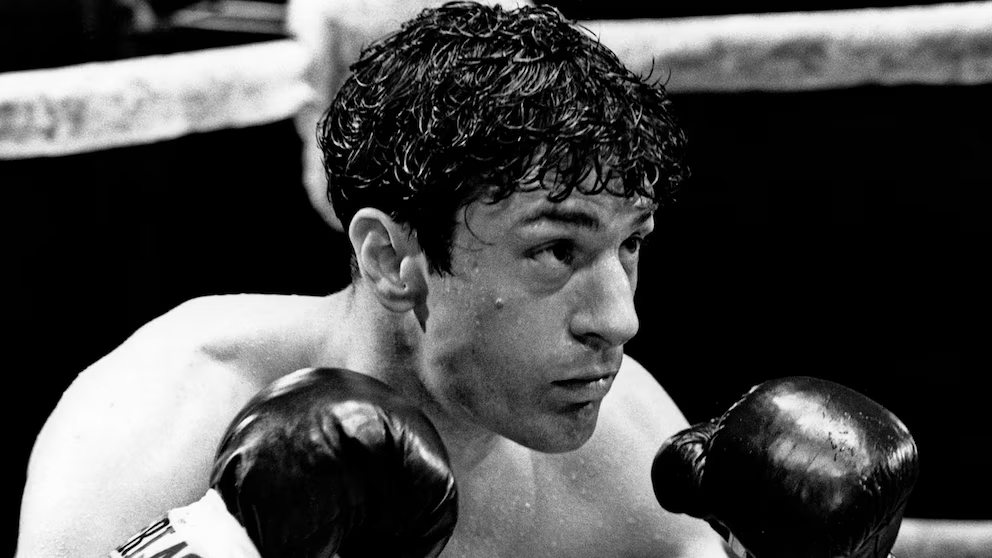
Even the cultural afterlife adds layers. The rivalry has been reinterpreted through cinema, especially in a film that turned LaMotta into a symbol of self-destruction, masculinity, and the cost of violence turned inward. That artistic framing kept the 1951 fight alive for people who never watched the round-by-round footage. It also reinforced the connection between personal brutality and systemic corruption, a pairing that mirrors the logic of the original 1929 massacre: power operates most freely when institutions are porous and narratives are easy to control. Chicago simply gave both stories a stage.
In the end, “St. Valentine’s Day Massacre” is not just a nickname for a classic fight. It is a reminder that sport, at its most intense, can reveal the architecture around it: who profits, who is protected, and what kinds of violence a society is willing to normalize when the ticket is paid and the lights are on.
Truth is structure, not noise. / La verdad es estructura, no ruido.