

 Ren Takahashi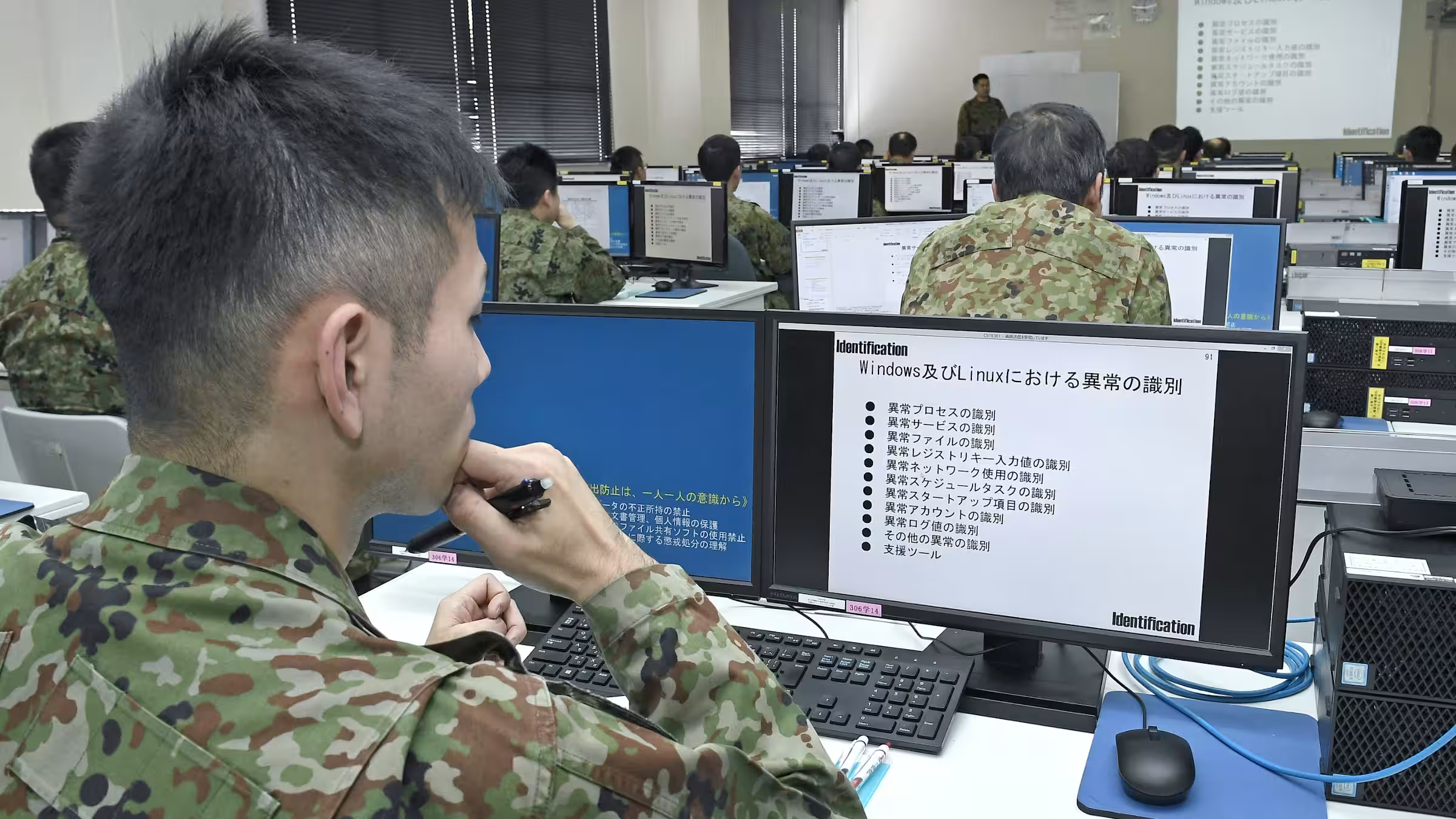
In an era where global power is no longer defined by nuclear warheads but by algorithmic control and quantum processing capacity, Japan is quietly recalibrating its strategic posture. Far from being the passive economic player or tech-savvy observer of the past, the island nation is emerging as a discreet yet formidable actor in the contested terrain of cyberwarfare.
From Tokyo’s Ministry of Defense to innovation hubs in Fukuoka, Japan has multiplied its cybersecurity budget and intensified its digital intelligence programs. According to the Ministry of Internal Affairs and Communications, national investment in cyber defense has tripled over the past four years. The National Center of Incident Readiness and Strategy for Cybersecurity (NISC), backed by both the military and civil sectors, now operates as a central node in Japan’s effort to repel digital incursions and assert strategic autonomy in the Indo-Pacific.
Japan’s alliance within the Quad Security Dialogue—alongside the United States, Australia, and India—has further accelerated its cyber realignment. Under this framework, Japanese officials are quietly engaging in real-time cyber threat sharing, red-team simulations, and joint exercises aimed at defending democratic infrastructure across the region.
But the deeper transformation is structural. Through a national initiative informally dubbed “Cyber Samurai”, Japan is training a new generation of elite digital warriors. This ambitious program, developed in partnership with the University of Tokyo, NEC, Fujitsu, and NTT Data, prepares thousands of engineers in artificial intelligence, hybrid warfare, and deep-learning-based counterintelligence. These individuals—part technologists, part strategists—represent Japan’s answer to the asymmetrical power struggles of the 21st century.

Japan’s parliament enacts on May 16, 2025, a law to allow preemptive “active cyber defense.” (Kyodo)
China and North Korea, unsurprisingly, are at the center of Tokyo’s digital threat assessments. A recent surge in cyber intrusion attempts originating from Chinese IP addresses—up 38% in the first quarter of 2025, according to Japan Times—has elevated concerns around energy grids, nuclear plants, and sensitive government databases. Although Japan refrains from open diplomatic confrontation, its agencies have already begun deploying predictive simulation systems and advanced interception protocols using machine learning.
Yet Japan’s strategy is not solely defensive. It is ethical—and ideological. While authoritarian regimes advance AI systems designed to monitor, control, and suppress dissent, Japan has positioned itself as a counterforce advocating for democratic digital norms. At the 2023 G7 Summit in Hiroshima, Japanese officials emphasized that “artificial intelligence must serve democracy—not replace it.”
This position is not merely rhetorical. It is geopolitical. Japan cannot outmatch China or the U.S. in data volume, but it can lead in algorithmic integrity and global trust. By exporting its “human-centric” AI model—already being adopted in Southeast Asia, parts of Africa, and Latin America—Tokyo is building a subtle but potent alliance network anchored in shared democratic values and data ethics.
The private sector plays a critical role in this strategy. Major corporations like Sony, Hitachi, SoftBank, and Toyota have restructured their cybersecurity divisions to operate in tandem with state goals. This mirrors, in democratic form, the mobilization of Japan’s industrial base during the postwar period—but now redirected toward digital sovereignty.
Still, the domestic consensus is not absolute. Independent voices, such as columnist Taro Suzuki writing for the Asahi Shimbun, have raised concerns about growing surveillance under the guise of cybersecurity. “The line between protection and overreach is dangerously thin,” he warned, highlighting the need for legal frameworks to ensure accountability in Japan’s cyber expansion.
Regardless of these internal tensions, the trajectory is clear. The new samurai do not carry swords—they write code. Their battlegrounds are not traditional arenas but distributed networks, quantum clusters, and shadow databases. Their enemies may not raise flags, but instead wear avatars, pseudonyms, and anonymous masks.
Japan has grasped an uncomfortable truth: 21st-century sovereignty is defended not by armies, but by firewalls, algorithms, and ethical frameworks. Its historical legacy of precision, discipline, and strategic restraint now converges with digital resilience. This makes Japan one of the last democracies capable of resisting the algorithmic drift toward a global surveillance dystopia.
The silence is deceptive. The Silicon Samurai are already in formation—and the world would be wise to pay attention.
Ren Takahashi, Japanese global opinion editor at Phoenix24. Specialist in Asia-Pacific, democracy & tech.