

 Phoenix 24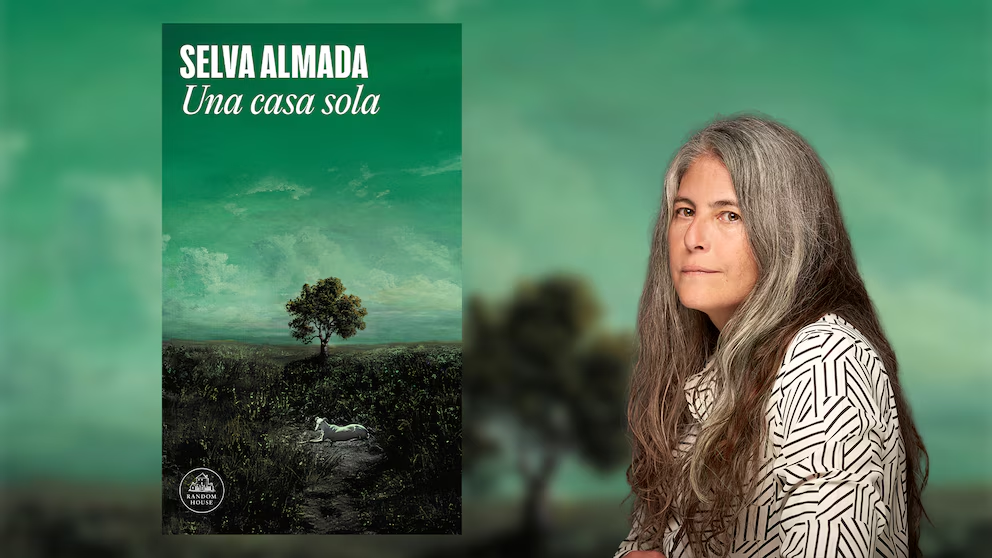
A home can remember what people refuse to name.
Buenos Aires, March 2026
Selva Almada’s Una casa sola is not simply another rural novel shaped by atmosphere and loss. It is a literary wager on whether a house can become a witness powerful enough to disturb the living. The premise is deceptively simple: a rural dwelling, precarious at first and later transformed into a family home, becomes the narrative center of a story marked by disappearance, memory, and the unresolved weight of something that may have been terrible, beautiful, or both. What makes the novel compelling is not only its plot, but the way Almada turns the house itself into a listening structure, a keeper of traces, and a container of unease.

That choice matters because it changes the scale of perception. A house cannot move, cannot investigate, cannot verify what lies beyond its immediate horizon. Yet it can absorb voices, silences, gestures, and the residue of lives lived inside it. Almada uses that limitation not as a weakness, but as the novel’s central force. The house knows enough to unsettle, but not enough to resolve. That produces a tension more durable than revelation. The reader is not led toward a neat answer, but toward a thickening sense that absence itself has become the story’s most active presence.

The rural setting sharpens that effect. Almada has long known how to write landscapes that feel less like scenery than like moral weather, and here the countryside does not offer pastoral calm. It offers distance, opacity, and the particular loneliness of a place where what happens can remain half-hidden for years. The house begins almost as a shelter for workers and becomes, through habitation, attachment, and repetition, something like a fragile organism. Then the family at its center vanishes, and the place is left holding what people no longer can or will explain. In that transformation, the novel moves from domestic formation to spectral aftermath without ever surrendering its material ground.
What is especially striking is the way Almada resists melodrama. A disappearance sits near the center of the novel, but the book does not seem interested in behaving like a conventional mystery. It does not rush toward forensic clarity or emotional overstatement. Instead, it lets memory circulate in a more restless form. The house recalls births, routines, conversations, labor, intimacy, and fear with the same patient receptivity. That equal treatment is important. It suggests that horror does not always arrive as rupture. Sometimes it accumulates in the same rooms where tenderness once lived, until the ordinary itself begins to feel contaminated by what it has witnessed.

There is also a political undertone that gives the story added weight. The disappearance at the heart of the book is not framed as an event from the dictatorship, but that distinction only makes the unease sharper. A disappearance in democracy carries its own kind of moral disturbance. It suggests not the familiar darkness of a known terror apparatus, but something more diffuse and perhaps more unsettling: the persistence of vanishing, impunity, and silence even after the formal language of democracy has returned. Almada does not appear to turn the novel into a programmatic statement, yet the resonance is unmistakable. The private rural space becomes a chamber where the national difficulty of naming violence continues to echo.
The narrative experiment is risky, and that is part of its achievement. Giving voice to a house could easily become a literary trick, a concept admired more than felt. Here, however, the device seems to deepen rather than decorate the story. The house is not anthropomorphized into a quaint character. It remains a structure, a fixed point, a perceiving enclosure. That keeps the voice strange enough to preserve its power. The result is a perspective that is intimate without being human, emotional without becoming sentimental, and limited in exactly the way that makes the novel’s silences more troubling.
Almada’s larger literary world helps explain why this works. She has spent years turning the Argentine interior into one of the most charged territories in contemporary Spanish-language literature, a place where oral memory, rural life, violence, tenderness, and abandonment can coexist without being flattened into folklore. Una casa sola extends that project in a new direction. It does not abandon landscape or atmosphere, but it radicalizes point of view. The countryside remains present, yet the real frontier here is narrative itself: who gets to remember, who gets to speak, and what kind of truth a nonhuman witness can carry.
What emerges is a novel less interested in solving the past than in showing how the past inhabits matter. Walls, rooms, and thresholds become repositories of unfinished meaning. The title itself points toward that condition. A solitary house is never just architecture in this universe. It is a remnant, a shell of intimacy, a keeper of voices, and perhaps the only entity left that refuses to forget. That is what gives the book its unsettling force. It suggests that when people disappear, memory does not disappear with them. Sometimes it remains where they slept, where they spoke, and where something unnamed still lingers.
Every silence speaks. / Every silence speaks.