

 Phoenix 24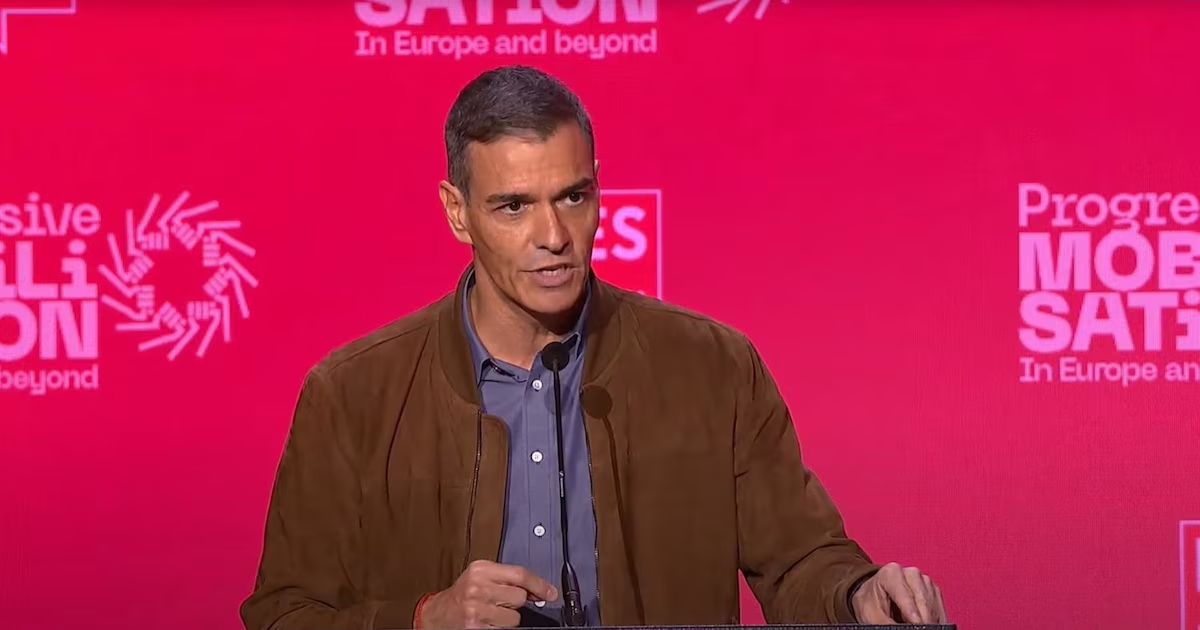
In a continent marked by widening income gaps and stubborn inflation, the idea of a shared economic floor emerges as a political attempt to reconcile social justice with continental stability.
Amsterdam, October 2025. At a summit of progressive leaders held in Brussels, Spanish Prime Minister Pedro Sánchez formally proposed the creation of a common minimum wage for the entire European Union. Conceived as an instrument of economic cohesion, the initiative aims to reduce disparities among member states and shield workers’ purchasing power from market volatility.
Sánchez argued that European integration cannot endure on the basis of disjointed labor models in which living costs and basic conditions differ dramatically between north and south. According to his vision, a unified wage threshold would strengthen internal competitiveness while curbing the social dumping that continues to undermine weaker economies.
Sources within the European Council confirmed that the proposal will be discussed as part of the 2026 social agenda, though several northern countries have already voiced reservations. Germany and the Netherlands insisted that wage policy must remain a matter of national sovereignty. In contrast, France and Portugal expressed support for a harmonized framework tied to a percentage of each nation’s average wage, thus avoiding a fixed numerical figure.
From Strasbourg, the European Parliament acknowledged the symbolic value of the idea but emphasized the technical difficulties of implementation. A group of liberal-leaning MEPs warned that a single wage floor could distort emerging economies in the east. The European Institute for Economic Policy, based in Berlin, noted that any salary convergence would require prior fiscal harmonization and a coordinated productivity strategy—both still uneven across the eurozone.
International organizations reacted cautiously. The International Monetary Fund endorsed the notion of strengthening Europe’s labor base but warned that a continent-wide wage must align with budget sustainability. From Geneva, the International Labour Organization called the initiative potentially historic if coupled with active employment and training policies. Meanwhile, the European Central Bank has maintained a guarded stance, aware that the final design could affect inflation and competitiveness across global markets.
For Spain, the proposal represents both a political gamble and a bid for leadership within Europe’s social-democratic axis. Sánchez seeks to consolidate his reformist image and present an integrative vision that contrasts with the austerity rhetoric favored by certain governments. Analysts in Brussels interpret his move as part of an effort to reclaim the narrative of European solidarity—one weakened by years of fiscal orthodoxy.
In Eastern Europe, responses have been more cautious. Governments in Poland and Hungary fear that a common wage could pressure their national economies and disrupt industrial production costs. Yet regional labor unions have welcomed the possibility of narrowing wage inequalities and aligning their labor standards with western counterparts.
The debate has only begun, but it already redraws the ideological boundaries of the Union. A common minimum wage would test Europe’s ability to act as a social project rather than a purely economic one. Whether the continent succeeds will depend on its willingness to transcend national interest in the name of a distributive justice long deferred.
Phoenix24: journalism without borders. / Phoenix24: periodismo sin fronteras.