

 Phoenix 24
A determined crowd moved through Rome with a force that filled avenues and plazas, demanding that war stop dictating Gaza’s fate.
Rome, November 2025
The Italian capital witnessed one of its most significant demonstrations of the year as thousands marched in solidarity with Gaza during a global day of mobilization coordinated by the Global Movement to Gaza. The march began at Porta San Paolo and grew rapidly into a dense, multigenerational wave calling for an immediate ceasefire and an end to military cooperation with Israel. Even in a city accustomed to protests, the sheer scale and emotional intensity revealed a shifting public mood in which moral urgency outweighed political fatigue.
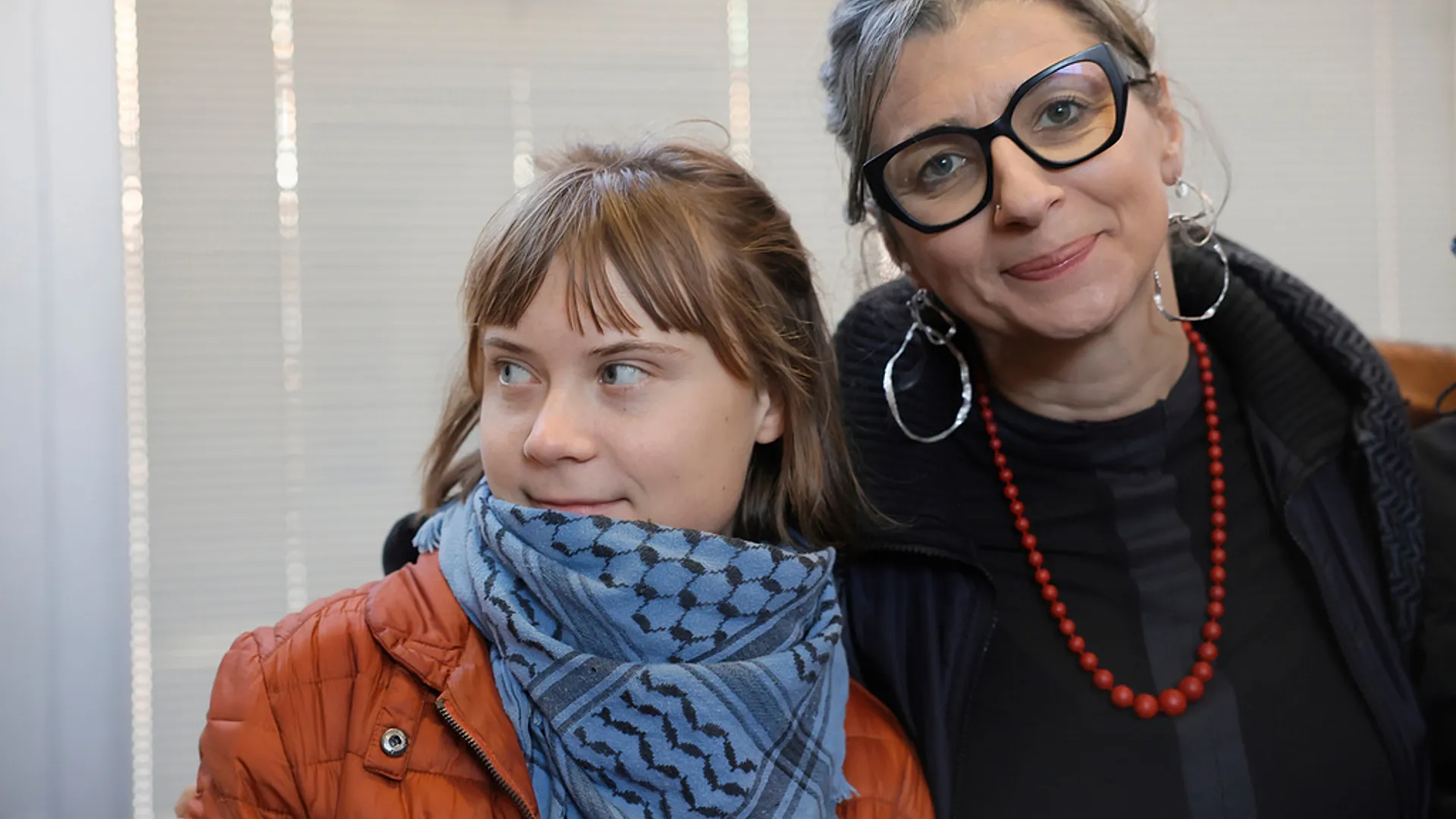
Among the most visible participants were climate activist Greta Thunberg and United Nations rapporteur Francesca Albanese, whose presence added international weight to the mobilization. Thunberg described the humanitarian situation in Gaza as a systemic failure of the global community, while Albanese criticized the information asymmetries surrounding the conflict and urged European democracies to suspend all forms of military assistance. Their interventions positioned the Rome march not as an isolated demonstration but as a key node in a widening international demand for accountability and humanitarian action.
As the procession advanced toward Piazza San Giovanni, flags, banners and chants multiplied. Groups of transport workers, migrant associations, student collectives and grassroots unions joined on the way, turning the streets into a mosaic of political and social voices. The atmosphere remained peaceful yet charged with a sense of moral determination that echoed through slogans calling for genuine humanitarian corridors and a cessation of bombing in Gaza. Volunteers distributed water and leaflets while families marched holding photographs of civilians affected by the ongoing violence.
Human rights specialists noted that the mobilization aligns with a broader erosion of public trust in European diplomatic strategies. Institutions such as the Council of Europe have warned that the humanitarian cost of the conflict is reshaping public expectations, while research networks in the Middle East highlight that long term security strategies cannot endure without credible accountability frameworks. Analysts in Latin America emphasized that mass protests often act as social indicators capable of influencing political decisions, especially when they synchronize across regions around a shared humanitarian concern.
Leaders of the Global Movement to Gaza announced ongoing preparations for an international humanitarian convoy early next year. The initiative aims to move hundreds of trucks carrying food, medicine and essential supplies, despite logistical and diplomatic hurdles. For many in the Rome crowd, the convoy represents an attempt by civil society to fill the gaps left by stalled diplomatic efforts, transforming solidarity into a tangible form of intervention.
Throughout the march, Rome’s streets reflected a blend of exhaustion and resolve. Participants described the demonstration as a necessary act amid a conflict that continues to inflict civilian suffering without offering a viable path toward resolution. The mixture of young activists, families, workers, academics and local organizations created a collective atmosphere where indignation coexisted with an increasingly structured call for action. Far from being a symbolic gesture, the mobilization signaled a transition from empathy to organized pressure.
As the demonstration drew to a close, one message stood out among the speeches and chants: solidarity must evolve into action. The demands for a ceasefire, the suspension of military support, the establishment of humanitarian access and the acknowledgment of the full scale of the crisis in Gaza all converge at a critical moment. For many Italians, the march marked a turning point in which the public chose to approach the conflict not as distant observers but as active participants shaping the conversation.
Global narrative resilience. / Global narrative resilience.