

 Phoenix 24
The game now sees through authority
World Cup 2026, June 2026.
The arrival of Referee View at the 2026 World Cup marks a new stage in how football is watched, narrated, and commercialized. By placing a camera on the referee, the match is no longer seen only from the stands, the broadcast booth, or the tactical overhead angle. It is seen from the position of authority inside the field.
The innovation is visually powerful. It allows audiences to experience speed, proximity, pressure, and decision-making from a perspective rarely available to viewers. Every collision, protest, sprint, and disputed play becomes more immediate. The referee is no longer just the official who interrupts the spectacle. He becomes a moving camera within it.

This changes the emotional architecture of the broadcast. Traditional football coverage turns players into protagonists and referees into secondary figures. Referee View disrupts that order. It reminds viewers that officiating is not abstract judgment from a distance, but a high-speed interpretive task performed under pressure, noise, limited angles, and constant scrutiny.
The technology may also reshape public perception of refereeing. Fans often judge officials through slow-motion replays, tactical cameras, and emotional bias. A body-mounted perspective can reveal how little time exists to process a foul, an offside movement, a handball claim, or a player reaction. It may not eliminate controversy, but it can humanize the difficulty of decision-making.

At the same time, the innovation raises deeper questions. Football is increasingly becoming a data and camera ecosystem. VAR, semi-automated offside technology, goal-line systems, player tracking, biometric analytics, and now referee-mounted cameras are expanding the visual and informational control of the game. The promise is transparency. The risk is that football becomes over-mediated, with every gesture captured, packaged, and monetized.
Referee View is not simply a technical upgrade. It is part of a broader struggle over the future of sports entertainment. Broadcasters want immersion. Fans want access. Governing bodies want legitimacy. Sponsors want new visual assets. But the game must protect the human rhythm that makes football unpredictable, imperfect, and emotionally powerful.
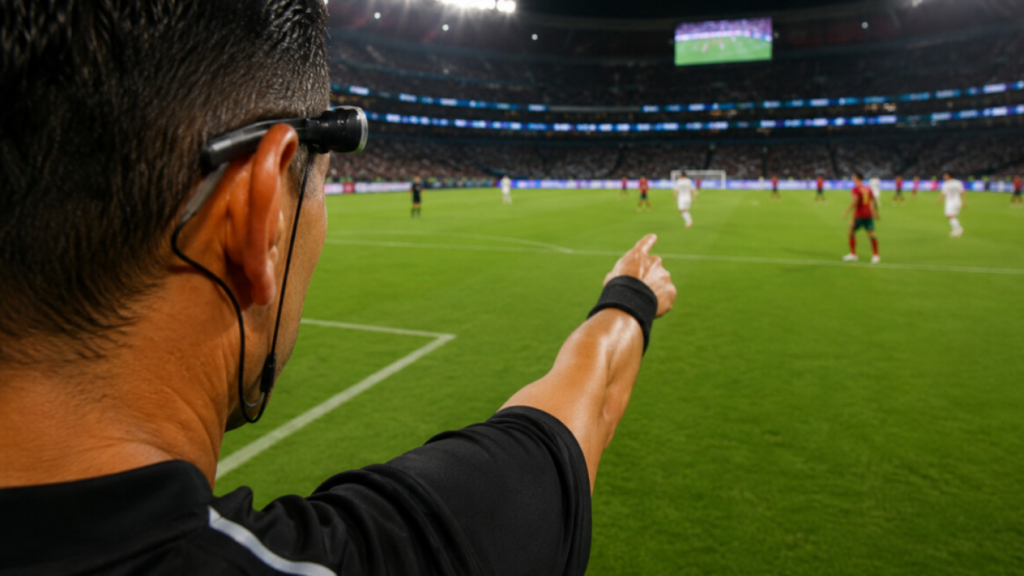
The camera on the referee may help audiences understand the game better. It may also accelerate the transformation of football into an all-seeing spectacle where every actor on the pitch becomes both participant and content. The challenge is to use visibility without reducing the sport to surveillance.
Technology improves sport when it deepens understanding without replacing the game itself.