

 Mario López Ayala, PhD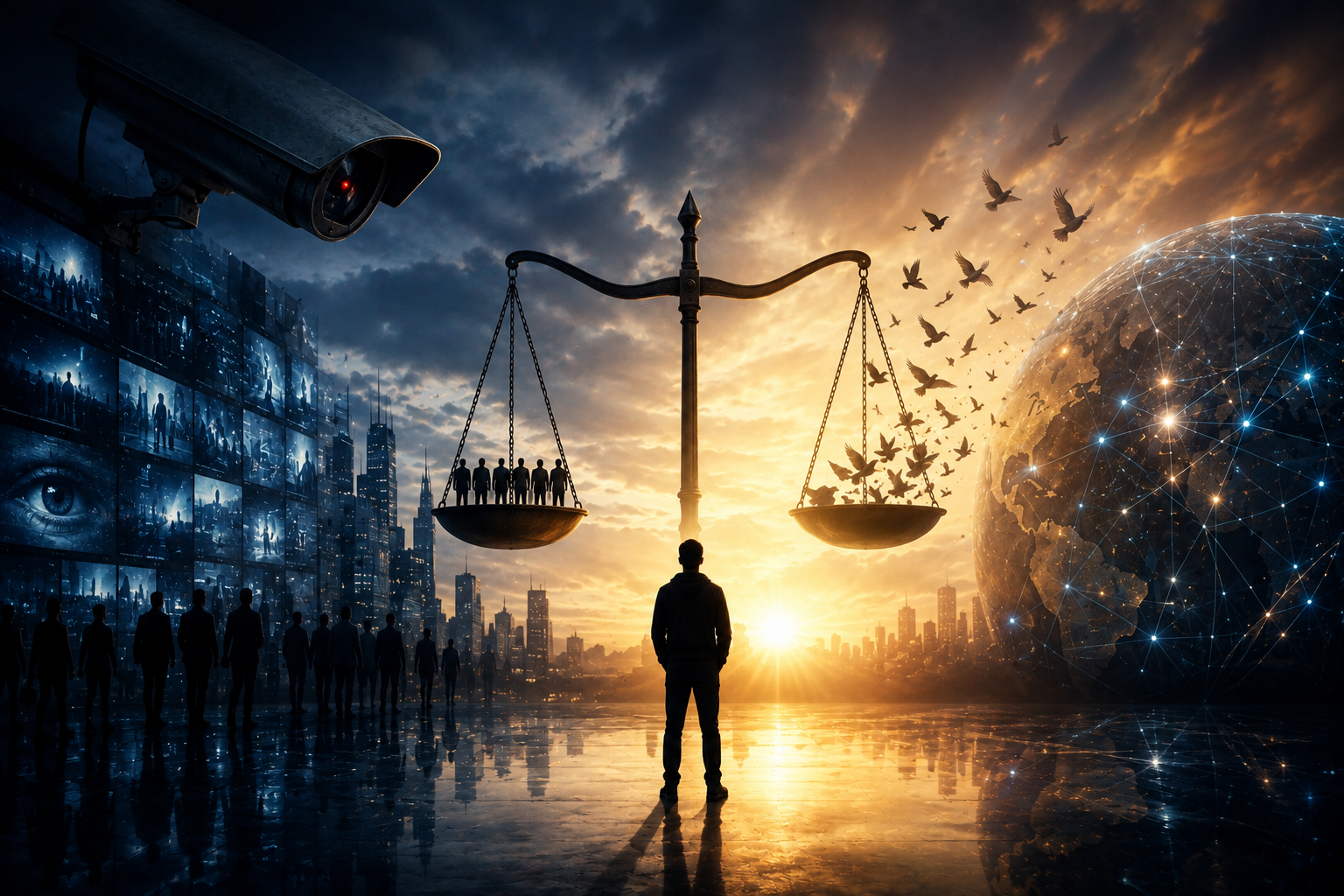
Part I | Who Watches Those Who Regulate Information?
There was a time when controlling information was remarkably simple. Governments could silence dissent by shutting down a newspaper, revoking a broadcasting license, banning a book, or imprisoning a journalist. Power was visible, censorship was explicit, and citizens could easily identify who was attempting to suppress inconvenient voices. Modern democracies rarely operate that way anymore. Today, the debate is no longer centered on whether people may speak, but on the conditions under which speech is allowed to circulate.
That shift represents one of the defining political transformations of the twenty-first century. Democracies have moved beyond asking who has the right to speak and now wrestle with a far more complex question: who has the authority to regulate information? The distinction may appear subtle, yet it fundamentally reshapes the relationship between governments, media organizations, technology platforms, and the public. Every attempt to regulate information inevitably redistributes power. Every redistribution of power deserves the same level of scrutiny as the freedoms it claims to protect.
Over the past two decades, the speed of information has surpassed the ability of institutions to adapt. Disinformation campaigns, coordinated influence operations, synthetic media generated by artificial intelligence, and algorithmic recommendation systems have created challenges that previous generations could scarcely imagine. Democracies cannot simply ignore these realities. Yet responding without adequate institutional safeguards may prove equally dangerous. Between inaction and overregulation lies one of the most consequential constitutional debates of our time.
History offers a lesson that remains remarkably consistent. Freedom rarely disappears through a single dramatic act. It seldom vanishes overnight. More often, it erodes gradually through reforms that appear reasonable when considered individually. National security, public order, the fight against disinformation, the protection of vulnerable groups, or the defense of the public interest are all legitimate democratic objectives. The crucial question is not whether those goals matter, but who receives the authority to pursue them—and what limits are placed upon that authority.
This concern has shaped constitutional thought for more than three centuries. Montesquieu understood that liberty depends not only on recognizing rights but also on preventing any institution from accumulating unchecked power. James Madison expanded that principle by arguing that constitutions are not written because rulers are inherently malicious, but because no human being should exercise unlimited authority. Stable democracies are therefore built not on trust in those who govern, but on institutions capable of restraining even the most popular governments.
That is precisely why enduring democracies design legal frameworks that outlast political cycles. Governments are temporary; institutions endure. Parliamentary majorities change; constitutional precedents often shape generations. Sound legislation should never be evaluated solely by the intentions of those who enact it, but also by the consequences it may produce once power changes hands. A good law is one that protects freedom regardless of who occupies public office.
For much of the twentieth century, the central debate focused on the relationship between governments and traditional media. Today the landscape is far more complex. Alongside states and news organizations stand global technology companies whose algorithms influence what billions of people read, watch, and discuss every day. Never before has so much of the public conversation depended on systems designed and managed by private corporations operating across national borders. Informational power is no longer concentrated in a single institution; it is shared among political authorities, media organizations, and digital platforms.
This reality leads to a question that transcends ideology, geography, and political circumstance: Who watches those who regulate information? The answer cannot rest solely on trusting governments, nor can it rely entirely on market forces or voluntary self-regulation by technology companies. Comparative experience suggests that excessive concentrations of power—whether political, economic, or technological—ultimately distort the conditions necessary for a free society. Democracy requires institutional checks precisely because no single actor should become the ultimate arbiter of truth.
Mexico now finds itself participating in this broader global conversation. The debate surrounding its new telecommunications and broadcasting framework, particularly the rights of audiences, is not merely a legal or administrative issue. It reflects a much larger discussion about how democracies should balance freedom of expression with legitimate public interests in an era of profound technological change. Framing the debate as a simple confrontation between regulation and freedom overlooks the real constitutional challenge. Before deciding whether a law strengthens or weakens liberty, societies must first ask whether its institutional design distributes power—or concentrates it.
The answer to that question will shape the quality of democratic life for decades to come. Protecting audiences is a legitimate objective. Safeguarding freedom of expression is equally indispensable. The real challenge is ensuring that one principle is never invoked to undermine the other. That is where the conversation must begin: not with partisan slogans or temporary political disputes, but with a deeper commitment to constitutional balance, institutional restraint, and historical memory.
The next installment will examine that challenge through the Mexican case. We will explore the constitutional foundations of freedom of expression, the legal framework governing audience rights, relevant jurisprudence from Mexico’s Supreme Court and the Inter-American Court of Human Rights, and a question increasingly confronting democracies around the world: Can societies strengthen the rights of audiences without granting governments powers that, under different political circumstances, could become instruments of pressure against a free press?
Mario López Ayala, PhD
Researcher and Director of Phoenix24