

 Phoenix 24
A condemnation delivered from Oslo has amplified scrutiny of the alliances sustaining one of the hemisphere’s most entrenched authoritarian regimes.
Oslo, December 2025.
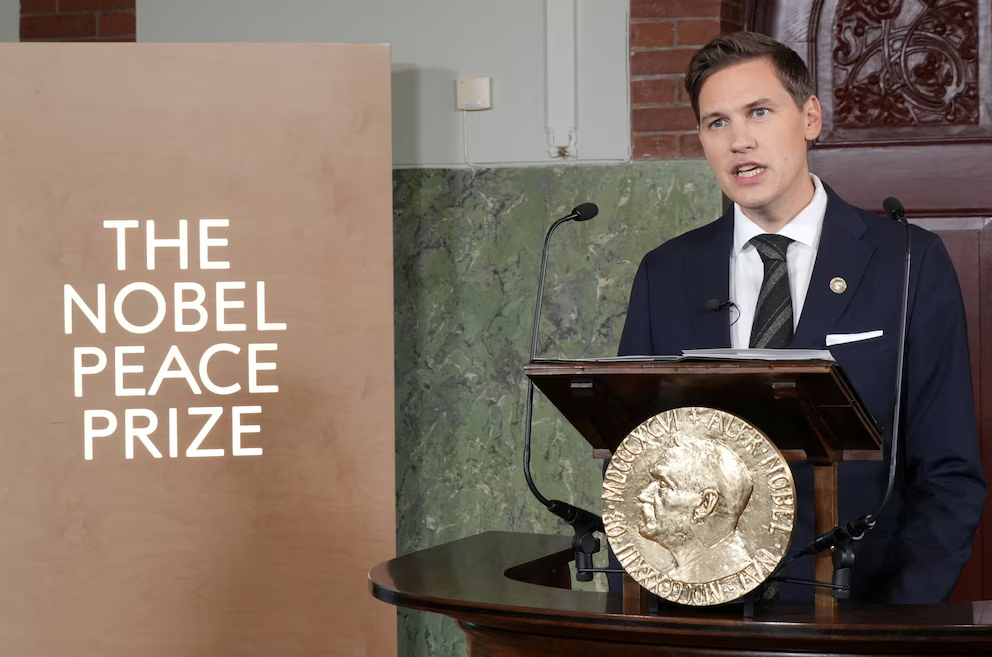
The president of the Norwegian Nobel Committee issued an unusually direct accusation against Cuba, Russia and Iran, asserting that their political, intelligence and logistical backing has intensified the repressive capacity of Nicolás Maduro’s government. His remarks, delivered shortly after the Peace Prize ceremony, positioned Venezuela’s internal crisis within a broader geopolitical framework, arguing that the country’s authoritarian durability is strengthened by a triad of external partners whose support extends beyond diplomacy and into operational reinforcement of the regime’s coercive apparatus.
Analysts indirectly referenced by Reuters interpret the statement as a calculated diplomatic signal, aimed at highlighting how foreign alliances shape the conditions under which Venezuelan dissidents, activists and humanitarian workers operate. According to these assessments, the Committee’s criticism underscores a shift from purely national framing to recognition of cross border networks that provide surveillance technologies, security training and strategic advisory roles to Caracas. By invoking Cuba, Russia and Iran simultaneously, the Committee chief drew attention to a convergence of interests that collectively reinforce repression even as Venezuela confronts international sanctions and domestic turbulence.
European observers cited by the Financial Times note that Cuba’s longstanding presence inside Venezuelan intelligence structures has been extensively documented by regional experts. Cuban advisers, often embedded within security institutions, have played roles in organizational restructuring and internal monitoring, shaping the regime’s capacity to preempt dissent. Russia’s contribution, in contrast, often manifests through defense cooperation, cyber capabilities, and political backing in multilateral forums. Iran’s involvement has been described by analysts as more covert but tactically significant, tied to technological support and coordination with pro government entities that benefit from asymmetric strategies.
Analysts from the Jacques Delors Institute argue that the Committee’s denunciation reflects growing acknowledgment within Europe that Venezuela’s crisis is not solely the product of domestic authoritarian consolidation but part of a geopolitical architecture in which alliances operate as stabilizing pillars for the Maduro government. This framing complicates diplomatic approaches: measures aimed exclusively at Venezuelan institutions may prove insufficient if external actors continue supplying the resources that sustain repression and political control.
Security researchers indirectly referenced by CSIS add that Venezuela’s internal landscape has evolved into a layered ecosystem of intelligence agencies, paramilitary groups and criminal structures that interact with foreign partners. This environment increases the resilience of the regime by dispersing coercive power across multiple nodes, reducing the risk of internal fracture. The Committee’s remarks, they suggest, point toward an internationalization of accountability, urging greater scrutiny of states that contribute to the durability of authoritarian systems.
The response from Caracas was immediate and dismissive. Venezuelan officials rejected the accusations as politically motivated and accused the Nobel institution of aligning with Western agendas. Yet the timing and venue of the Committee president’s remarks ensured broad global resonance, particularly as they came during a week in which the regime faced intensifying criticism for detentions, censorship and targeted actions against civil society. For dissident networks, the statement offered rare validation from an institution with strong symbolic authority.
Diplomatic analysts observe that the widening conversation about external enablers may influence future policy toward Venezuela, prompting governments to consider measures that target international support channels rather than focusing solely on the regime’s internal dynamics. European policymakers in particular face mounting pressure to respond to the Committee’s call for attention, as it aligns with ongoing debates about strengthening sanctions frameworks and monitoring dual use technologies that may be diverted to state repression.
As Oslo’s spotlight fades, the significance of the accusation lingers. By naming specific foreign states as contributors to Venezuela’s authoritarian excesses, the Committee reframed the crisis as a multinational challenge requiring coordinated international response. In doing so, it advanced a narrative in which repression is not merely a domestic act but a transnational enterprise enabled by strategic alliances.
Phoenix24: information that anticipates futures. / Phoenix24: información que anticipa futuros.