

 Phoenix 24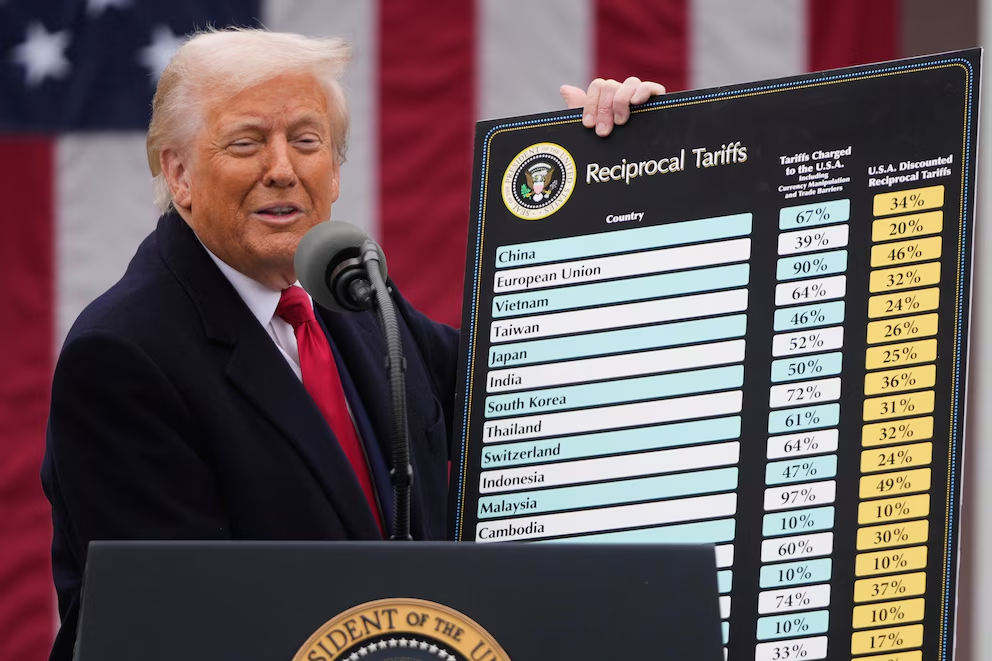
Certainty returns, yet the bill does not.
Washington, February 2026.
Mexico’s trade exposure to U.S. tariffs has shifted shape, not disappeared. A U.S. Supreme Court decision narrowed the legal basis for a broad, emergency-style tariff architecture, but it did not eliminate the United States’ ability to impose duties through other statutes. For Mexico, the practical question is which tariffs fall away, which remain in force, and how the risk redistributes across sectors.
The most immediate relief is tied to the punitive rate that had been applied to Mexican goods outside strict compliance with the United States–Mexico–Canada Agreement. The 25 percent tariff aimed at non-compliant products is expected to be annulled. That is not a symbolic change. It removes the steepest penalty that was punishing firms for gaps in rules-of-origin compliance, documentation, or content thresholds. In its place, a lower 10 percent duty is expected to remain for products that are not covered under the agreement. The new structure turns compliance into a tariff firewall: products that qualify under the agreement preserve the clearest path to preferential treatment, while goods outside the perimeter become the residual category that pays.
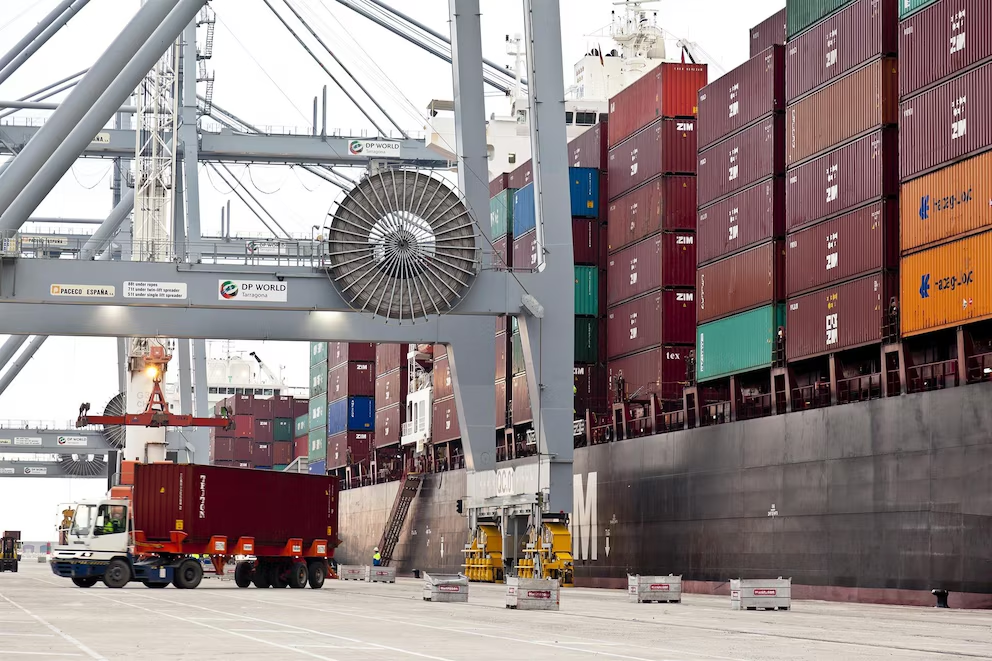
This firewall quickly becomes a business governance issue. Compliance stops being a back-office obligation and becomes a margin defense mechanism. The difference between compliant and non-compliant status can represent a double-digit tariff swing that alters pricing, contracts, and sourcing decisions. In integrated supply chains, the cost rarely stays with one firm. It spreads through suppliers, importers, and end consumers, influencing inventory strategy and investment timing.
The larger challenge is that the tariffs most likely to remain are the ones justified under national-security-style authorities. These sector duties are harder to attack legally and easier to defend politically because they are framed as strategic rather than purely fiscal. That is why the surviving list concentrates precisely where Mexico’s export model is most entangled with North American production. Continuing exposure includes a 25 percent tariff on automobiles, trucks, and auto parts with carve-outs linked to U.S. content, plus other high-rate duties such as 25 percent on kitchen cabinets and certain wood furniture. A 10 percent duty remains on buses and on softwood lumber and sawn wood. Metals sit at the sharpest edge: copper at 50 percent, and steel and aluminum at 50 percent, levels that signal industrial coercion rather than minor corrective policy.
This concentration effect is the structural story. Mexico may still export a large share under preferential conditions when products qualify under the agreement, but the tariffed share is not random. It clusters around sectors that generate maximum leverage: automotive manufacturing, metals, and selected industrial goods. These categories are high-volume, politically visible, and difficult to reroute quickly, which is exactly why they function as effective bargaining instruments.
The decision also reinforces a governance reality in Washington. When one legal channel is narrowed, tariff policy does not vanish; it migrates. The executive branch still retains statutory pathways to impose duties through different frameworks, and political incentives to use tariffs as leverage remain intact. For Mexico, this means the environment remains kinetic even as one legal dispute clarifies part of the map. Businesses gain a clearer sense of which tools are vulnerable, but they also learn that the tariff agenda can be rebuilt rather than abandoned.
For Mexican industry, the operational implications are immediate. Treaty compliance becomes the first line of defense, with renewed focus on origin verification, supplier certification, and documentation discipline. Sector risk becomes the main volatility source, especially in autos and metals. Political timing becomes an economic variable because tariff changes can be announced quickly and priced into decisions long before collection begins, shaping hedging, inventory placement, and capital expenditures.
Mexico’s public posture tends to emphasize prudence and impact assessment rather than escalation. That strategy preserves room to negotiate, but it also reflects a dilemma built into integration. Deep supply-chain integration is leverage because it binds economies together, yet it also creates hostage points where a tariff applied to one node can ripple through multiple industries across borders. The dispute stops being about abstract trade fairness and becomes a contest over who absorbs the shock: exporters, importers, consumers, or governments.
The bottom line is that the court ruling narrows Mexico’s most punitive exposure by removing a broad 25 percent penalty tied to noncompliance, but it leaves intact the sector tariffs that matter most to industrial trade. Compliance becomes the shield, security framing remains the sword, and the North American supply chain stays the arena where leverage is measured.
Hechos que no se doblan. / Facts that do not bend.