

 Phoenix 24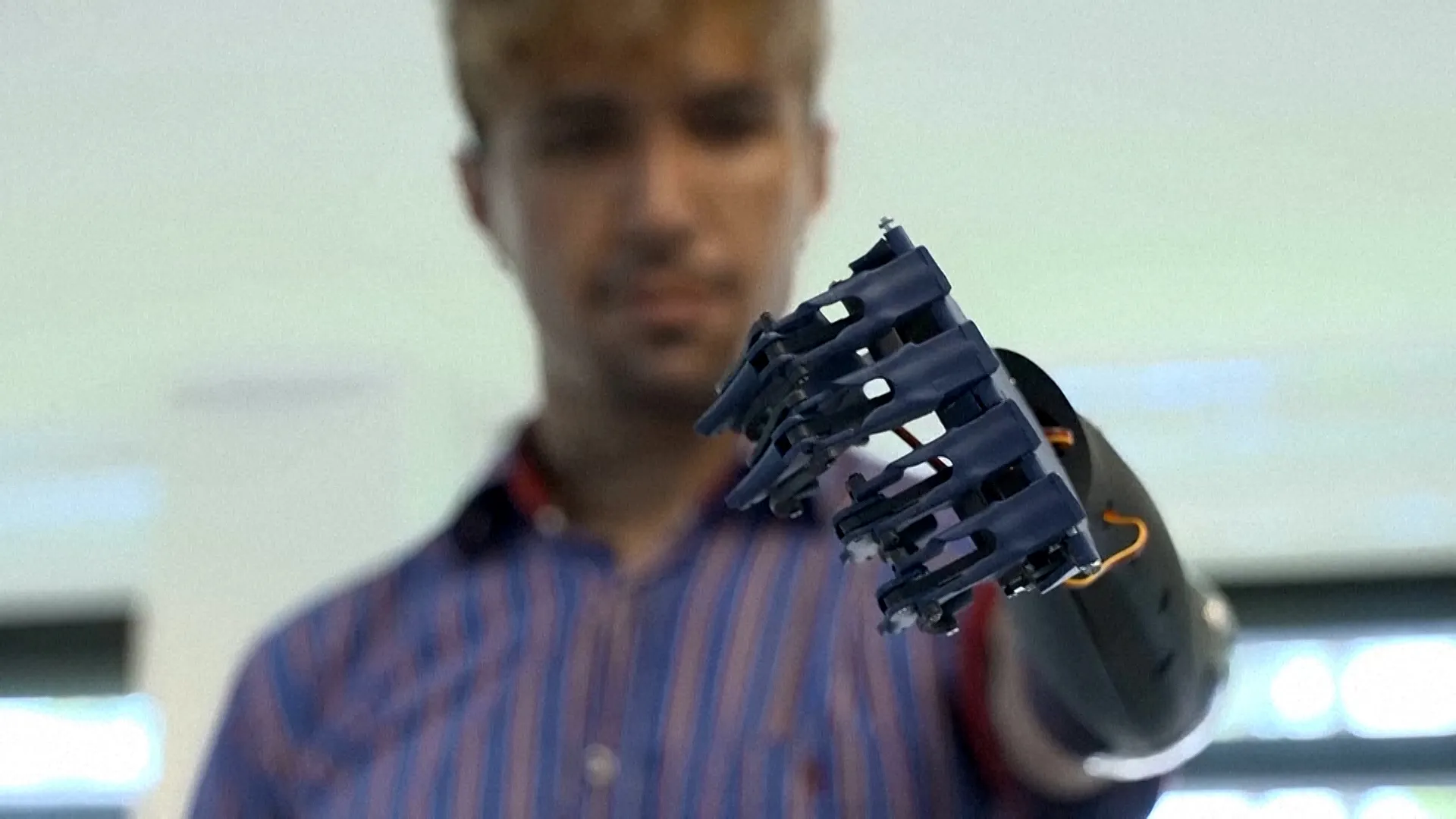
Innovation becomes real when complexity retreats.
Guadalajara, April 2026. What began as a childhood promise between two friends in Mexico has evolved into something far more consequential than an emotional science story. Researchers at the University of Guadalajara developed E Redi, a simplified robotic prosthetic arm designed to reduce the technological complexity that often discourages long term use. Behind the human narrative lies a more important structural question: whether Latin American innovation can move from symbolic ingenuity to scalable, socially useful engineering.
The project stands out because it does not chase sophistication for its own sake. Instead of building a prosthetic system overloaded with barriers to adaptation, the team focused on usability, accessibility, and practical learning time. E Redi allows different hand movements to be controlled through a single muscle sensor, an approach that aims to lower the entry threshold for users who might otherwise abandon more complicated devices. That design philosophy matters because in assistive technology, technical elegance often fails if the user experience remains punishing.
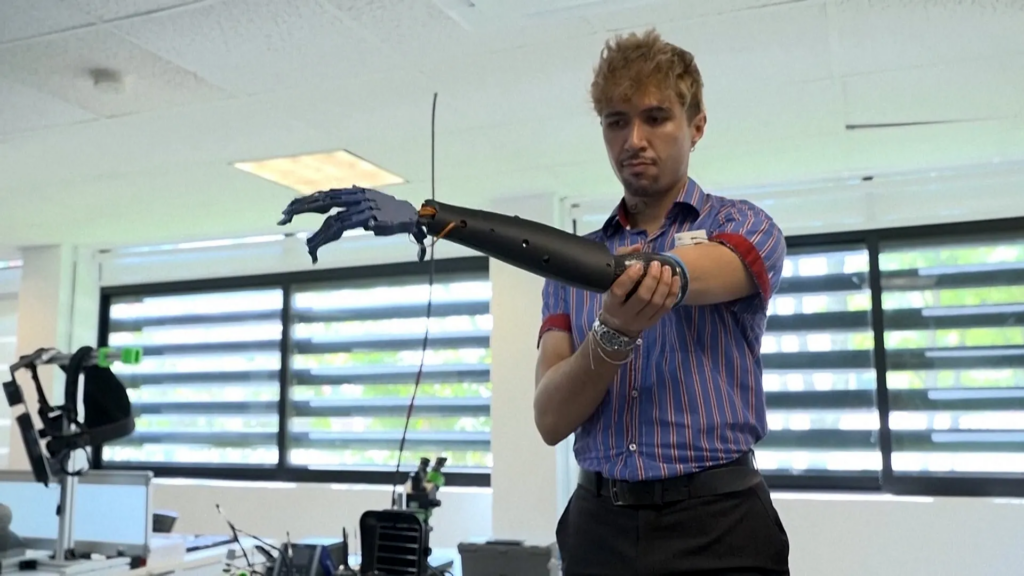
At the center of the story is Alberto Orozco, born with meromelia, a rare congenital condition involving partial absence of a limb, and Jorge Velazco, the mechanical designer who years earlier had jokingly promised to build him a bionic arm. What could have remained a sentimental anecdote instead became a thesis project and later a collaborative engineering effort under the direction of Dr Erick Guzmán. The result is not just a prototype shaped by friendship, but a proof of concept that places human need before technological vanity.
That is what gives the development broader significance. Too often, innovation ecosystems in emerging economies are celebrated for creativity but ignored when it comes to strategic industrial relevance. E Redi challenges that pattern by showing that meaningful technological intervention does not always begin with the most advanced or expensive architecture. Sometimes it begins with simplification, which in practical terms can be more disruptive than complexity because it improves adoption, lowers training friction, and expands real world accessibility.
The researchers themselves have framed adaptability as one of the project’s main goals. That point should not be underestimated. One of the persistent problems in prosthetics is not merely access to the device, but the time, cognitive effort, and frustration involved in learning to live with it. When a prosthetic becomes too difficult to master, the promise of inclusion breaks down into abandonment. E Redi enters that problem directly by treating speed of adaptation as a central engineering challenge rather than a secondary clinical inconvenience.
This also opens a larger conversation about the political economy of assistive robotics in Mexico and across Latin America. A region marked by inequality, uneven health access, and fragmented innovation financing cannot afford to develop only prestige technologies that remain distant from ordinary users. It needs devices that can travel from laboratory logic into social reality. In that sense, E Redi is important not because it represents a futuristic leap, but because it suggests a model of innovation grounded in constraint, affordability, and human centered design.
There is also a quiet educational message embedded in the story. The project emerged from a university environment where personal biography, technical knowledge, and institutional mentorship converged into a usable prototype. That is exactly the kind of ecosystem many countries claim to want but rarely sustain: one in which higher education does not merely produce papers or ceremonies, but applied solutions tied to lived problems. The symbolic value of that matters for Mexico’s scientific identity, especially when national conversations about technology often oscillate between imported dependency and inflated rhetoric.
Future versions of the device may integrate voice commands alongside muscle activity, which suggests the team is already thinking beyond a static prototype. Yet the true power of this development does not lie in possible future features alone. It lies in the fact that the current design already redefines what counts as success. Instead of asking whether the prosthetic is as advanced as the most expensive devices on the global market, the more relevant question is whether it can be learned, accepted, and incorporated into daily life by the people it is meant to serve.
That shift in perspective is strategically important. Around the world, robotics is often narrated through military systems, industrial automation, humanoid spectacle, or venture capital mythology. E Redi points in another direction. It reminds us that some of the most meaningful robotic advances are those that restore agency at the scale of the body, not only productivity at the scale of the factory. In that sense, this Mexican project belongs not to the realm of technological curiosity, but to the deeper struggle over who innovation is truly for.
What makes this story endure is that it joins emotion with engineering without collapsing into sentimentality. The promise of a child became a technical system, but the technical system only matters because it may reduce exclusion for others. That is where the article’s real force lies. E Redi is not merely a robotic arm. It is a challenge to the idea that serious technological innovation must emerge only from the wealthiest laboratories, the largest companies, or the most complex machines. Sometimes the future arrives not by becoming more intimidating, but by becoming more usable.
Detrás de cada dato, hay una intención. Detrás de cada silencio, una estructura.
Behind every data point, there is an intention. Behind every silence, a structure.