

 Phoenix 24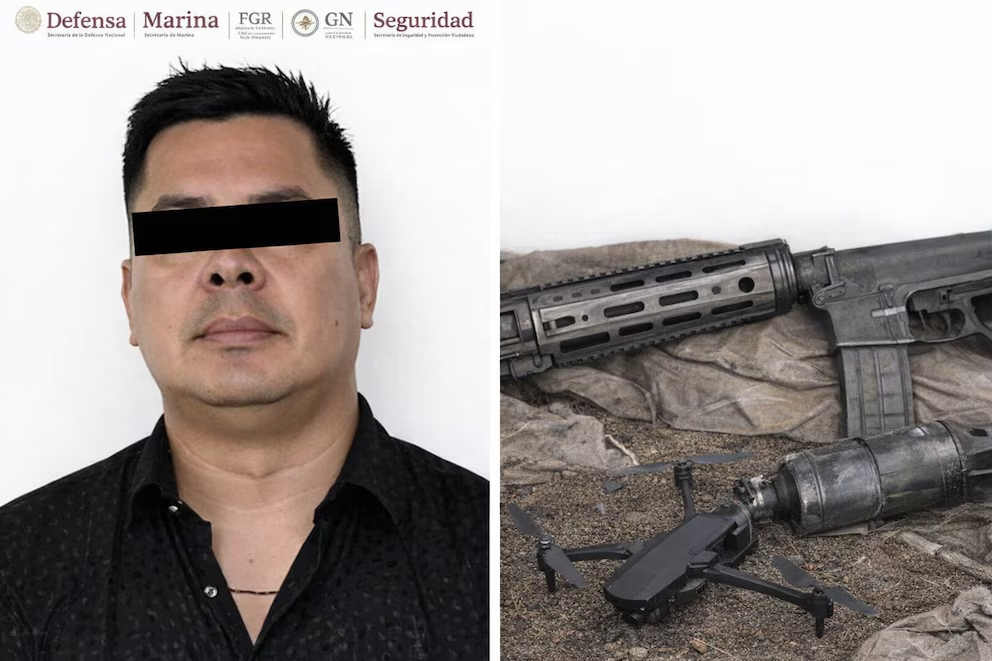
The battlefield is no longer only territorial.
Hermosillo, June 2026. Mexican federal and state authorities captured Hugo “N,” alias “El 01,” identified as a priority criminal target and alleged generator of violence with operational presence in Sonora and Chihuahua. The arrest places renewed attention on the technological mutation of organized crime in northern Mexico, where criminal cells are no longer relying only on firearms, convoys and territorial intimidation, but also on aerial devices adapted for attacks against rivals, authorities and civilian spaces.
According to security authorities, “El 01” is linked to high-impact crimes and to the alleged use of drones in attacks associated with organized criminal activity. He has been connected to Los Salazar, a regional structure tied to the broader orbit of the Sinaloa Cartel and its internal factions. His detention in Sonora is therefore not only another capture in the long list of arrests against cartel operators, but a sign of how criminal command structures are adapting to more flexible, mobile and technologically assisted forms of violence.
The operational meaning is significant. Drones allow criminal groups to observe, threaten, attack and psychologically pressure communities without exposing personnel in the same way as traditional armed incursions. Their use modifies the logic of territorial conflict because violence can now arrive from above, at lower cost and with a higher capacity to generate fear. In regions where state presence is fragmented, this type of tool gives criminal organizations a tactical advantage that exceeds the symbolic shock of the device itself.
Sonora and Chihuahua form part of a strategic corridor where organized crime intersects with drug routes, migrant flows, weapons trafficking and disputes over local control. In that geography, the arrest of an alleged operator connected to drone attacks suggests that criminal innovation is not limited to one cartel or one state. It reflects a broader pattern in which illicit groups absorb commercial technologies and convert them into instruments of coercion, surveillance and asymmetric aggression.
The case also underscores the pressure facing Mexican security institutions. Capturing a figure like “El 01” may disrupt a specific cell, but it does not automatically neutralize the technological learning already incorporated into criminal practice. Once a method proves useful, it can be replicated by rival groups, outsourced to smaller cells or adapted to new terrains. That is why the challenge is not merely detaining operators, but building the intelligence, forensic and regulatory capacity to anticipate the next operational leap.
For Mexico, the drone factor marks a dangerous escalation. It blurs the boundary between street-level violence and low-cost tactical warfare, forcing authorities to treat organized crime as a hybrid threat that combines territorial control, digital adaptation and paramilitary behavior. The capture in Sonora may represent a tactical success, but the deeper warning is structural: criminal organizations are learning faster, cheaper and with fewer institutional constraints than the state can comfortably tolerate.
Against propaganda, memory. / Contra la propaganda, memoria.