

 Phoenix 24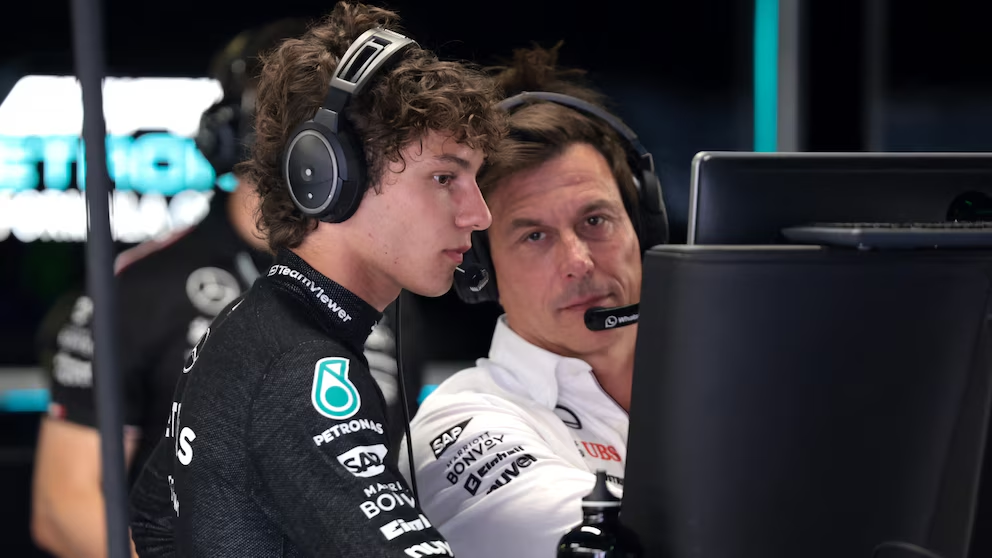
When potential collides with pressure, even prodigious talent can stumble.
Monza, September 2025.
The Italian Grand Prix was meant to be a celebration for Mercedes’ young promise, Kimi Antonelli, racing on home soil before a crowd eager to see if the teenager could translate potential into points. Instead, it became the first true moment of public friction between the rookie and team management. After a series of errors over the weekend, Mercedes team principal Toto Wolff spoke with unusual frankness, admitting disappointment and making clear that expectations had not been met. His remarks marked a turning point in the narrative around Antonelli, who had until now been shielded from direct criticism.
The weekend began poorly during practice, where Antonelli crashed and limited his running time. That misstep curtailed his preparation and placed him on the back foot heading into qualifying. When Sunday’s race arrived, he fought bravely but made contact with Williams driver Alex Albon, a mistake that earned him a five-second penalty. Initially crossing the line in eighth, Antonelli dropped to ninth once the penalty was applied, turning what could have been a minor triumph into another reminder of his inconsistency. For Wolff, the verdict was simple: Antonelli had shown flashes of speed but had made too many errors, and the car itself was not yet at a level to compensate. The team principal summarized the weekend as disappointing, leaving little room for ambiguity.
Yet Wolff was careful not to abandon his long-term vision. He reiterated that Antonelli is still an extraordinary talent and that Mercedes will stand by him as he learns. “We know the car is not where it needs to be, and Kimi has to grow into this environment. It takes time,” Wolff explained in his post-race reflections. The statement underscored a balance between critique and support, a signal both to Antonelli and to the wider paddock that Mercedes remains invested in its rookie but will not shy away from demanding accountability.
Behind the scenes, Mercedes’ engineering director James Allison offered another perspective. He noted that recent upgrades to the rear suspension had inadvertently unsettled the car’s balance, a factor that disrupted both Antonelli’s and George Russell’s performance. By stressing the technical side of the equation, Allison sought to protect his young driver and reframe the conversation around development rather than failure. It was a reminder that in Formula 1, performance is never the product of a single variable but of the complex relationship between man and machine.
For Antonelli, the Monza experience carried symbolic weight. To compete at home as the heir to Italy’s racing tradition placed him under intense scrutiny. Every camera followed his movements, every headline amplified his mistakes, and every fan expected heroics. At 19, he faced not only the physical demands of Formula 1 but also the emotional burden of expectation. The penalty with Albon, though minor in racing terms, became a magnified error under the lights of Monza. For many rookies, such weekends are part of the learning curve, but for Antonelli, the spotlight makes them harder to escape.
The episode reveals broader truths about Mercedes’ current position. The team is caught between eras, no longer the dominant force of the Hamilton-Rosberg years but still searching for a return to the top. In this transition, nurturing a rookie like Antonelli is both a gamble and a necessity. Mistakes will occur, but Mercedes must weigh how much patience it can afford in a championship where rivals exploit every weakness. Wolff’s public critique can be read not as a rejection of Antonelli but as a signal that the margin for indulgence is narrowing.
Among fans, the reaction has been mixed. Supporters in Italy expressed frustration at the penalty and disappointment at what felt like a lost opportunity. Others, however, see the season as a necessary apprenticeship, a year in which Antonelli must endure setbacks to mature into the driver Mercedes hopes he will become. On social media, discussions ranged from calling for patience to questioning whether Mercedes had promoted him too quickly. This split in perception mirrors the reality: Antonelli embodies both promise and uncertainty, and his trajectory will depend on how he responds to pressure.
Looking ahead, Antonelli’s challenge is not only to eliminate errors but to show resilience. In Formula 1, talent is abundant, but the capacity to rebound from failure defines careers. For Mercedes, Monza may be remembered as the weekend when protection gave way to expectation, when the rookie label began to carry the weight of accountability. For Antonelli, it will serve as a reminder that every lap is scrutinized and every mistake magnified, but also that growth is forged in precisely these crucibles.
The story of Monza is not one of collapse but of confrontation with reality. Antonelli stumbled, Mercedes voiced its concerns, and the world watched. What happens next will determine whether the Italian teenager rises from criticism to carve his place among the elite, or whether the weight of expectation proves heavier than the promise of talent.
Phoenix24: clarity in the grey zone.
Phoenix24: claridad en la zona gris.