

 Phoenix 24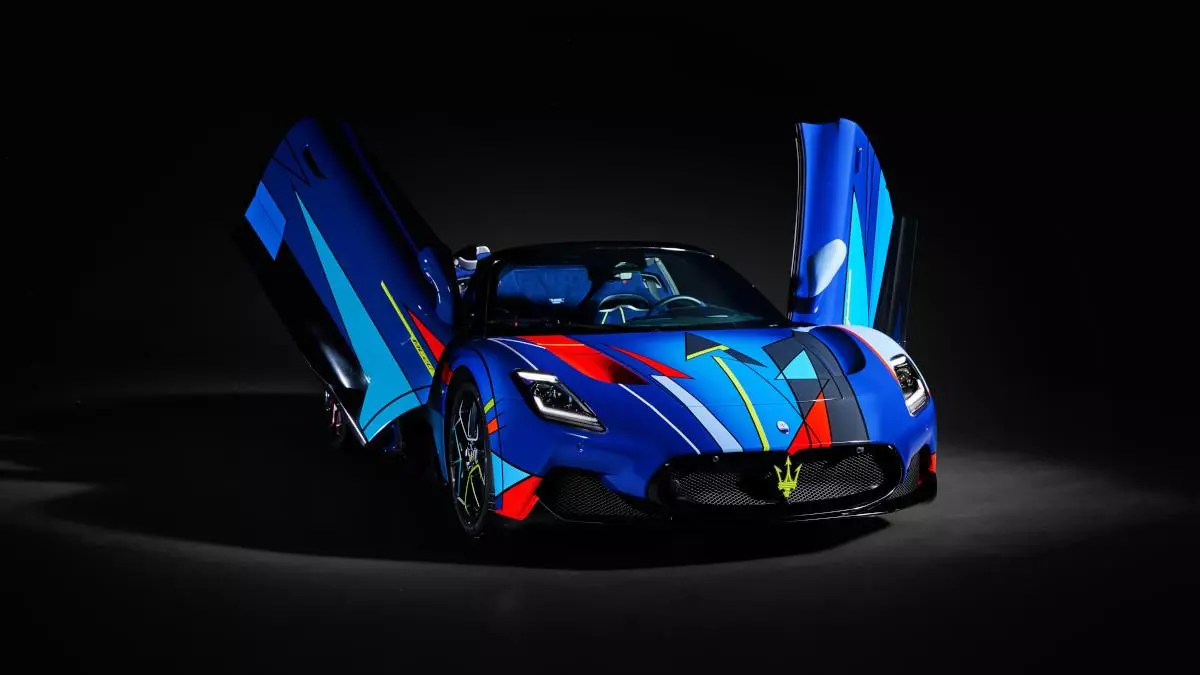
Art redefines speed.
Modena, November 2025. Maserati has introduced a version of the MC20 Cielo that challenges the boundaries between automotive engineering and contemporary art, framing the supercar not simply as a machine but as a crafted objet d’art built to provoke emotion as much as adrenaline. The “Opera d’Arte” edition, developed through the brand’s Fuoriserie bespoke division, transforms every exterior surface into a hand-painted composition inspired by abstract visual language. It is a bold move from a manufacturer navigating the pressures of electrification, luxury-market fragmentation and renewed competition, yet intent on reaffirming that Italian performance design can still operate simultaneously on the aesthetic and mechanical frontier.
The foundation of the model is the MC20 platform, powered by the in-house Nettuno V6 twin-turbo engine, an architecture that marked Maserati’s return to self-developed powertrains. Lightweight carbon-fibre monocoque construction, an open-air Cielo configuration and aerodynamic sculpting constitute its technical spine. What distinguishes the Opera d’Arte edition is the deliberate choice to treat the car’s body as a curated surface. Fifteen hand-applied colours, layered textures and meticulous gradients converge to create a visual experience that changes under different light conditions. This is not decorative painting but an attempt to merge performance engineering with an artistic ethos historically absent from series-production supercars.
The emotional narrative surrounding the car is intentional. Maserati is navigating a luxury landscape where the traditional metrics of speed and horsepower compete with personalisation, symbolism and cultural capital. As electric vehicles proliferate and performance differentials narrow, legacy brands increasingly rely on identity to maintain relevance. The Opera d’Arte seeks to provide precisely that: an object positioned at the intersection of art collection, high-craft manufacturing and elite motoring. The risk is inherent; in a market dominated by algorithmic optimisation and industrial efficiency, dedicating artisanal hours to each car is costly and unscalable. Yet the reward is exclusivity, and exclusivity has always been the currency of Italian automotive prestige.
The decision also engages several global dynamics. In Europe, automotive critics see the model as a counter-narrative to the regulatory pressure pushing brands toward electrified homogeneity. In Asia, where luxury consumption thrives on emotional storytelling and design icons, the Opera d’Arte is expected to resonate strongly with buyers who view vehicles as cultural extensions rather than functional instruments. In North America, the car’s artistic positioning speaks to a collector demographic that increasingly blends automotive acquisitions with fine-art investment.
Technically, the MC20 Cielo remains a formidable machine. Its carbon-fibre monocoque ensures torsional rigidity suited for both track performance and road comfort. The engine’s pre-chamber combustion system, derived from motorsport applications, gives the car a distinctive power signature that sets it apart from competitors. The retractable electrochromic roof retains the dual personality of a coupé and an open-top sports car, enabling the visual artistry of the Opera d’Arte to be experienced in both confined and expansive driving settings. The fact that Maserati chose to introduce such an edition at this moment—while many competitors consolidate platforms rather than diversify them—signals confidence in its long-term brand trajectory.
The edition also reveals internal strategic priorities. Maserati is working to reposition itself against both European rivals and rising Asian luxury brands. By emphasizing artisanal expression, the company reinforces a narrative that aligns with Italian cultural heritage: craftsmanship as identity, beauty as engineering logic, performance as emotional output. This approach has resonance but also exposes the brand to scrutiny regarding scalability, environmental expectations and future-proof product strategies. Whether the Opera d’Arte becomes a one-off milestone or evolves into a wider design language will shape Maserati’s competitive profile for years.
The challenge, however, lies beyond aesthetics. Global luxury markets are affected by supply-chain instability, rising component costs and shifting regulations on emissions and materials. A combustion-powered supercar painted as a mobile artwork sits at the crossroads of desirability and regulatory tension. In Europe, the tightening regulatory framework will eventually constrain such vehicles, while in North America the cultural appetite for high-performance internal-combustion engines remains vibrant but politically pressured. In Asia, expanding luxury markets offer opportunity but demand constant innovation and differentiation. Maserati’s bet is that a piece of automotive art can transcend these constraints by appealing to an archetype older than engines: the desire to possess something irreducibly unique.
What cannot be ignored is the symbolic dimension. The MC20 Cielo Opera d’Arte is an argument against uniformity in an age defined by platform convergence. It asserts that technology and artistry need not compete, that mechanical precision can coexist with human expression. Whether the market responds with enthusiasm or skepticism will depend on how effectively Maserati communicates the car’s identity—not just as a vehicle but as a narrative. In a global environment saturated with increasingly similar machines, the most distinct stories may ultimately dictate value.
The Opera d’Arte stands as a reminder that automotive culture is entering an era where design, craftsmanship and emotion are equal pillars to performance. It is a provocation from Modena, a demonstration that in the pursuit of speed, beauty still matters, and that in the pursuit of beauty, speed can become meaning.
Truth is structure, not noise. / Truth is structure, not noise.