

 Phoenix 24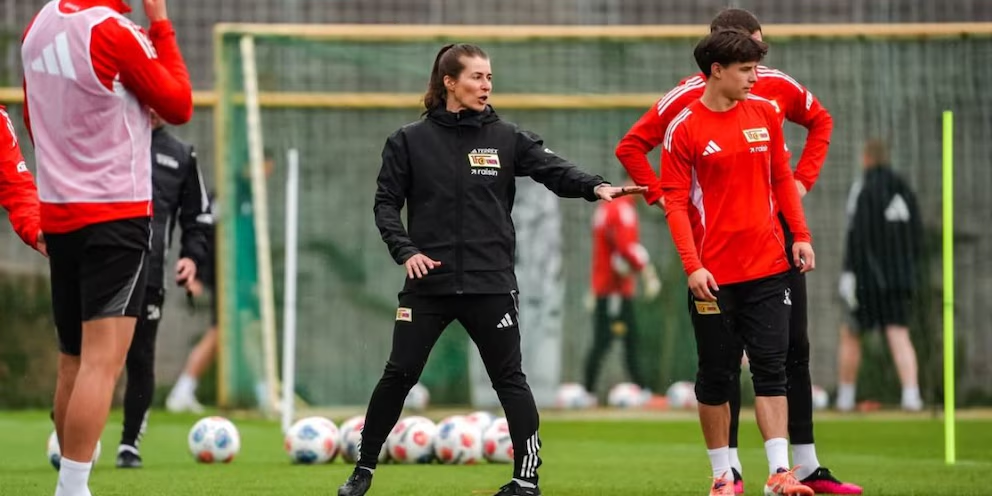
History arrives when institutions finally move.
Berlin, April 2026. Marie-Louise Eta has become one of the most symbolically important figures in German football after taking charge of Union Berlin’s men’s team on an interim basis, making history as the first woman to serve as head coach of a Bundesliga side. The milestone is not just personal and not merely statistical. It marks a breach in one of the sport’s most guarded institutional thresholds, where coaching authority in elite men’s football has long remained coded as male even when women have already proven technical capacity across the wider game.
Eta did not emerge from nowhere. Before entering coaching, she built a serious playing career, winning major honors in women’s football and later moving into technical roles that gave her credibility inside the German system. Her appointment at Union Berlin follows years of work as a coach rather than a symbolic gesture designed for headlines. That matters because history in football often becomes easier to dismiss when institutions frame it as novelty instead of earned progression.
The context of the appointment is also important. Union Berlin turned to Eta after a difficult stretch that placed the club under pressure, which means she was not brought in for ceremonial visibility but for competitive necessity. In other words, the club handed her a real problem, inside a real relegation-sensitive environment, under the scrutiny that comes with top-flight football. That alone changes the meaning of the moment. She was not invited to represent change abstractly; she was asked to manage risk, tactics, and results.
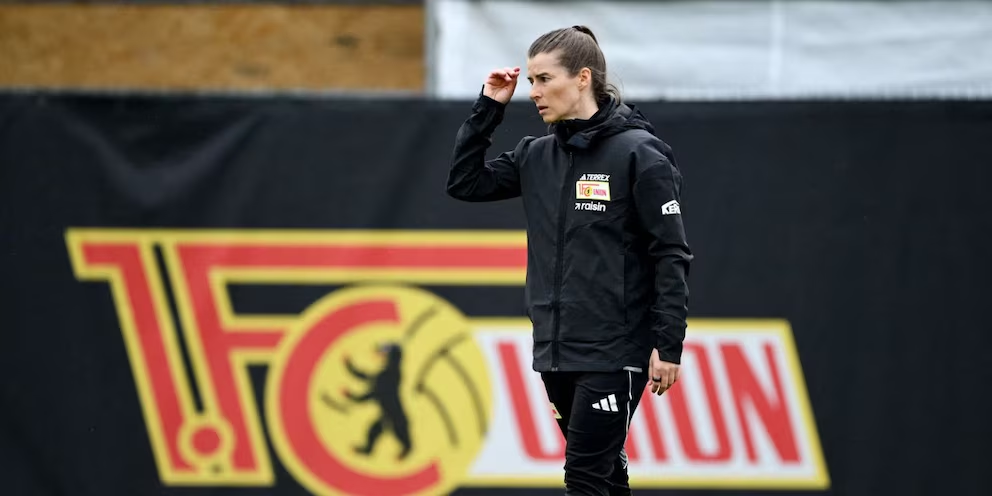
That distinction is crucial because elite football still tends to celebrate female breakthroughs while quietly isolating them. A woman can be praised as historic and still be treated as exceptional rather than as evidence that the system itself has been artificially closed. Eta’s rise exposes that contradiction. If she is qualified enough to lead a Bundesliga team in crisis, then the real story is not only her achievement, but the lateness of the structure in allowing it.
Her first match in charge did not produce a fairytale outcome, but that almost makes the episode more important. Once a coach is judged through performance, adaptation, and tactical execution rather than through symbolic sentiment, the barrier begins to lose its old cultural force. Eta herself has emphasized the team over her personal spotlight, which suggests an awareness that pioneering figures are often trapped by narratives larger than their daily work. The stronger move is to normalize competence faster than the media can exoticize it.
What makes this moment resonate beyond Germany is that men’s football remains one of the last major public stages where institutional masculinity still operates with unusual stubbornness. Women have already transformed refereeing, executive roles, youth development, analysis, and assistant coaching across Europe. The head coach position in a top men’s league, however, has retained a myth of exclusivity that now looks more ideological than technical. Eta’s appointment does not complete that change, but it punctures the myth at a very visible level.

The broader significance, then, is not that a woman made history. It is that German football has been forced to reveal how much history was being delayed by culture rather than by merit. Eta now stands at the intersection of performance and symbolism, where every result will be overread and every decision will carry disproportionate weight. But that is precisely how structures begin to change: first through exception, then through repetition, and finally through the disappearance of surprise. Her appointment matters because one barrier has fallen. It matters even more because others are now harder to defend.
Behind every data point, there is an intention. Behind every silence, a structure.