

 Phoenix 24
The land remembers what power erases.
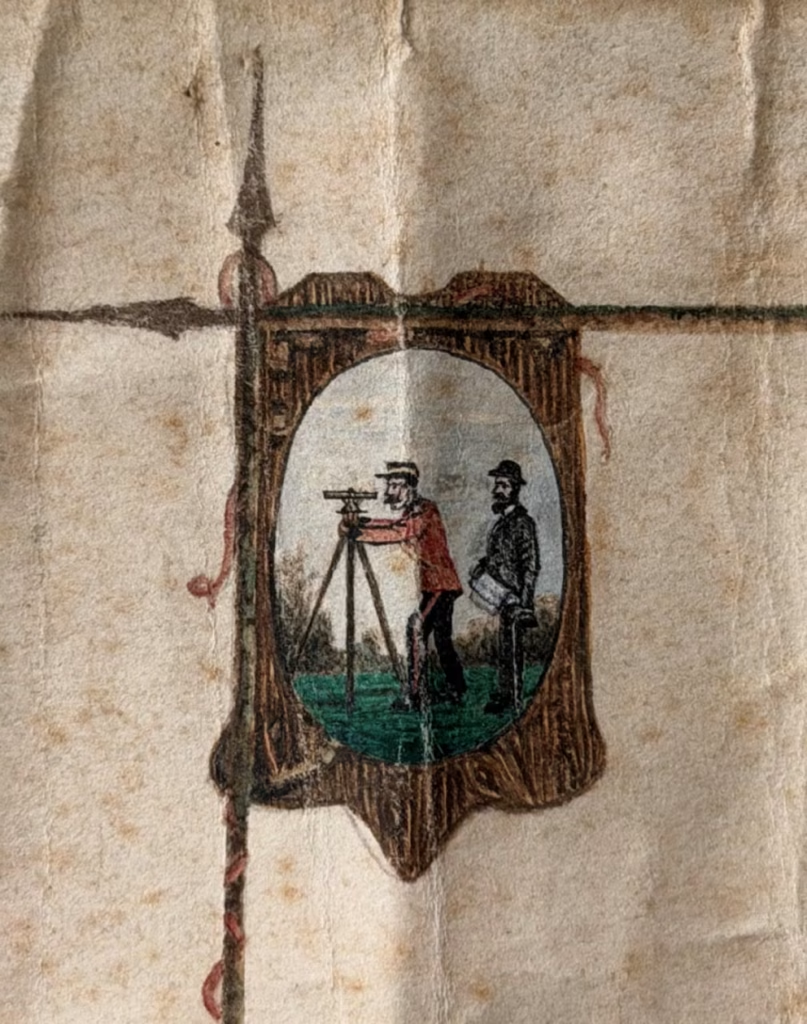
Dublin, June 2026. Maggie O’Farrell’s new novel Land returns to post-famine Ireland through a story rooted in family memory, cartography and historical trauma. Inspired partly by the work of her own great-great-grandfather on British mapping projects, the novel follows a father and son across a wounded Irish landscape where geography becomes inseparable from grief.
The premise is deceptively simple. A mapmaker enters the terrain to measure, record and define land after catastrophe. But O’Farrell’s fiction turns that act into something morally charged, because mapping is never neutral when the territory has already been marked by hunger, displacement and colonial power.

In Land, Ireland is not only a setting. It becomes an archive. Fields, roads, wells and coastlines carry traces of the Great Famine that official records often failed to hold with sufficient human weight. The novel asks what happens when a state can chart property lines but cannot fully register suffering.
O’Farrell’s literary strength has long been her ability to recover lives pushed to the margins of history. In Hamnet, she reimagined Shakespeare’s family through grief and domestic intimacy. In Land, she widens that method toward national memory, using one family’s inheritance to explore how private stories survive inside public catastrophe.
The figure of the mapmaker is especially powerful. He works within a system of imperial measurement, yet he also confronts the emotional truth of what measurement cannot contain. Every line drawn across the page risks becoming both documentation and erasure.
That tension gives the novel its contemporary force. In an age obsessed with data, borders and territorial control, O’Farrell reminds readers that maps are political instruments as much as technical objects. They define ownership, visibility and legitimacy. They decide what is named, what is ignored and who gets to describe a place.
The post-famine frame also keeps the book from becoming simple nostalgia. Ireland’s Great Hunger was not merely a historical tragedy; it was a rupture whose effects traveled through migration, language, memory and family silence. O’Farrell appears to understand that inherited trauma is often preserved less through official documents than through fragments, myths and unfinished stories.
The result is a novel positioned between historical fiction and moral excavation. Land does not only ask readers to imagine Ireland after famine. It asks them to consider who has the authority to draw the world after devastation, and whether literature can restore human depth to landscapes once reduced to lines.
La verdad es estructura, no ruido. / Truth is structure, not noise.