

 Phoenix 24
When silence becomes a launch strategy.
New York, April 2026. Madonna has turned digital disappearance into a form of announcement. By deleting all prior content from her Instagram account, changing her profile image, and rewriting her bio with a line associated with one of her most iconic dance eras, she has reignited speculation around a possible sequel to Confessions on a Dance Floor. The move does not read as random cleanup or personal retreat. It reads as choreography. In the language of contemporary pop, erasure is often the first form of revelation.
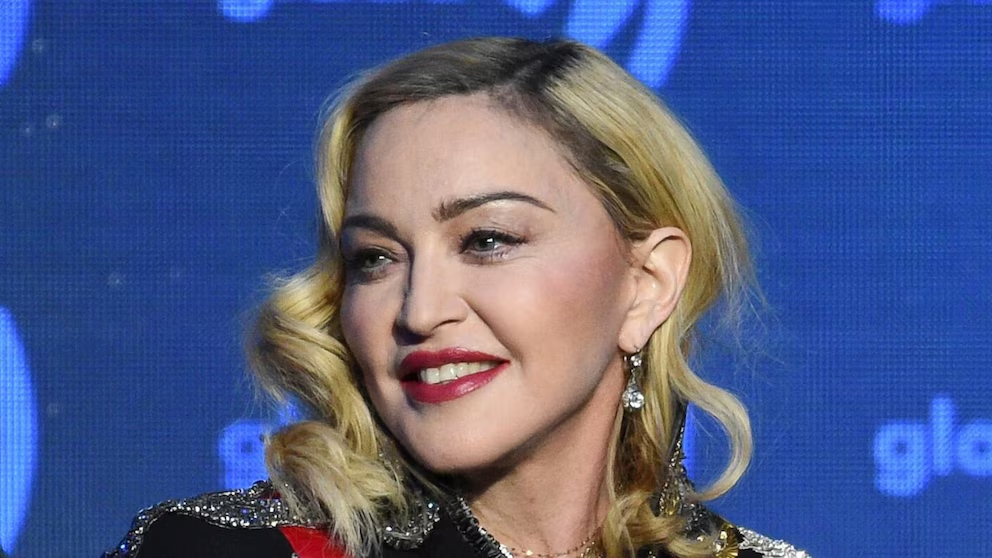
What makes the gesture effective is that audiences now understand visual reset as coded communication. Major artists no longer need to explain every step when fans, media, and industry observers have learned to interpret deletion, symbolism, and lyrical callbacks as deliberate signals. In Madonna’s case, the strategy works especially well because Confessions on a Dance Floor remains one of the most recognizable reinventions of her career, a record closely associated with electronic pop, nightlife mythology, and a late-stage artistic rebirth. To invoke that era is to activate one of the strongest memory reservoirs in her catalog.
The speculation gains force because it fits a longer pattern rather than appearing from nowhere. Over time, there have been signs that Madonna was circling back toward that sonic universe, including renewed creative movement and suggestive references to a continuation of that chapter. What matters here is not simply whether a sequel is formally confirmed. What matters is the architecture of anticipation. Pop power today depends not only on the finished product, but on the controlled buildup of atmosphere around its possibility.

There is something especially revealing in the way Madonna manages expectation. She does not merely promote music. She constructs a climate. A wiped feed, an altered image, and a strategically suggestive identity reset create a field of partial information that keeps public attention in motion. In the current entertainment economy, mystery itself functions as capital. Audiences do not only consume announcements. They consume the speculation before the announcement, the decoding before the product, the emotional charge of not yet knowing.
That dynamic fits Madonna particularly well because reinvention has always been central to her authority. She is not an artist whose cultural power depends only on consistency or nostalgia. Her legacy is built on the ability to reframe herself without surrendering authorship. That is why even a seemingly simple digital gesture carries weight. It is interpreted not as passive marketing, but as intentional narrative design. She understands that in pop culture, the reset can be as important as the release.
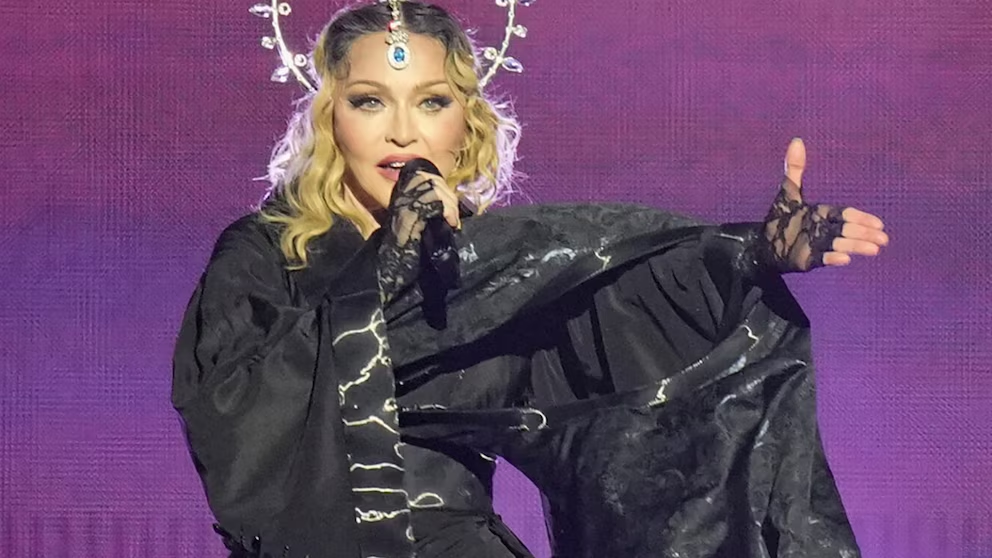
The deeper significance of this moment lies in what it says about memory and control. If a new project connected to Confessions does emerge, it will not simply function as a sequel to a beloved album. It will operate as a negotiation between past triumph and present relevance. Madonna is returning, potentially, not to repeat herself, but to test whether a previous aesthetic empire can be reactivated under new cultural conditions. That is a much harder task than nostalgia usually admits.
What we are watching, then, is not merely a rumor cycle around an iconic pop figure. It is a demonstration of how veteran artists still command the digital stage by turning absence into signal and silence into speculation. Madonna’s feed may be empty, but the cultural mechanism behind it is full. In that tension between disappearance and announcement, she continues to prove that the art of pop power is not only in what is shown, but in what is withheld.
Detrás de cada dato, hay una intención. Detrás de cada silencio, una estructura.
Behind every datum, there is an intention. Behind every silence, a structure.