

 Phoenix 24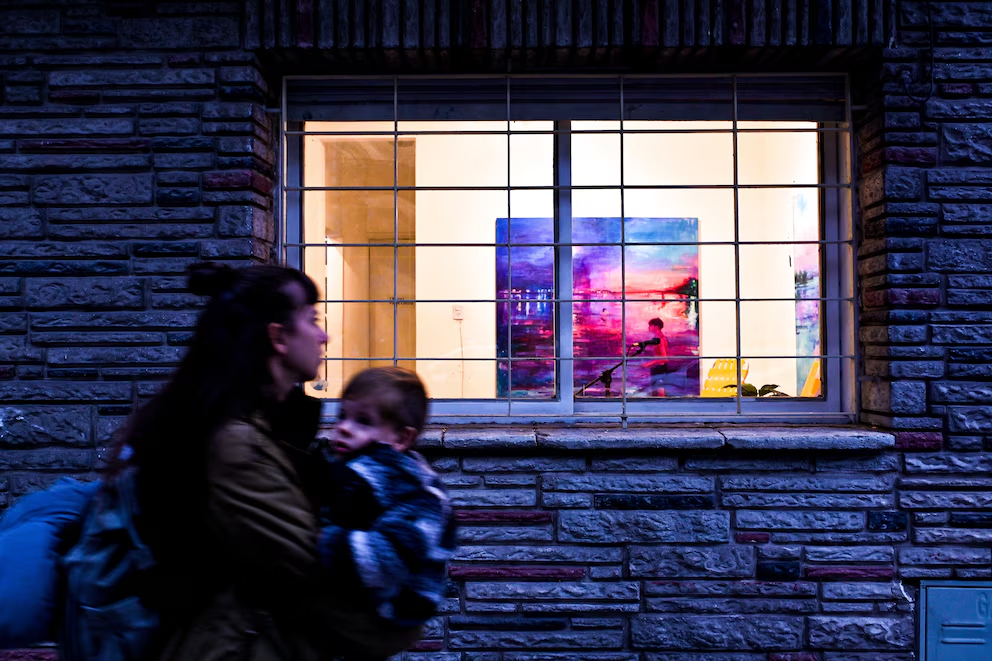
Infinite Windows connects private worlds and shifting landscapes.
BUENOS AIRES, ARGENTINA — July 2026.
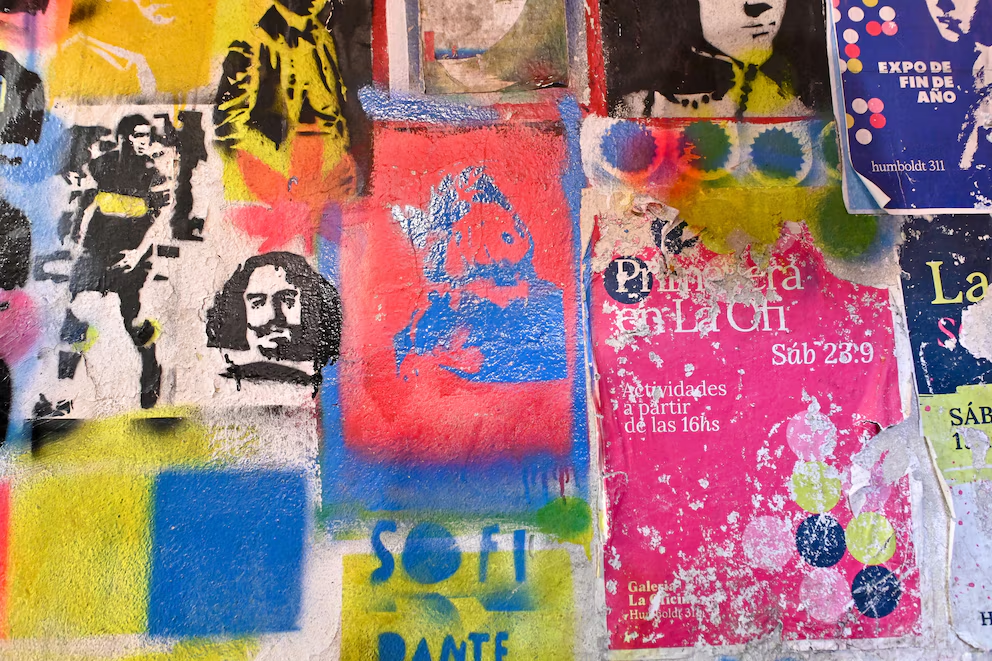
La Oficina has joined Villa Crespo’s growing contemporary art circuit with Infinitas ventanas, an exhibition bringing together paintings by Paula Cecchi and Pablo Noce. The gallery’s arrival at Humboldt 311 strengthens a neighborhood already recognized for its dense concentration of independent galleries, studios and cultural initiatives. Directed by Roma Godoy, the space combines artistic research, production, exhibitions, education and curatorial development within a program centered primarily on drawing and painting. Its opening in Villa Crespo represents both a territorial relocation and an effort to participate more actively in Buenos Aires’s evolving cultural landscape.
The project was originally founded in 2010 in the Once neighborhood as a workshop shared by Cecchi and Noce. Over time, it expanded beyond studio practice to include a school, exhibition programming and support for artists developing new creative and curatorial processes. La Oficina now seeks to connect its internal work with a broader urban community characterized by intense cultural, social and architectural diversity. Its presence in Villa Crespo places the gallery near other institutions that have transformed the district into one of the city’s most dynamic artistic destinations.
Infinitas ventanas presents two pictorial languages that develop independently while repeatedly approaching, touching and separating from one another. The exhibition explores the relationship between exterior and interior spaces, everyday experience and emotional perception, as well as visible scenes and meanings that remain unresolved. Small gestures, formal tensions and shifting horizons create passages through which viewers can move between the artists’ distinct sensibilities. Rather than offering a single narrative, the exhibition treats each painting as an opening toward another psychological, visual or temporal territory.
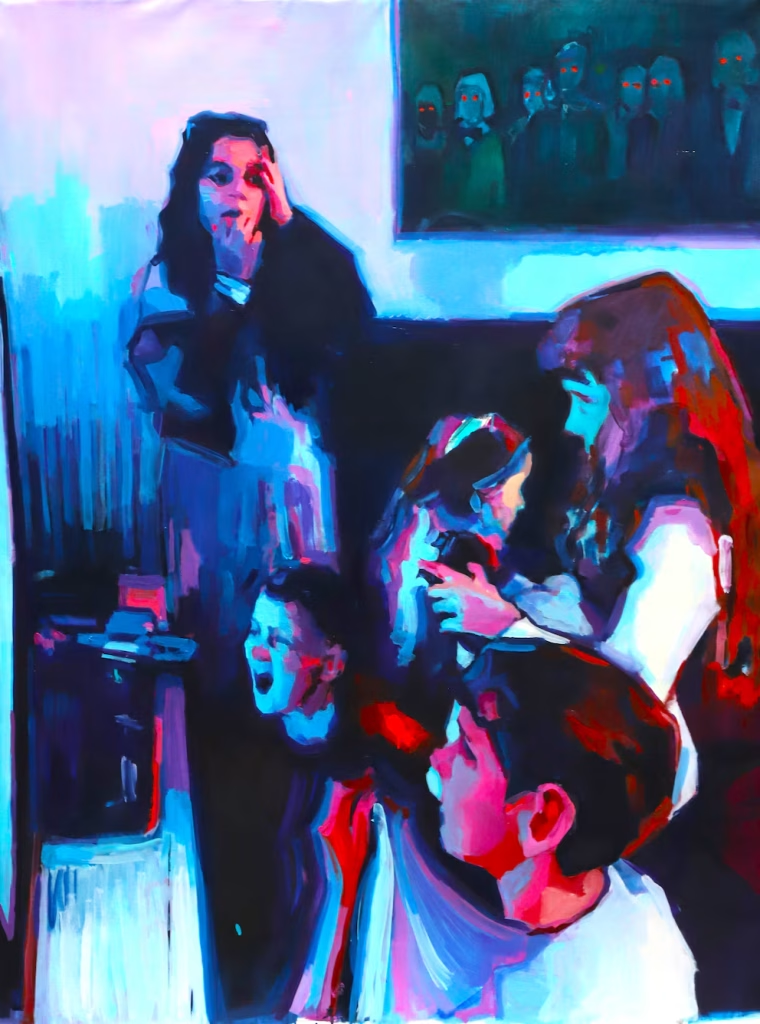
In Noce’s works, natural and digital realities coexist within simultaneous scenes that resist conventional transitions. Light falling across the green surface of a leaf may appear beside the glow of a screen displaying a video game, creating two planes that occupy the same space without fully communicating. These juxtapositions reflect the contemporary demand to inhabit several realities at once, moving continuously between physical environments and technologically mediated experiences. The threshold in his paintings is therefore not a comfortable entrance, but a risky and unavoidable leap between different modes of perception.
Noce describes his practice as an attempt to capture a specific moment, quality of light or sensation of time within a space. Working directly from observation allows him to identify what he considers essential before translating it into the structure and atmosphere of a painting. His images do not simply reproduce recognizable environments, because their emotional force emerges from the unstable relationship between elements that appear close yet remain psychologically distant. This tension gives his work a quiet uneasiness, suggesting that coexistence does not necessarily produce connection or mutual understanding.
Cecchi moves the exhibition’s central idea toward intimate experience through portraits of middle-aged women and the spaces they have constructed, inhabited and reconsidered over time. Her paintings emerge from attentive listening and personal closeness, converting another person’s life experience into color, gesture and emotional atmosphere. Each portrait opens a private territory without completely explaining the individual represented, allowing uncertainty to remain part of the encounter. The artist understands every window as a possible story, a frame through which memory, identity and transformation become visible without being fully resolved.
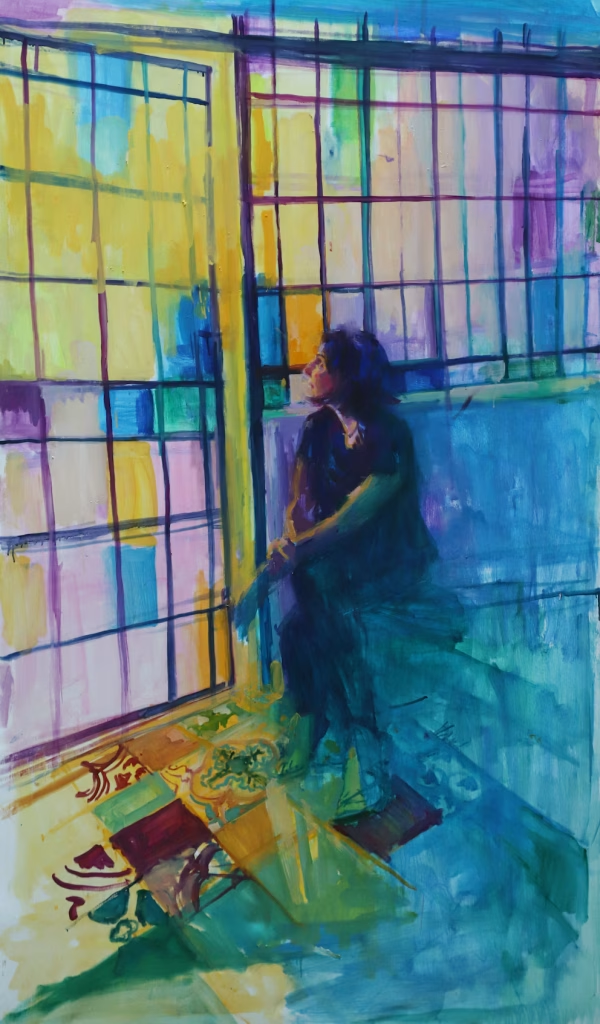
Another element of Cecchi’s work involves swimmers and the circular movement associated with water, repetition and the passage of life. These images suggest that a biography might be narrated through the act of swimming, with physical motion becoming a metaphor for persistence, change and return. Her broader practice explores how interior and exterior worlds are built over the years and subsequently deconstructed through age, experience and changing relationships. Instead of imposing a definitive interpretation, the paintings preserve the sensation produced by another person and translate that response into a visual language.
Godoy frames the exhibition as a collection of countless passages between the artists, including their similarities, differences and transitions. The title revisits the classical idea of painting as a window onto the world, while expanding it into a reflection on how individuals approach unfamiliar people and realities. Opening doors and windows becomes a symbolic gesture against hypervigilance, isolation and fear of others within contemporary urban life. The gallery therefore presents aesthetic experience as a possible interruption of defensive habits that restrict communication and emotional openness.
La Oficina’s broader program connects painting and drawing with literature, philosophy and aesthetics while encouraging exchange with creative centers outside Buenos Aires. The institution intends to accompany artists through both production and exhibition, rather than functioning solely as a commercial display venue. It also seeks to establish itself as a cultural agent embedded within Villa Crespo, responding to the neighborhood instead of simply occupying a physical address. This model reflects the increasingly important role of independent galleries as spaces for education, dialogue, experimentation and community formation.
Noce and Cecchi were both born in Buenos Aires in 1978 and have developed careers combining artistic production with teaching. Noce trained at the Prilidiano Pueyrredón School and earned a degree in painting from the National University of the Arts, later exhibiting in Buenos Aires, London and Dubai. Cecchi studied with artists including Guillermo Roux and Tulio de Sagastizábal, and her work has appeared in exhibitions, fairs and awards in Argentina and abroad. Their shared history gives Infinitas ventanas the character of an ongoing artistic conversation shaped by years of collaboration, observation and independent investigation.
The exhibition will remain open through July 8, with free admission on Wednesdays, Fridays and Saturdays from 5 p.m. to 8 p.m. Its final activation will take place on July 4 at 7 p.m. with Tertulias Poéticas: Una casa, imaginarios hogareños, extending the exhibition’s visual themes into poetry and domestic imagination. That event reinforces La Oficina’s intention to connect painting with other forms of thought and artistic expression. With Infinitas ventanas, the gallery enters Villa Crespo by presenting itself not merely as a new venue, but as a space devoted to encounters between images, ideas, artists and audiences.
Phoenix24 — Global news with clarity and perspective.