

 Phoenix 24
In an ego industry, decency still carries force.
Los Angeles, April 2026
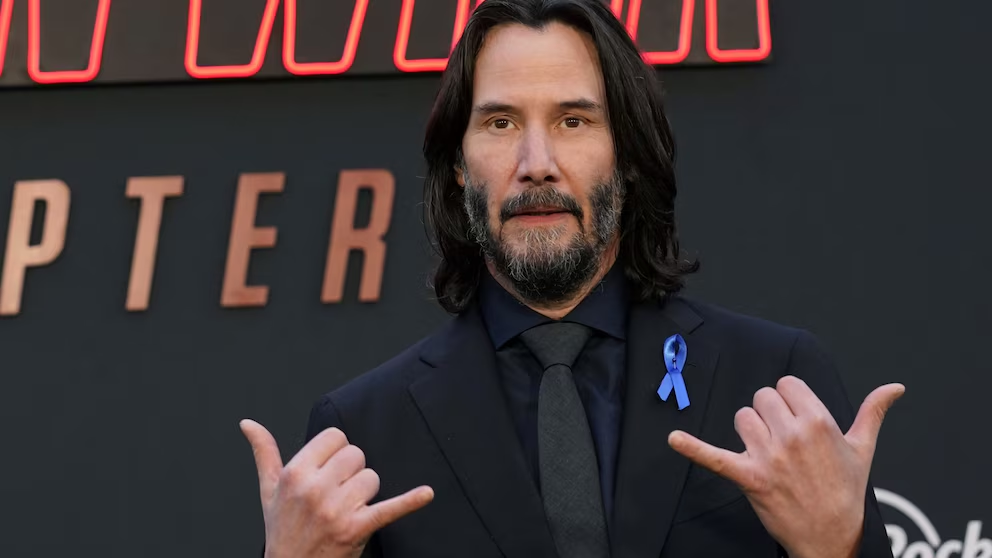
Keanu Reeves has offered aspiring actors a piece of advice that is blunt, profane, and unusually clear: do not be a terrible person to work with. During the promotion of his new comedy Outcome, Reeves distilled what he sees as a basic survival principle for newcomers in the entertainment industry. The phrase was deliberately sharp, but the meaning behind it was disciplined rather than theatrical. Show up, work, and respect the people around you unless they prove unworthy of that respect.

What makes the remark resonate is not simply its wording, but the credibility of the person delivering it. Reeves has spent more than three decades in Hollywood while maintaining a public reputation for professionalism, humility, and consistency in an industry often associated with vanity, volatility, and inflated self-regard. When someone with that trajectory reduces career advice to conduct rather than ambition, the message cuts against the mythology of celebrity culture. Talent matters, but behavior remains infrastructure.
The advice also exposes a structural truth about screen industries that is often obscured by glamour. Acting may be associated with visibility and individual recognition, but filmmaking is a deeply collaborative environment built on timing, trust, technical interdependence, and emotional endurance. A production does not function on charisma alone. It depends on people being able to work under pressure, repeat demanding tasks, solve problems quickly, and coexist with crews, producers, assistants, directors, and fellow actors for long stretches of time.

That is why Reeves’s formulation lands with unusual force. He is not offering a motivational slogan about chasing dreams or believing in oneself. He is identifying the minimum ethical threshold for entering a professional ecosystem where reputation circulates fast and interpersonal behavior often determines who gets invited back. In that sense, his advice is less sentimental than operational. Decency is not just virtue. It is career intelligence.
His co-stars reinforced that logic from different angles. Cameron Diaz reportedly expanded the idea by saying the principle applies beyond acting and into life itself, while Matt Bomer emphasized the importance of keeping grounded relationships, especially with people who knew you before success altered your environment. Together, those remarks sketch a deeper code of endurance in fame-adjacent professions: respect others, protect perspective, and do not confuse attention with character.

The timing of the comment also matters because contemporary celebrity culture often rewards spectacle, provocation, and self-branding over steadier forms of discipline. In that climate, Reeves’s advice feels almost countercultural. It suggests that amid algorithmic visibility and relentless image management, the oldest rule in collaborative work may still be the most durable. Be competent, be respectful, and do not poison the room.
There is a broader lesson here for creative industries beyond Hollywood. The mythology of genius often excuses arrogance, but institutions rarely operate well under sustained interpersonal toxicity. Whether in film, media, academia, or business, teams remember who makes difficult work possible and who makes it harder than it needs to be. Reeves’s message strips away the fantasy that success is built only on brilliance. Quite often, it also depends on whether others can stand being around you.

That is why the line matters. Behind its rough phrasing lies a precise diagnosis of professional life in elite creative systems. Careers are not made only by visibility, opportunity, and talent. They are also shaped by the habits of respect that determine whether trust can accumulate around a person over time. In a culture obsessed with image, Reeves has pointed back to conduct, and that may be the most useful advice a newcomer can actually use.
Detrás de cada dato, hay una intención. Detrás de cada silencio, una estructura.
Behind every data point, there is an intention. Behind every silence, a structure.