

 Phoenix 24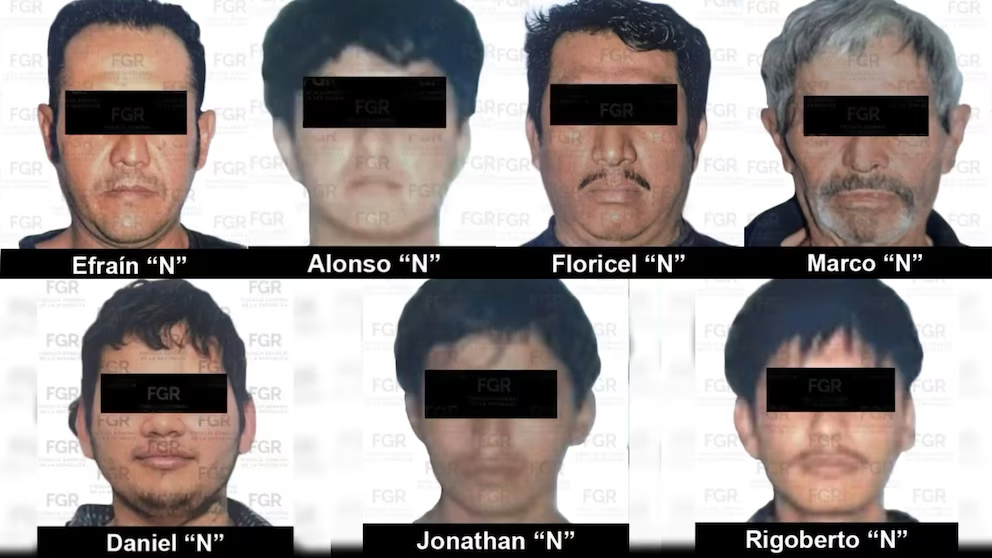
When criminal logistics are exposed, the justice system becomes the next battleground.
Culiacán, Sinaloa, January 2026. Federal prosecutors in Mexico have formally linked seven individuals to criminal proceedings following their arrest in a warehouse in the Las Tranquitas area of Culiacán. The case centers on alleged members of a criminal cell known as Los Rugrats, whose activities, according to authorities, included the storage of synthetic drugs, possession of high caliber weapons, and participation in organized crime operations within one of the country’s most contested regions.
The arrests were carried out during a coordinated operation led by the Mexican Navy with support from federal security agencies. The suspects were detained inside a warehouse that investigators describe as a logistical node rather than a simple stash location. This distinction is key, as prosecutors argue the site played a role in sustaining broader criminal activity rather than serving as an isolated cache.
During the operation, authorities seized large quantities of methamphetamine and fentanyl, along with firearms, ammunition, and equipment associated with drug processing and distribution. The presence of fentanyl elevated the case’s severity due to the drug’s high lethality and its role in cross border trafficking networks. Federal officials emphasized that the volume and composition of the seizure point to an organized structure with access to supply chains and protection mechanisms.
In court, prosecutors presented evidence asserting that the seven detainees acted collectively as part of a criminal organization. Under Mexican federal law, this classification carries aggravated penalties and enables the use of preventive detention while investigations continue. A judge determined there was sufficient cause to bind the defendants to trial and ordered them held in a high security federal facility while the case advances.

The judicial ruling granted authorities a four month period for complementary investigation. During this phase, prosecutors are expected to expand the evidentiary record through forensic analysis, financial tracking, and intelligence cross referencing. The objective is to establish not only individual responsibility, but also the operational role of the group within a larger criminal ecosystem.
Security analysts identify Los Rugrats as an armed faction operating within the broader orbit of the Sinaloa Cartel. While early assessments suggested ties to one internal faction, more recent intelligence points to operational alignment with a wing known for prioritizing synthetic drug production. This shift reflects a wider transformation in organized crime, where methamphetamine and fentanyl have displaced traditional narcotics due to higher profitability and scalability.
The case illustrates the strategic importance of targeting logistical infrastructure rather than only visible street level actors. Warehouses, processing sites, and distribution hubs form the backbone of criminal economies. Disrupting these nodes can temporarily fracture supply chains, though authorities acknowledge such impacts are often contested and reversible.
From a governance perspective, the proceedings also test the capacity of Mexico’s federal justice system to sustain complex prosecutions against organized crime. Preventive detention, extended investigations, and coordinated interagency operations are designed to counteract intimidation, evidence tampering, and rapid reorganization by criminal groups. Their effectiveness, however, depends on institutional resilience over time.

In Sinaloa, where criminal organizations have historically embedded themselves within local economies and social structures, enforcement actions carry both legal and symbolic weight. Each prosecution signals an assertion of state authority, yet also exposes the scale of the challenge faced by security institutions in dismantling deeply rooted networks.
As the case against the seven defendants moves forward, it will be closely watched by both security analysts and local communities. Its outcome may influence future operational strategies and judicial approaches in a region where law enforcement and organized crime continue to coexist in uneasy tension.
Behind every data point, there is an intention. Behind every silence, a structure.
Detrás de cada dato, hay una intención. Detrás de cada silencio, una estructura.