

 Phoenix 24
Art becomes defiance when returning home carries the weight of punishment.
Marrakech, December 2025
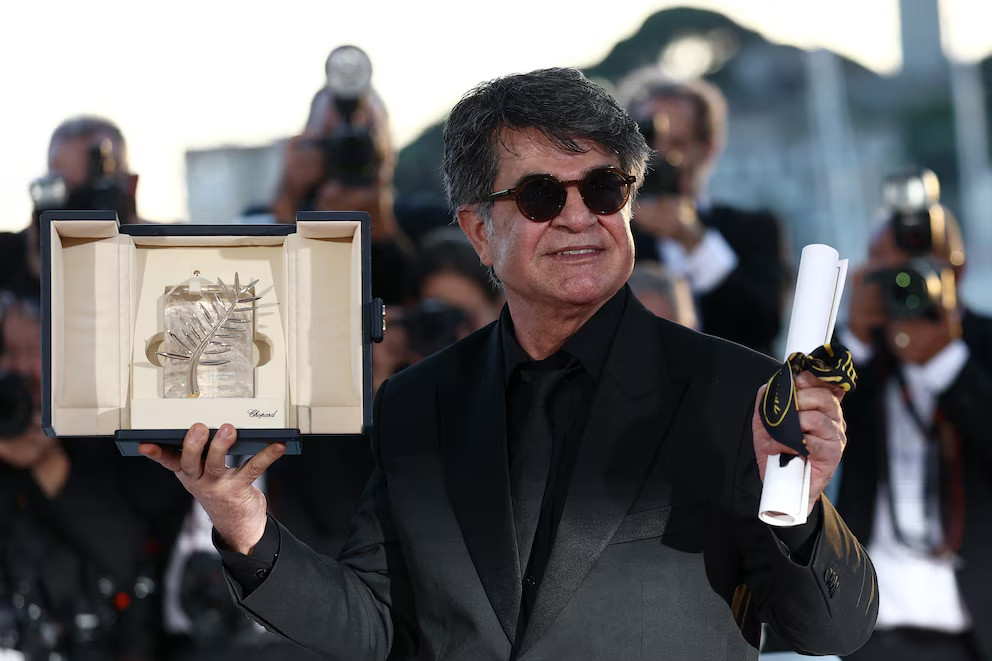
Iranian filmmaker Jafar Panahi has announced that he intends to return to Iran even though a revolutionary court has issued a prison sentence against him following the international acclaim of his latest work. The director, whose career has long been shaped by state restrictions, confirmed his decision during a cultural appearance abroad, emphasizing that neither recognition nor exile could replace the sense of belonging tied to his homeland. His statement adds a new layer of tension to a longstanding conflict between creative expression and political authority in Iran.
Observers in Europe note that Panahi’s announcement coincides with a period of heightened repression inside the country. Cultural figures, journalists and activists continue facing increased surveillance and legal pressure. Yet Panahi’s choice to return is seen not merely as a personal act but as a symbolic challenge to the boundaries imposed on artistic speech. Specialists argue that his resolve reflects a broader truth: in societies where dissent is regulated, returning home becomes a form of testimony.
In North America, analysts studying the politics of cultural repression highlight that Panahi’s case illustrates how cinema can threaten authoritarian structures even without explicit political messages. His films often depict ordinary lives shaped by constraint, revealing social realities that Tehran prefers to keep unseen. Experts point out that the government’s response to such works suggests an enduring anxiety about narratives it cannot fully control. The latest sentence issued against him underscores the difficulty of separating artistic merit from political interpretation in contexts where the state scrutinizes every public gesture.
Across Asia, scholars of Iranian cinema observe that Panahi’s decision to re enter the country challenges both official expectations and informal norms. Many artists facing legal risk choose to extend stays abroad, postponing or avoiding return altogether. Panahi’s refusal to follow that path sets him apart. Analysts interpret his stance as a declaration that creative identity is inseparable from geographic and cultural roots, even when those roots exist in environments marked by censorship. They also caution that his homecoming will test the limits of the authorities tolerance for international attention.
The reaction within Iran is complex. Supporters of independent cinema see Panahi as a figure whose persistence keeps alive the possibility of cultural autonomy. His presence in the international arena reinforces the global visibility of Iranian artistic contributions despite domestic constraints. Meanwhile, conservative factions view his work as disruptive to national cohesion. They frame his films as distortions crafted to appeal to foreign audiences. This tension deepens with each international award he receives, amplifying scrutiny upon his return.
For Panahi himself, the consequences remain uncertain. The sentence reportedly includes imprisonment and restrictions on travel. Legal experts familiar with similar cases note that such sentences are sometimes enforced immediately. Others are applied selectively, depending on political climate and internal negotiations. Regardless of timing, the prospect of confinement looms. The risk highlights a principle often ignored in discussions of artistic freedom: for many creators, the cost of expression is not abstract but borne in physical consequences.
The filmmaker’s recent success complicates the situation further. His latest film, celebrated at major international festivals, was produced under conditions shaped by earlier detentions and prohibitions. Critics across continents praised the work for its narrative subtlety, emotional depth and quiet critique of social conditions. The global acclaim has elevated his profile, making any punitive action against him more visible. Cultural institutions in Europe and North America have urged Iranian authorities to reconsider the sentence, arguing that penalizing artists for their creative output undermines cultural diplomacy and damages the country’s global reputation.
Human rights organizations emphasize that Panahi is not an isolated case. They document patterns in which creative professionals face charges tied to vague allegations of propaganda or destabilization. These patterns reveal an institutional approach that conflates dissent with threat. The return of a high profile figure like Panahi may therefore intensify debates about freedom of expression inside Iran, whether openly or in private. His presence would force institutions, colleagues and citizens to confront questions about the relationship between art and authority.
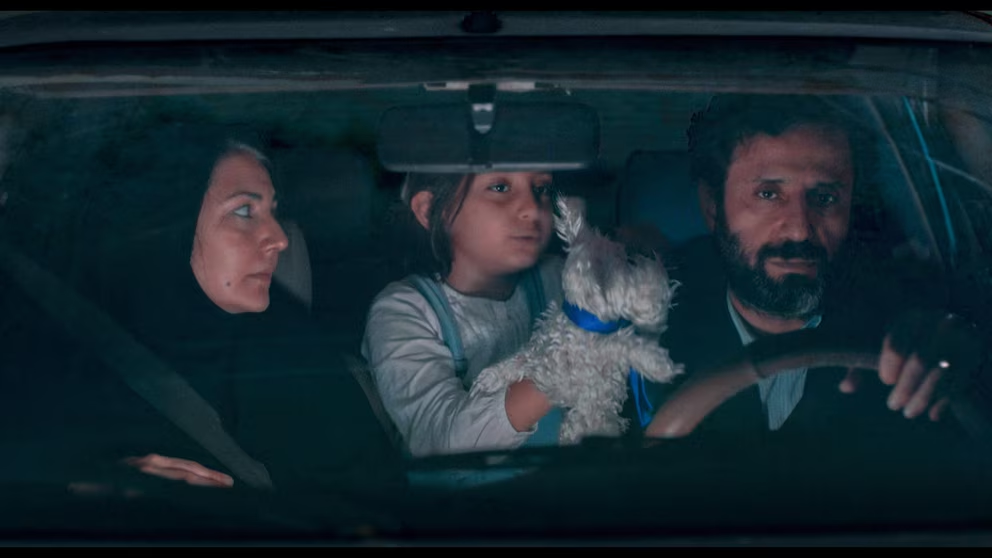
The emotional dimension of the filmmaker’s announcement resonates widely. For audiences familiar with his work, his decision embodies the themes he often portrays: individuals navigating invisible boundaries, confronting systems larger than themselves and seeking dignity in constrained environments. For younger artists in Iran, his choice may serve as a signal that persistence remains possible, even in the face of institutional adversity. For global spectators, it reinforces the notion that cinema can function as both cultural expression and human rights testimony.
As Panahi prepares to return, the world watches with cautious attention. His journey home represents more than a physical step. It is a movement across lines that states draw to contain narratives they cannot control. Whether his return leads to imprisonment, negotiation or a renewed cycle of cinematic resistance remains unknown. What is certain is that his decision reaffirms the enduring conflict between artistic freedom and political authority, a conflict that resonates far beyond Iran’s borders.
Phoenix24: journalism without borders.
Phoenix24: periodismo sin fronteras.