

 Phoenix 24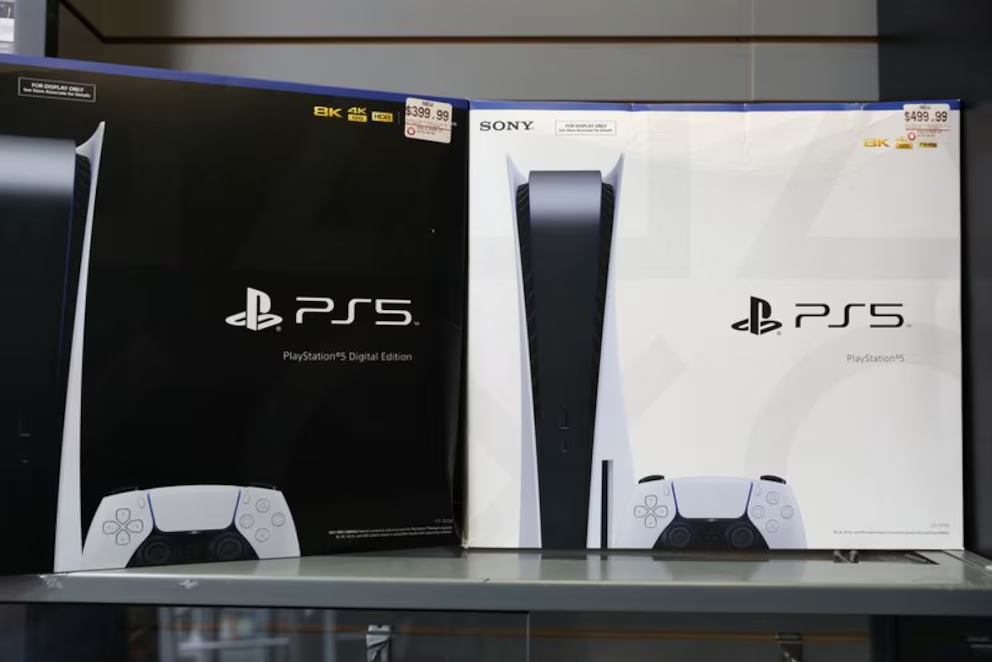
A mid‑generation hardware evolution that bets on smarter AI, greater efficiency, and backward compatibility over sheer power.
Tokyo, August 2025.
Rumors surrounding the upcoming PlayStation 6—internally referred to as Project Orion—point to a strategic approach that favors intelligent upgrades over radical reinvention. Rather than launching a high-priced, ultra-powerful machine, Sony appears to be prioritizing performance optimization, AI integration, and cross-generation continuity at a launch price of around $499 USD.

Sony también estaría trabajando en otra consola. REUTERS/Issei Kato/File Photo
According to preliminary technical leaks, the PS6 may feature an AMD APU with 8 Zen 6 CPU cores and between 40 to 48 RDNA 5 GPU compute units, clocked above 3 GHz. While these figures suggest fewer compute units than the PS5 Pro, the newer RDNA 5 architecture is expected to deliver up to three times the rasterization performance and a significant boost in ray tracing capabilities. Power consumption could be optimized at approximately 160 watts—lower than the PS5’s—thanks to GDDR7 memory and a 160‑ or 192‑bit memory bus that improves bandwidth without sacrificing efficiency.
Sony’s partnership with AMD—under the codename “Project Amethyst”—is reportedly focused on embedding artificial intelligence directly into the console’s graphical and processing architecture. This includes AI-enhanced upscaling (like FSR 4), real-time frame generation, and dynamic rendering adjustments, effectively making AI a foundational element of visual performance rather than a peripheral add-on.
Another key element of Sony’s roadmap involves a handheld companion device, internally nicknamed Canis or Robin Plus. It is rumored to incorporate 4 Zen 6C cores, 12 to 20 RDNA 5 compute units, and a 15-watt power profile—delivering performance close to half of a PS5. It is designed to support full backward compatibility with PS4 and PS5 titles, with a target price under $500 USD.

Sony optimizaría el consumo de energía de la consola y conservaría su precio en 499 dólares. REUTERS/Claudia Greco/File Photo
These developments signal a shift in Sony’s philosophy. Rather than pushing boundaries with brute hardware strength, the company seems to be embracing an ecosystem-centric approach: lower energy draw, smarter architecture, and broader compatibility. If confirmed, these design choices would offer a seamless transition for gamers while keeping development costs and user investment under control.
Market analysts suggest that Sony’s pricing strategy reflects a broader industry trend. With console cycles lengthening and cloud-based gaming rising, the emphasis is shifting from raw power to integrated intelligence. A $499 price point would make the PS6 highly competitive, maintaining accessibility while delivering tangible improvements in graphics and performance.
Perhaps the most transformative aspect of the upcoming console is the native use of AI not only in graphics but in user experience. From adaptive loading optimizations to real-time performance tuning, the PS6 could become the first major console generation where artificial intelligence plays a proactive role in shaping gameplay fluidity and immersion.
Though Sony has not officially confirmed any of these specifications, the convergence of leaks across sources suggests a coherent direction: a console built for intelligent performance rather than exaggerated specs, with backward compatibility as a core principle and AI as its defining feature.
“This piece was developed by the Phoenix24 editorial team using reliable sources, public data, and rigorous analysis in alignment with the current global context.”
“Esta pieza fue desarrollada por el equipo editorial de Phoenix24 con base en fuentes confiables, datos públicos y análisis riguroso, en coherencia con el contexto global vigente.”