

 Inuk Sorensen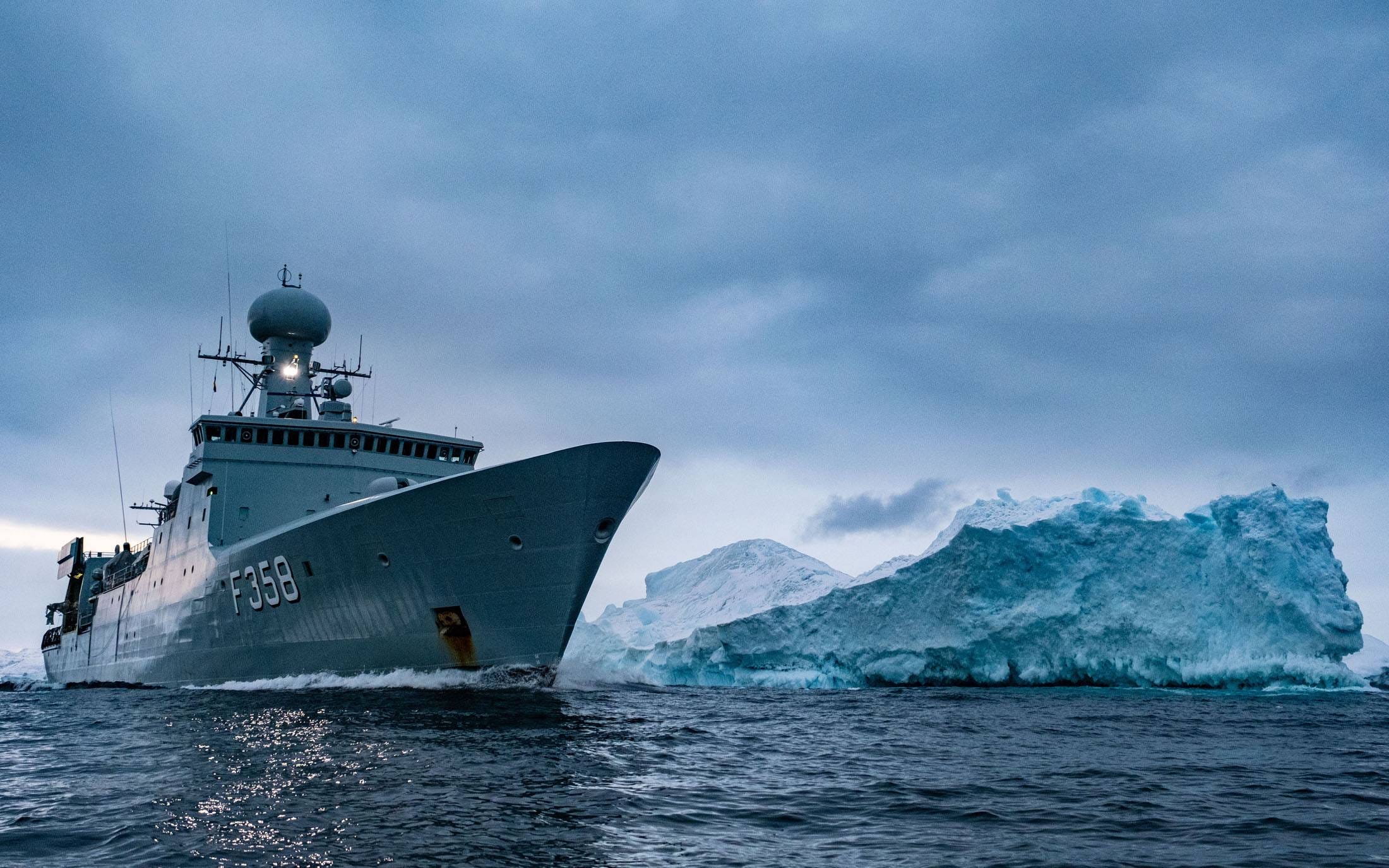
The Arctic is no longer a frontier. It is a contest.
Nuuk, March 2026
For too long, Greenland was described from outside as an empty expanse, a white surface awaiting measurement, extraction, or strategic use. Ice, minerals, routes, coordinates. That language never really disappeared, but it has returned with new force and a sharper sense of urgency. Greenland is no longer being read merely as a climate story or a geographical curiosity. It is being pulled toward the center of a harder geopolitical imagination, one in which radar systems, rare earths, military planning, and transport corridors converge over a land still too often discussed as territory before it is recognized as home.
That is the first tension worth naming without euphemism. The Arctic is being militarized in the language of security, but inhabited in the language of memory. For allied planners, expanded missions, northern surveillance, and strategic presence may look like prudence in an unstable era. For many Arctic communities, the same process can look like something more familiar and far less reassuring: the return of a pattern in which defense arrives faster than dignity, and the infrastructure of observation grows faster than the infrastructure of life.
This matters because Arctic sovereignty has never been only about flags, coast guards, or legal lines on a map. It is also about who defines necessity and who gets to speak in the name of protection. Washington speaks of access. NATO speaks of deterrence, resilience, and capability gaps. European capitals speak of the High North as an emerging strategic zone. Yet Inuit political thought begins from a different premise altogether. Not from possession in the imperial sense, but from continuity, relation, and lived presence. That difference is often treated as symbolic. It is not symbolic. It is one of the central political fractures of the Arctic century now taking shape.
The mineral question deepens that fracture. Greenland is increasingly spoken of through the grammar of critical minerals, rare earth potential, and industrial leverage, especially as Western governments seek alternatives to Chinese supply-chain dominance. But extraction is never only extraction. It reorganizes land use, labor expectations, logistics planning, environmental thresholds, and the political terms under which a territory becomes legible to the outside world. Once a place begins to matter primarily for what lies beneath it, sovereignty itself starts to tilt. It becomes less about governing a society in its own terms and more about negotiating how much of that society’s land can be adapted to external systems of need.
Pressure now comes from several directions at once. The United States has revived a strategic language around access and Arctic importance. NATO has moved toward a more structured military posture in the High North. Nordic governments and Canada are deepening defense coordination as the northern flank becomes more central to alliance planning. None of these developments stands alone. Together they produce an Arctic atmosphere in which military urgency, industrial ambition, and alliance discipline begin to reinforce one another. Greenland sits inside that convergence, but not from a position of symmetry.
That asymmetry helps explain why Greenland’s political shifts matter far beyond electoral arithmetic. As outside powers speak more openly about Arctic necessity, internal pressure grows to redefine the terms under which Greenland is represented, defended, and negotiated. The more the island is described as essential by others, the stronger the impulse becomes to ask who that essentiality is really for. Strategic attention does not automatically strengthen local agency. Sometimes it does the opposite. Sometimes it compresses time, narrows consent, and turns political complexity into an inconvenience.
This is where the Arctic reveals one of the most persistent hypocrisies of the contemporary West. Security is invoked as a shield for freedom, yet the communities expected to host military and surveillance infrastructure are often asked to accept that buildup as if its benefits were self-evident. Radar, runways, logistics hubs, new missions, dual-use infrastructure. All of it can be justified within the grammar of deterrence. Yet the everyday needs of Arctic populations do not disappear simply because geopolitical urgency has risen. Healthcare, mobility, education, social continuity, and environmental resilience remain part of what any serious idea of security should mean. Too often, however, they are treated as secondary, almost domestic, beside the grandeur of strategic necessity.
Greenland sharpens this contradiction because it stands at the meeting point of imperial memory and strategic futurism. Ice melt is opening routes, exposing resources, and accelerating military attention. Yet the same processes that make Greenland more valuable to external actors can make local autonomy more fragile if political agency does not keep pace. Climate change does not merely open corridors. It opens negotiations over who gets to define the future of newly legible space. The danger is not only that ice retreats. It is that control hardens as it does.
That is why Greenland should not be framed merely as an object of competition between Washington, Moscow, Beijing, Brussels, and Copenhagen. That framing is analytically convenient, but politically incomplete. It turns Arctic life into background scenery for the maneuvers of states and leaves indigenous governance as a secondary variable in someone else’s strategic narrative. In reality, Inuit sovereignty is not an ethical supplement to Arctic affairs. It is one of the core tests of whether Arctic security can be imagined without reproducing the same extractive and militarized logic that has long treated peripheral peoples as expendable margins of history.
The deeper issue, then, is not whether Greenland matters strategically. That question is already settled. The real question is what kind of Arctic order is being assembled in its name. One model is already visible: a colder zone of surveillance, mineral access, alliance management, and logistical acceleration, where local consent is acknowledged rhetorically but outpaced structurally by the tempo of external need. Another model remains possible, though far less consolidated: an Arctic politics in which indigenous governance is not merely consulted after the architecture is designed, but treated as one of the principles that determines what security is meant to protect in the first place.
The distance between those two models may end up defining the Arctic more than any radar grid or shipping route. Because legitimacy in the far north will not be measured only by capability, but by reciprocity. Not only by presence, but by political form. A militarized Arctic without durable local legitimacy may still look orderly from the standpoint of alliance maps. It will look very different from the ground.
Greenland, then, is not simply where ice melts and empires converge. It is where the future grammar of Arctic legitimacy will be tested. If the region is militarized without reciprocity, extracted without durable local control, and defended without listening to those who have lived there longest, then the West will not be securing the Arctic so much as repeating an older imperial reflex in colder language. And there are few things more dangerous than an empire convinced it is merely being prudent.
Inuk Sorensen, Greenlandic-Danish correspondent at Phoenix24. Expert in Arctic sovereignty, climate militarization, and indigenous rights at the northernmost frontiers of geopolitics.