

 Phoenix 24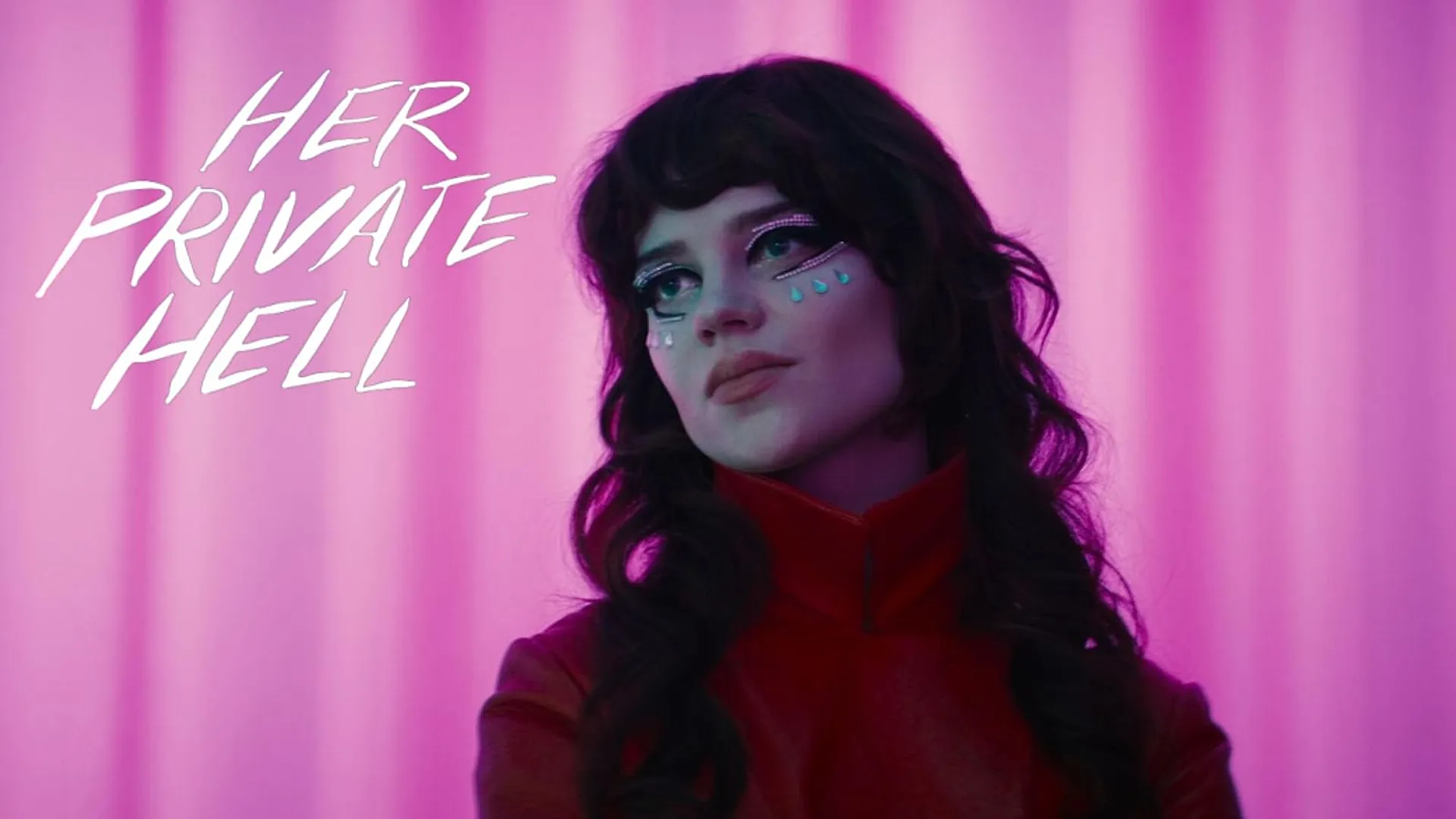
The images seduce, but the story never awakens.
Cannes, August 2026
Nicolas Winding Refn returns to feature filmmaking after a decade with Her Private Hell, a psychosexual science-fiction nightmare led by Sophie Thatcher and Charles Melton. The director’s familiar visual obsessions remain intact, from saturated neon and carefully posed bodies to violence treated as an almost sacred ritual. Yet beneath its immaculate surface, the film struggles to find enough narrative or emotional substance to sustain its 109-minute descent into darkness.
Thatcher plays Elle, a troubled young woman who arrives at a monolithic high-rise in a futuristic metropolis slowly disappearing beneath a mysterious mist. She is searching for her father, filmmaker Johnny Thunders, while becoming entangled in the production he has left behind. Her encounter with actress Hunter introduces an atmosphere of rivalry, seduction and concealed danger, while Elle’s stepmother Dominique adds another layer of ambiguity to the fragmented family drama.
Running parallel to her story is the journey of Private K, an American soldier played by Melton who is attempting to rescue his daughter from a personal and possibly literal hell. His mission appears to promise forward momentum, but Refn treats conventional storytelling as an unnecessary restriction. Characters drift between environments, timelines and symbolic encounters without receiving clear motivations or meaningful development.
The film’s universe combines dystopian architecture, postwar imagery, giallo influences and erotic pulp fiction. Leather-clad killers, cavernous interiors and artificial cityscapes appear designed less as locations than as exhibits in an extravagant installation. Cinematographer Magnus Nordenhof Jønck captures Thatcher with remarkable precision, turning every gesture and expression into part of the production design.
That visual control is both the film’s principal achievement and its most persistent limitation. Individual frames can be hypnotic, particularly when pink and blue light transforms ordinary spaces into threatening dream chambers. However, the relentless emphasis on composition eventually reduces the actors to mannequins, leaving the audience to admire images that rarely accumulate dramatic weight.
Thatcher gives Elle a compelling mixture of vulnerability and suspicion, even when the screenplay denies her a coherent psychological journey. Melton possesses the physical presence required for Refn’s mythic soldier figure, but Private K functions more effectively as an icon than as a grieving father. Havana Rose Liu, Kristine Froseth and Dougray Scott contribute to the film’s atmosphere, although their characters remain deliberately elusive and frustratingly underwritten.
Pino Donaggio’s score supplies much of the personality missing from the dialogue. Its romantic and ominous tones connect the film to European horror traditions while creating an emotional intensity that the characters themselves seldom express. Matthew Newman’s editing reinforces the dream logic, but the extended pauses and lethargic conversations frequently turn suspense into inertia.
Her Private Hell arrives as Refn’s first feature since The Neon Demon in 2016, following his excursions into long-form streaming with Too Old to Die Young and Copenhagen Cowboy. It also carries the additional significance of his return after a serious medical emergency that he has described as a personal and creative rebirth. Such circumstances invite expectations of renewed urgency, but the finished film feels more like a consolidation of his established style than a decisive transformation.
The divided reception is therefore unsurprising. Admirers can reasonably describe the film as an immersive disco nightmare, a work intended to be experienced through rhythm, colour and sensation rather than decoded through conventional logic. More sceptical viewers will see a wafer-thin story wrapped in the visual language of a luxury advertisement, prolonged until provocation becomes repetition.
Its Cannes premiere reportedly received an extended standing ovation, but ceremonial enthusiasm cannot conceal the film’s likely status as one of the year’s most divisive releases. Refn remains a filmmaker with an immediately recognisable signature, something increasingly rare in an industry shaped by interchangeable visual formulas. Recognition, however, is not the same as evolution, and Her Private Hell often resembles an artist wandering through rooms he has decorated before.
The film is not devoid of ambition, and its artificial world contains moments of genuine beauty, unease and strange humour. Devoted followers of Refn may surrender willingly to its languid tempo and sensory excess, while others will find that its mysteries conceal little beyond additional mysteries. Her Private Hell ultimately proves that a film can be visually alive while remaining dramatically motionless.
Cada silencio habla. / Every silence speaks.