

 Phoenix 24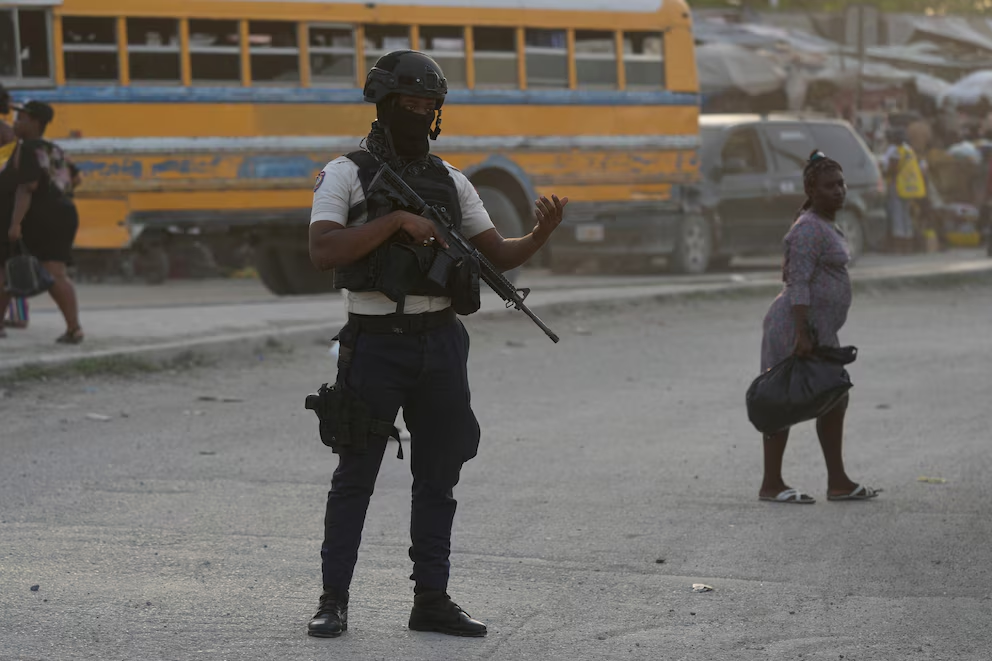
When peacekeepers become targets, diplomacy must learn the language of chaos.
Port-au-Prince, October 2025.
The promise of order in Haiti met its first real test this week, and the result was a reminder that peacekeeping in the Caribbean’s most fragile state is never procedural—it is existential. Units of the newly deployed Multinational Security Support Mission (MSS) came under heavy fire during a joint patrol through the neighborhoods of Carrefour and Cité Soleil, where local gangs responded with organized resistance rather than retreat.
According to official briefings from the Haitian National Police (PNH), the mission—led operationally by Kenyaunder a United Nations mandate—had entered the area to secure main corridors for humanitarian aid. Within minutes, the patrol was met with automatic gunfire and barricades, sparking a three-hour engagement that left at least nine assailants and two local officers dead. Casualty figures from the MSS have not been disclosed, but diplomatic sources in Nairobi and Washington confirmed minor injuries among international personnel.
This confrontation marks the first recorded armed exchange involving the international contingent since its formal deployment earlier this month. The United Nations Integrated Office in Haiti (BINUH) described the encounter as “anticipated but regrettable,” stressing that the objective remains stabilization, not combat. Yet the reality on the ground suggests that the mission has entered a phase of de facto counter-insurgency.
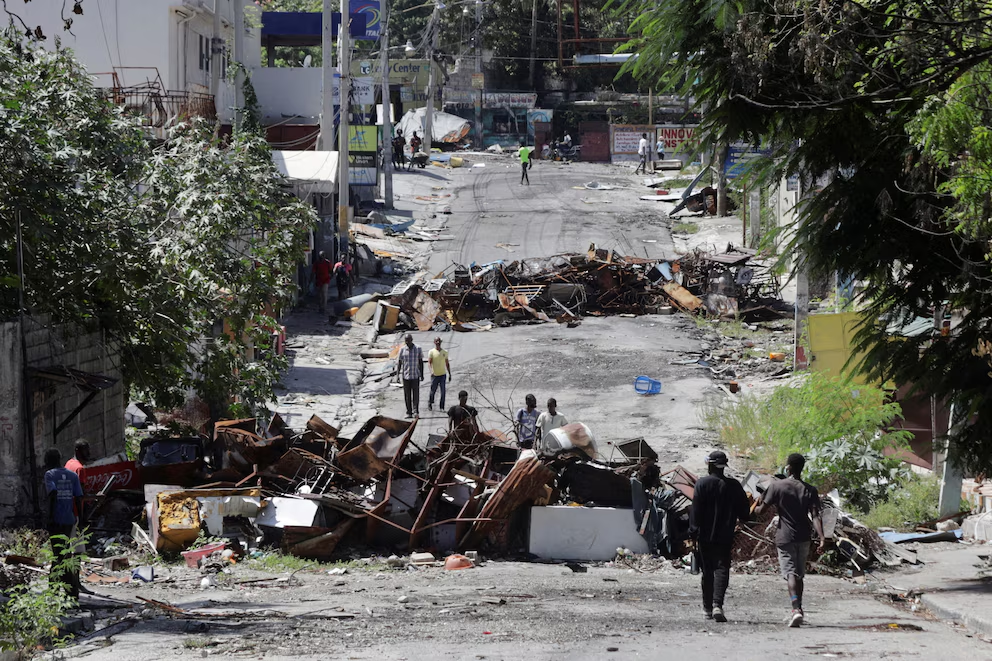
For months, security analysts had warned that gangs in Port-au-Prince have evolved into hybrid militias, blending criminal networks with political leverage. Reports from the Inter-American Dialogue and the Geneva Centre for Security Policy indicate that at least 60 percent of the capital remains under direct gang influence, with more than 250,000 residents displaced by extortion, kidnapping and territorial warfare.
The MSS, which includes troops from Kenya, Jamaica, The Bahamas and Benin, was established to fill the vacuum left after years of failed stabilization efforts. Its mission differs from previous UN operations such as MINUSTAH, aiming for rapid-response mobility rather than prolonged occupation. But as Sunday’s clash revealed, even limited missions can inherit unlimited hostility.
Eyewitnesses described scenes of panic as armored vehicles rolled through narrow streets while residents sheltered in churches and schools. Humanitarian workers from Médecins Sans Frontières temporarily suspended operations in Cité Soleil after projectiles struck near their field clinic. A local nurse said, “We have lived with fear for years, but now fear has uniforms.”
In regional capitals, reactions were swift. The Organization of American States (OAS) convened an emergency session to evaluate implications for Caribbean security, citing the risk of cross-border trafficking and refugee flows. In Washington, the U.S. Department of State reaffirmed logistical support for the Kenyan-led mission, while Canada offered to expand aerial surveillance and humanitarian funding through the Pan American Development Foundation.
Kenya’s foreign ministry, for its part, defended the mission’s rules of engagement, stating that troops acted strictly in self-defense. “Our mandate is protection, not aggression,” said spokesperson David Ndii in Nairobi. Still, the optics of African soldiers under fire in the Western Hemisphere have reignited debates over legitimacy, sovereignty and neocolonial imagery. Analysts from the Brookings Institution argue that while the mission operates under UN authorization, its operational dependence on U.S. logistics makes it vulnerable to accusations of proxy intervention.
Inside Haiti, the political vacuum deepens the complexity. Prime Minister Garry Conille, governing without a functioning parliament, faces simultaneous crises: institutional collapse, food insecurity and public distrust. Local media outlets such as Le Nouvelliste report that several civil-society organizations view the MSS as a “foreign bandage on a domestic wound,” arguing that no mission can succeed without parallel reforms in governance and justice.
For the Haitian population, fatigue defines the national mood. Decades of international missions—each promising reconstruction, none delivering continuity—have generated skepticism bordering on despair. Yet amid the disillusionment, there remains cautious hope. A community leader from Carrefour stated, “If the mission holds its ground without punishing the poor, maybe this time will be different.”
The economic consequences of renewed violence are immediate. The World Bank estimates that insecurity costs Haiti more than 5 percent of its GDP annually, primarily through disrupted transport and informal taxation by gangs. The resurgence of fighting threatens not only aid corridors but also regional trade through the port of Port-au-Prince, where container movements have already fallen by 40 percent since August.
Beyond the statistics lies a human tragedy. Families continue to flee the capital toward the Dominican border, where refugee shelters report severe overcrowding. The International Organization for Migration (IOM) warns that unregulated flows could reach 50,000 people before the end of the year if violence persists.
For diplomats, the clash in Cité Soleil represents both a setback and a turning point. It reveals that stabilization cannot be imported and that military presence without political architecture risks repetition of past failures. The United Nations Security Council is expected to review the mission’s engagement protocols in the coming days, balancing restraint with deterrence.
In essence, what unfolded in Haiti this week is more than a skirmish; it is a stress test for the international system’s ability to restore order in collapsed states without becoming an occupying force. The bullets exchanged in Port-au-Prince were not only between gangs and soldiers—they were between history and repetition.
Contra la propaganda, memoria. / Against propaganda, memory.