

 Phoenix 24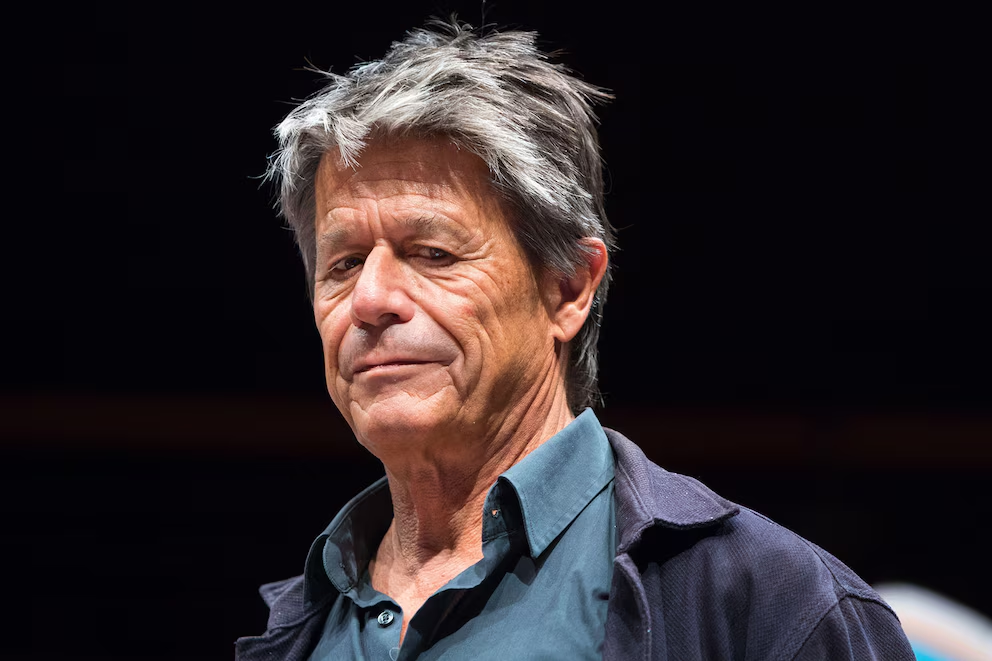
Buenos Aires is opening its literary stage.
Buenos Aires, May 2026. Emmanuel Carrère and Claire Keegan will arrive in Buenos Aires for FILBA, reinforcing the festival’s role as one of Latin America’s strongest bridges with contemporary world literature. Their presence brings together two distinct literary forces: Carrère’s hybrid territory between memoir, investigation and moral unease, and Keegan’s precise, compressed fiction built on silence, intimacy and emotional restraint.
The announcement matters because literary festivals no longer function only as cultural calendars. They are spaces where publishing markets, translation circuits, intellectual prestige and reader communities converge. FILBA’s ability to attract writers of this stature strengthens Buenos Aires as a regional capital for literary conversation.
Carrère represents the restless tradition of nonfiction that refuses to stay inside one genre. His work often explores faith, crime, identity, trauma and the unstable boundary between author and subject. Keegan, by contrast, works through narrative economy, turning small scenes into moral pressure chambers where what remains unsaid becomes decisive.
Together, their participation offers a map of contemporary literature’s two major energies: expansion and concentration. One writes toward the abyss of experience; the other compresses life until silence becomes revelation. That contrast gives FILBA a program with intellectual weight and emotional range.
For Buenos Aires, the visit is more than a cultural event. It confirms that literature still produces public attention when it gathers voices capable of interpreting private life, political memory and human vulnerability. In a noisy digital age, festivals like FILBA remind readers that language remains one of the few territories where complexity can still breathe.
La verdad es estructura, no ruido. / Truth is structure, not noise.