

 Phoenix 24
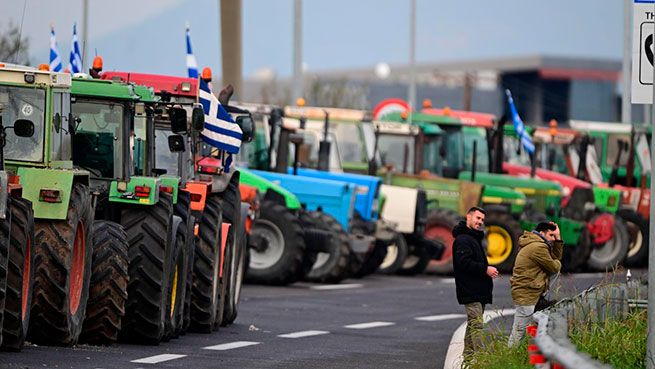
What began as scattered demonstrations has transformed into one of the most forceful rural mobilizations Greece has witnessed in years.
Athens, December 2025.
Farmer protests in northern Greece escalated sharply as thousands of agricultural producers expanded blockades across major transport corridors, border approaches and supply routes that feed the country’s internal market. What started as local frustration over delayed support payments has grown into a coordinated national movement that exposes long standing structural challenges within Greece’s agricultural economy. The disruption now radiates far beyond the fields and provincial towns where it began, drawing scrutiny from European institutions, global analysts and regional trade partners who depend on Greece’s corridors for circulation of goods.
At the center of this unrest lies a complicated mix of overdue subsidies, rising production costs and administrative bottlenecks that many farmers argue have pushed their businesses to the verge of collapse. According to assessments circulating among European agricultural observers, farmers in Greece face disproportionately high input costs compared with other parts of the Union, a burden worsened by weather instability and disease outbreaks that have reduced yields. Analysts in the United States who track rural economics have pointed out that these pressures mirror a broader pattern across multiple agricultural markets where rising debt loads and volatile commodity prices strain livelihoods and amplify political tensions.
As the mobilizations intensified, convoys of tractors moved to strategic locations across the northern regions, creating extensive bottlenecks on highways linking Thessaloniki, Kavala and the inland road networks that connect Greece with the Balkans. Local authorities reported prolonged standstills at border approaches where freight carriers, passenger vehicles and essential goods met long delays. Observers from think tanks in Western Europe noted that these disruptions could ripple across regional logistics chains, particularly for cross border food shipments and industrial materials circulating between Greece and its northern neighbors.
Clashes between demonstrators and police occasionally interrupted the blockades, highlighting the volatility of the protests as tensions rose around airports and regional administrative centers. Security analysts from independent European research institutes remarked that the nature of the confrontations remained largely contained but signaled the potential for further escalation if negotiations falter. The Greek government, while urging calm, reiterated that essential infrastructure must remain accessible and warned that prolonged obstruction could trigger legal consequences for organizers.
The political backdrop adds further complexity. For years, farmers have argued that institutional delays and inconsistent oversight weaken their ability to plan long term investments. International monitors based in Asia who follow agricultural resilience noted that delays in subsidy distribution can have cascading consequences in countries where farm structures rely heavily on seasonal cycles and thin operating margins. Such vulnerabilities become more pronounced when broader economic pressures converge, as Greece continues to adjust to energy price fluctuations and evolving requirements from European regulatory frameworks.
Rural unions and grassroots committees have coordinated their actions with a level of discipline uncommon in previous mobilizations. Daily assemblies in the northern regions serve as hubs for decisions about which roads to block, when to shift locations and how to maintain community support while sustaining pressure on central authorities. Agricultural specialists in Europe have commented that the breadth of participation suggests a unified rural front in which both small scale producers and larger operators feel equally exposed to systemic risks.
The government in Athens has attempted to counter growing discontent by announcing financial packages aimed at addressing subsidy delays and offering temporary relief measures. Yet these proposals have not convinced farmers who argue that assistance must be both immediate and structural. From the perspective of macroeconomic analysts in London, the challenge for Greece lies in crafting measures that provide tangible support without jeopardizing fiscal commitments made under broader European agreements. Balancing these competing imperatives demands political flexibility at a time when social pressure is mounting.
Beyond the economic dimensions, the protests have acquired a symbolic force that resonates deeply in rural Greece. Demonstrators frame their struggle as a defense not only of incomes but of a way of life increasingly threatened by economic volatility, environmental pressures and perceived policy neglect. This sentiment has drawn support from local communities, students and small businesses who view the agricultural sector as a cultural anchor as much as an economic one.
As mid December approaches, protest organizers signal that additional actions may expand into new regions and potentially target ports and distribution hubs if negotiations stall. Whether government outreach will be sufficient to de escalate the situation remains uncertain. What is clear is that the mobilization has already reconfigured the national conversation about rural policy, revealing fractures that extend from subsidy administration to questions of long term agricultural resilience.
Phoenix24: information that anticipates futures.
Información que anticipa futuros.