

 Phoenix 24
A convincing digital montage transformed a real stadium image into viral fiction.
Miami, June 2026
A manipulated photograph showing Camila Cabello beside Taylor Swift during Brazil’s World Cup match against Scotland spread rapidly across social media, convincing thousands of users that both singers had attended the game together. The image appeared realistic enough to trigger excited comments, celebrity speculation and widespread reposting. It was later revealed that Swift had been digitally inserted into an authentic photograph of Cabello at the stadium. The original person seated beside the Cuban-American artist was her mother, Sinuhe Estrabao.
Cabello was genuinely present to support Brazil during the match, making the fabricated scene easier to believe. Photographs showed her in the stands wearing colors associated with the Brazilian team and watching the action alongside her mother. A manipulated version replaced Estrabao’s face and appearance with those of Swift while preserving the surrounding crowd, lighting and stadium environment. The familiar friendship between both singers gave the false composition an additional layer of plausibility.
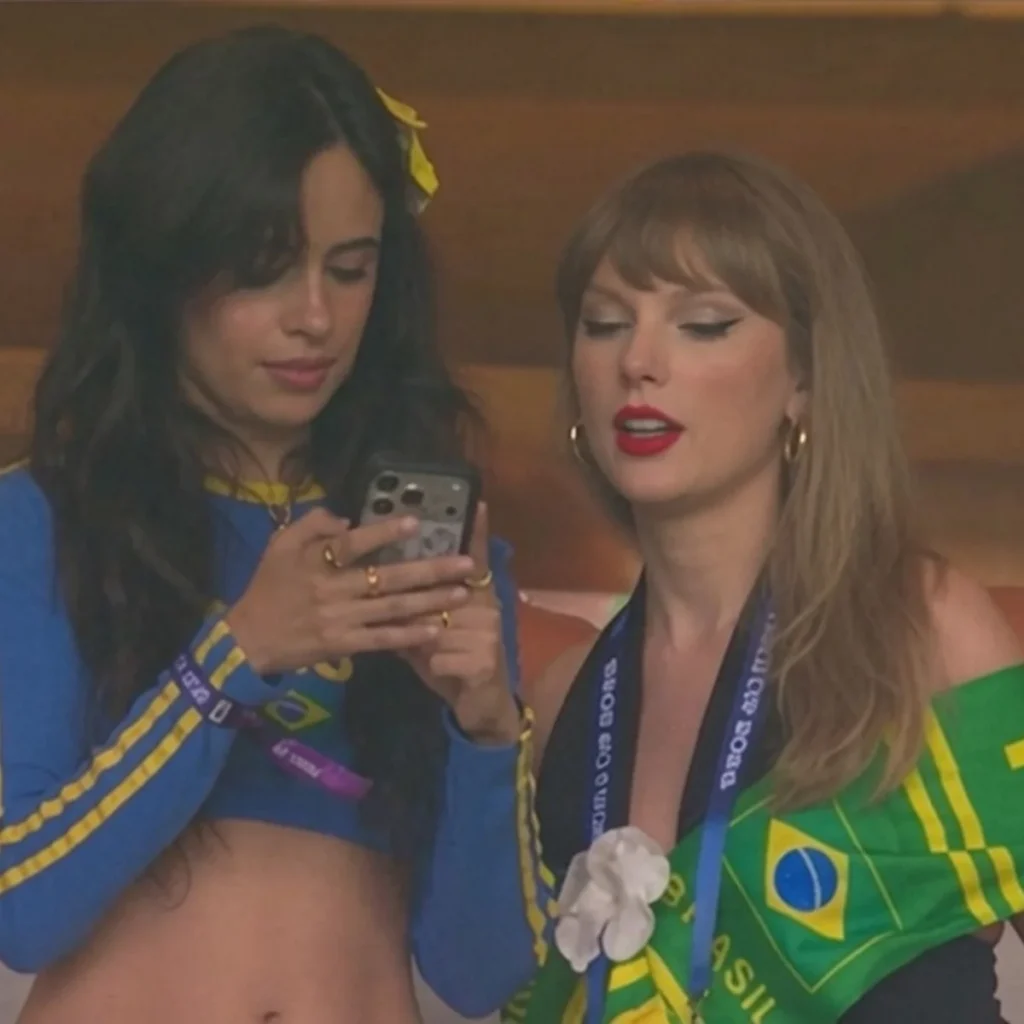
Social media accounts circulated the altered image with captions claiming that Cabello and Swift had been spotted together supporting Brazil. Some users accepted the photograph immediately and began discussing Swift’s supposed presence at the tournament. Others questioned why television cameras had not shown her more prominently during the broadcast. The confusion demonstrated how quickly a false celebrity appearance can become part of the public conversation when an image fits existing expectations.
Swift and Cabello have known each other for years, which made the montage more persuasive than a random pairing would have been. Cabello has spoken publicly about admiring Swift’s confidence and experience, while their friendship has been documented through performances and appearances. Viewers therefore had little reason to consider the combination impossible. The false image relied not only on visual quality but also on a believable social relationship.
The manipulation appears to have used artificial intelligence or advanced editing tools capable of replacing a person while preserving facial proportions, clothing, posture and environmental details. Modern image-generation systems can now produce celebrity composites that require only limited technical knowledge. Shadows, skin texture and perspective can be reproduced convincingly enough to survive casual inspection on a small screen. Compression during reposting can even conceal imperfections that might be visible in the original file.

The viral reaction also reflected the speed of tournament-related content. During major sporting events, users consume photographs, short videos and commentary almost continuously. Celebrity sightings become part of the entertainment surrounding the match, especially when globally recognized performers appear in the stands. The emotional atmosphere encourages immediate sharing rather than careful verification.
Several users later acknowledged that they had believed the image without questioning its origin. Some said they had noticed Cabello during the television broadcast but assumed they had simply missed Swift sitting beside her. Others praised the supposed appearance before learning that it had never occurred. Their reactions revealed how people often use incomplete memories to support information that appears visually convincing.
The original photograph provided the most direct method of verification. Comparing both versions showed that Cabello’s mother had occupied the position later assigned to Swift. The altered image retained nearly every other element, allowing the substitution to appear seamless. Reverse-image searches and examination of photographs published from the stadium could also expose the manipulation.
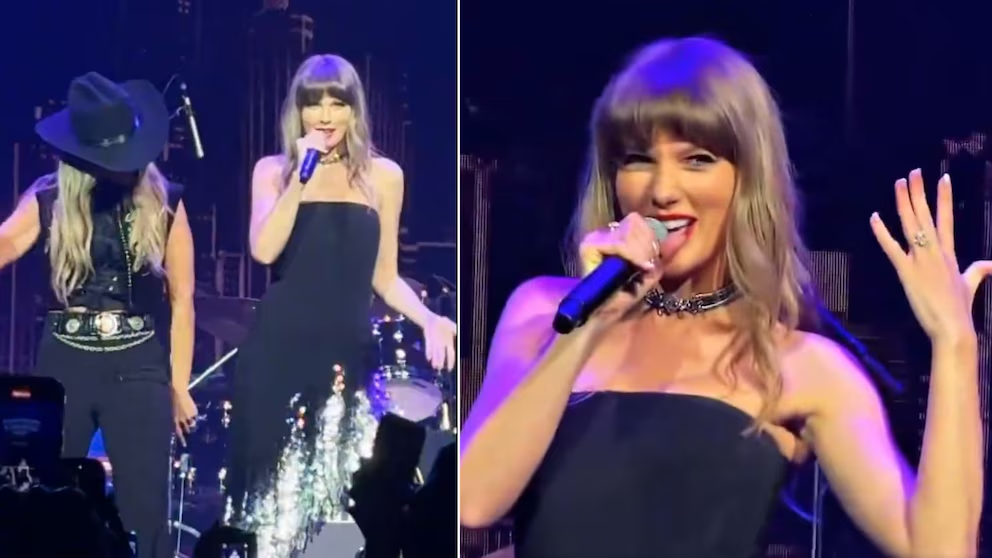
No evidence indicated that Swift attended the Brazil-Scotland match. A celebrity’s absence from a broadcast is not definitive proof, but an appearance of that magnitude would normally generate multiple photographs, videos and independent reports. The viral claim depended largely on a single image. When a major event is supported by only one visual source, skepticism is especially important.
The episode demonstrates the growing difficulty of distinguishing documentation from synthetic media. Traditional photo manipulation required considerable skill and often left visible inconsistencies. Generative artificial intelligence can now create convincing results in seconds, including changes to faces, clothing and entire backgrounds. The technology does not need to produce a perfect image; it only needs to appear credible during the brief moment before a user shares it.
Celebrity content is particularly vulnerable because public figures have enormous quantities of photographs available online. Their faces, expressions and physical characteristics are familiar to audiences and widely represented in training data. That abundance allows manipulated images to look recognizable while remaining fictional. It also increases the likelihood that users will engage emotionally before examining the source.
The false photograph did not appear to cause serious harm, but its success illustrates techniques that can be applied in more consequential contexts. The same methods can fabricate political meetings, criminal behavior, public statements or scenes from armed conflicts. A playful celebrity montage and a dangerous disinformation campaign may rely on nearly identical technology. The difference lies in intention, distribution and social impact.
Platforms face increasing pressure to identify altered content, but automated detection remains imperfect. Some services allow creators to label AI-generated images, while others use metadata or visual analysis to identify manipulation. Those systems can fail when files are cropped, compressed or repeatedly uploaded. Human verification therefore remains necessary.
Media literacy begins with examining who first published an image. An account known for satire, fan edits or sensational content should not be treated as an authoritative source. Users should search for confirmation from event organizers, professional photographers or multiple reputable outlets. The absence of independent visual evidence can be as important as the image itself.
Small physical details may also expose fabrication. Hands, jewelry, hairlines, reflections and background faces can contain distortions. Lighting may fall differently across the inserted person, while clothing can merge unnaturally with nearby objects. However, the quality of synthetic media is improving quickly, making visual inspection alone increasingly unreliable.
The Brazil-Scotland montage succeeded because it combined three powerful elements: a real event, an authentic photograph and two celebrities with a documented friendship. Nothing in the scene initially appeared extraordinary enough to demand suspicion. The fabrication did not invent the entire setting; it changed one person within a truthful context. Partial truth often produces the most persuasive misinformation.
Cabello’s actual appearance remained newsworthy without any alteration. She attended the match with her mother and publicly displayed support for Brazil. The digital substitution transformed a family moment into a fictional celebrity reunion. As the false version accumulated attention, the real photograph and the person removed from it became secondary.
The incident offers a clear reminder for audiences navigating major events in real time. A photograph can look authentic, feature familiar people and circulate through thousands of accounts while still being false. Viral popularity measures attention, not accuracy. In an environment where digital fabrication is becoming effortless, verification must begin before enthusiasm turns an edited image into accepted reality.
La imagen convence; el contexto revela. / The image persuades; context reveals.