

 Phoenix 24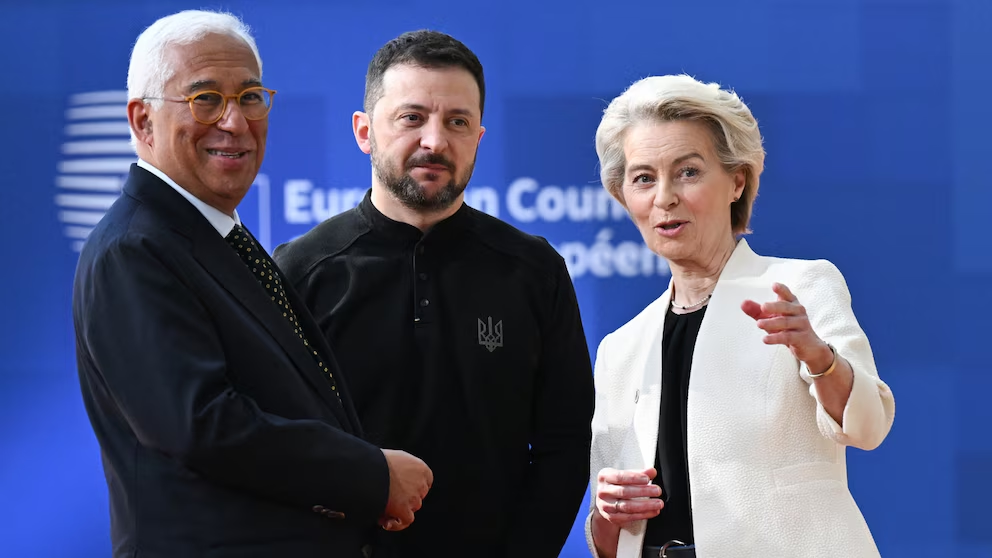
Membership becomes a process, not a promise.
Brussels, April 2026. The European Union has ruled out Ukraine’s immediate entry into the bloc, even as it maintains political, financial and military support for Kyiv. The decision does not close the door to accession, but it makes clear that membership will not be accelerated solely by wartime urgency. Europe is telling Ukraine that solidarity exists, but institutional entry still requires time, reforms and unanimity.
The message carries strategic weight because Ukraine is not a conventional candidate. It is a country fighting a war, defending territory and seeking to anchor its future inside the European project. That gives its candidacy enormous symbolic force, but it also complicates the legal, economic and security requirements of accession. The EU cannot treat membership as a gesture without changing the meaning of enlargement itself.
At the center of the issue is the Union’s merit-based process. Ukraine must align its institutions with European standards on justice, anti-corruption, public administration, market regulation and democratic governance. Those reforms are difficult in normal conditions. Under war, displacement, fiscal pressure and security threats, they become even more complex.
For Kyiv, the delay is politically painful. Ukrainian leaders have framed EU membership as part of the country’s civilizational choice and as recognition of its sacrifice against Russian aggression. Any postponement risks being read domestically as a gap between European rhetoric and European action. The danger is not only frustration, but fatigue.
For Brussels, however, immediate accession would create major institutional risks. Ukraine’s size, agricultural weight, reconstruction needs and security situation would reshape EU budgets, voting balances and internal policy priorities. Bringing in a state at war would also raise difficult questions about mutual defense, border security and long-term financial responsibility.
This is why Europe is likely to pursue a layered approach. Ukraine may receive deeper integration, broader funding and stronger political participation without full membership in the short term. Such arrangements can reduce isolation and strengthen alignment, but they do not offer the same power, rights or guarantees as formal accession.
The decision also reflects internal EU divisions. Enlargement requires consensus, and not all member states view Ukraine’s entry with the same urgency or strategic comfort. Some governments fear budgetary disruption, others worry about agricultural competition, and others use enlargement as leverage in broader political negotiations. Ukraine’s path therefore depends not only on Kyiv’s reforms, but on Europe’s internal cohesion.
The broader geopolitical message is delicate. The EU wants to show Russia that Ukraine belongs to the European future, but it also wants to avoid importing instability faster than its institutions can absorb it. That balance creates an uncomfortable contradiction: Ukraine is being politically embraced while institutionally delayed.
Yet delay does not mean abandonment. The Union continues to finance Ukraine, support reconstruction planning and coordinate sanctions against Russia. What has changed is the timeline. Brussels is signaling that the road to membership remains open, but that it will be governed by procedure rather than emotion.
For Ukraine, the challenge now is endurance. It must keep reforming while fighting, keep public confidence alive while waiting, and keep European attention focused despite war fatigue. That is a demanding political equation, but it may also strengthen the country’s accession case if reforms continue under pressure.
Europe, meanwhile, must confront the limits of its own enlargement model. The Ukrainian case shows that accession is no longer a purely bureaucratic process. It is now a security instrument, a reconstruction framework and a geopolitical signal. The question is whether the EU can adapt without diluting its rules or paralyzing its decision-making.
The decision to rule out immediate membership therefore marks a sober phase in Ukraine’s European path. The promise remains, but the shortcut is gone. Kyiv may still enter the Union, but not as an exception produced by war. It will have to enter as a state capable of carrying the institutional weight of membership.
That reality may frustrate Ukraine, but it also defines the seriousness of the project. Full accession is not symbolic shelter; it is structural incorporation into one of the world’s most complex political systems. Brussels has chosen caution over acceleration, and Ukraine must now convert sacrifice into reform, resilience and long-term convergence.
Detrás de cada dato, hay una intención. Detrás de cada silencio, una estructura.