

 Phoenix 24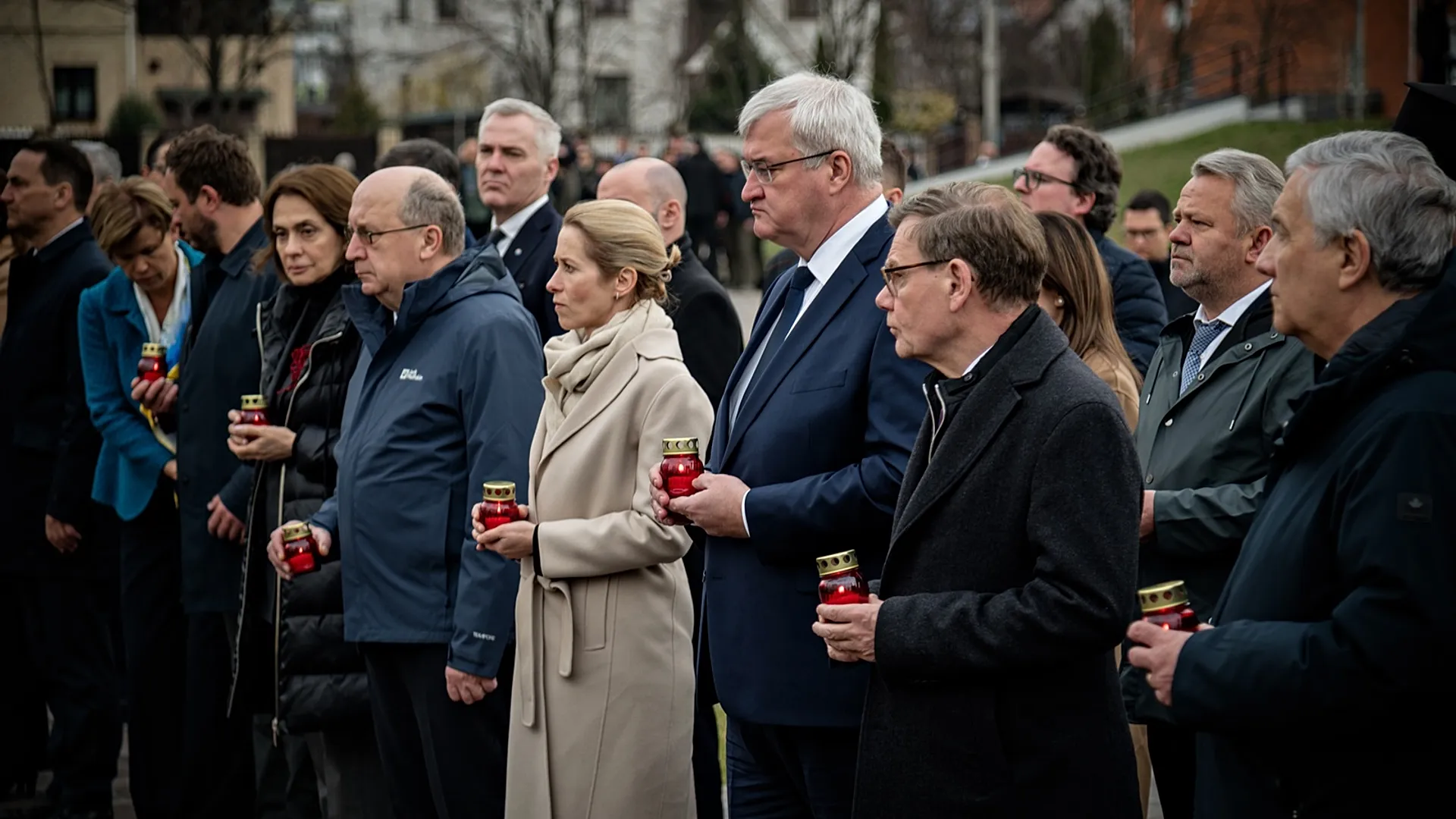
Justice now marks Europe’s internal fracture.
Kyiv, March 2026
European Union governments, with Hungary standing apart, used the anniversary of the Bucha massacre to reaffirm their commitment to pursuing accountability for war crimes committed during Russia’s invasion of Ukraine. The gesture was more than ceremonial because it came at a moment when the war is competing with other global crises for diplomatic attention and public urgency. By gathering around the language of full accountability, most European states signaled that atrocities committed against civilians will remain central to how the conflict is politically remembered. Hungary’s refusal to join that line turned a display of unity into a map of Europe’s unresolved divisions.
The choice of setting gave the declaration unusual moral force. Bucha is not simply another name in the geography of the war, but one of the places that fixed the invasion in European memory as a conflict defined not only by territory but by civilian suffering and questions of justice. Returning to that symbol four years later allowed EU officials to insist that accountability cannot be treated as an optional appendix to military and diplomatic strategy. In practical terms, they were defending the idea that legal responsibility must remain part of the war’s long institutional horizon, even if prosecutions are slow and politically difficult.
That matters because wars of attrition tend to erode moral clarity over time. As front lines harden and fatigue spreads across foreign electorates, governments often shift toward the language of negotiation, stabilization, and risk management. In that process, crimes committed earlier in the conflict can begin to lose political centrality, especially when other emergencies crowd the international agenda. The EU ministers who backed accountability in Kyiv were trying to prevent exactly that kind of erosion, preserving the legal and symbolic frame that Ukraine needs in order to resist not only militarily but historically.
Hungary’s exception therefore carried weight beyond a single diplomatic disagreement. Budapest has repeatedly complicated European positions on Ukraine, sanctions, financial support, and broader strategic alignment with Russia. Each act of resistance adds to the impression that the European Union can project moral seriousness without always securing full political cohesion behind it. What happened in Kyiv reinforced that pattern by showing that even on the issue of war crimes, where the ethical stakes are particularly high, one member state can still separate itself from the bloc’s dominant line.
For Brussels, this is not just an optics problem. The credibility of European policy depends partly on whether its rhetoric can survive internal obstruction when the issue becomes politically costly. A union that defines itself through law, rights, and democratic order cannot afford to sound selective or negotiable when mass civilian abuse is at stake. If accountability becomes vulnerable to tactical dissent from one government, then Europe’s claim to normative consistency weakens precisely where it most wants to appear firm. Hungary does not erase the broader European position, but it makes the limits of that position more visible.
For Ukraine, however, the declaration still matters. Kyiv needs weapons, funding, and diplomatic leverage, but it also needs its partners to preserve the legal grammar of the war. Once atrocities are pushed to the margins of official language, the conflict becomes easier to flatten into a mere dispute over borders, spheres of influence, or bargaining terms. That kind of flattening benefits Moscow because it dilutes the moral and judicial dimensions of the invasion. By insisting on accountability, most EU states were also defending the memory structure that will shape future tribunals, reparations debates, and postwar legitimacy.
Yet declarations alone are not enough. Investigating and prosecuting war crimes requires evidence preservation, institutional endurance, international coordination, and a willingness to pursue cases even when the immediate political spotlight fades. Justice in this context is not a press statement but a long administrative and legal struggle that may last years beyond the war itself. That is why Europe’s pledge will only remain credible if it is backed by sustained support for Ukrainian prosecutors, international courts, and the broader architecture designed to document responsibility at multiple levels. Without that follow-through, the language of accountability risks becoming morally resonant but operationally thin.
There is also a wider lesson in this moment. Ukraine has become the terrain on which Europe is testing not only its security posture but its political character. The war has forced the Union to ask whether it can act as a strategic power without abandoning the legal and ethical vocabulary that underpins its legitimacy. Most capitals in Kyiv answered that question by tying support for Ukraine to the pursuit of justice. Hungary answered by preserving distance, and in doing so exposed the fault line that still runs through the European project.
The deeper pattern is difficult to ignore. Europe remains broadly committed to holding Russia responsible for atrocities committed in Ukraine, but that commitment is not perfectly unanimous and therefore not fully secure. In times of war, even moral consensus has to survive institutional friction, national calculation, and political asymmetry inside the bloc itself. The result is a Union that can still speak with force about justice, yet cannot always do so with a single voice. That is why this episode matters beyond Bucha, beyond one anniversary, and beyond one dissenting capital.
Hechos que no se doblan. / Facts that do not bend.