

 Phoenix 24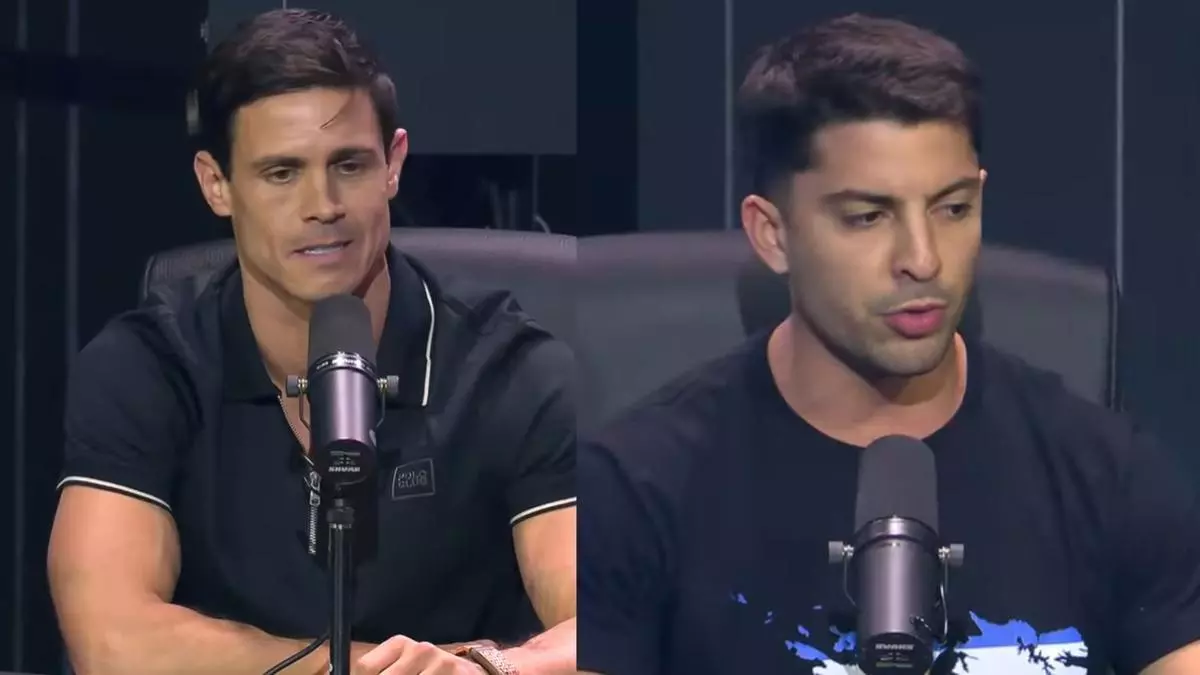
The rivalry is symbolic before the first punch.
Barcelona, March 2026
The confirmation of Edu Aguirre against Gastón Edul for La Velada del Año 6 is not just another crossover boxing stunt. It is a media rivalry carefully repackaged as spectacle, with football culture doing most of the promotional work before either man throws a jab. Ibai Llanos’ event has already turned creators, musicians, and internet personalities into amateur fighters, but this matchup adds a new ingredient: two sports journalists whose public identities are tied to opposite symbolic camps in the Messi–Cristiano universe.
Edu Aguirre arrives carrying the image he has built in Spanish football television, close to the Real Madrid orbit, closely associated with Cristiano Ronaldo, and often read by audiences as part of the anti-Messi ecosystem even when the argument is framed as “debate.” Gastón Edul comes from the Argentine football press, with credibility built around national-team coverage and a reputation that places him culturally much closer to the Messi side of the map. That contrast is why the fight was instantly marketable. The event does not need a deep personal feud. It already has a narrative shortcut that millions understand in seconds.
What makes the pairing effective is that both men are not traditional influencers in the classic sense. They come from sports journalism, which gives the fight a different social charge. When journalists step into the ring, the audience does not only watch two amateurs boxing. It watches two media personas testing the strength of their own public mythology. In this case, the symbolism is obvious: Spain versus Argentina, Cristiano’s ally versus Messi’s interpreter, television panel energy versus reporting-ground legitimacy. The fight sells because it compresses years of football argument into a format that rewards visibility more than nuance.
That shift is important. La Velada has always functioned as a machine that converts online identity into physical risk. The ring forces public figures to exchange irony for consequences. Once the gloves are on, opinions, clips, and fan edits stop being enough. What matters is preparation, composure, weight cut, stamina, and whether a person built for verbal confrontation can handle the honesty of contact. For journalists, that transition is especially revealing because their careers are usually built on analysis from outside the event. Here, they become the event.
The Edu Aguirre–Gastón Edul matchup also reflects how football media itself is changing. Traditional sports journalism no longer lives in a protected professional silo. It now overlaps with creator culture, streaming logic, personality branding, and event entertainment. A journalist is no longer only a reporter or commentator. He is also a public-facing character, with fan tribes, aesthetic codes, meme value, and monetizable tension. La Velada understands that transformation perfectly. It does not recruit athletes only. It recruits identities that already carry audience segmentation.
There is also a timing element that makes the fight sharper. The event is scheduled for July 25 in Seville, just after the World Cup cycle in North America ends. That means Edul’s participation lands in a period when his public visibility could already be elevated by tournament coverage, especially if Argentina makes a deep run. In practical terms, the fight could benefit from football’s afterglow, using global tournament attention as a launchpad for a completely different kind of performance. Aguirre, meanwhile, enters from the Spanish media ecosystem with a profile that fits La Velada’s preference for recognizable but polarizing figures, people who generate immediate reaction before they generate technical boxing expectations.
The event’s organizers also know that amateur boxing here is not sold as pure sport. It is sold as dramatic translation. The audience is not looking for elite ring craftsmanship. It is looking for meaning attached to punches. Edu against Gastón offers that meaning in abundance. Every stare-down, every training clip, every weigh-in comment can be read through football allegiances. That does not make the fight fake. It makes it semiotically dense, which in modern entertainment is often more valuable than authenticity in the traditional sense.
Still, there is a risk built into this kind of matchup. When symbolism grows too large, the actual contest can become secondary, and the participants risk being consumed by the roles assigned to them. Aguirre may be reduced to “the Cristiano guy.” Edul may be reduced to “the Messi guy.” The audience may end up watching a tribal proxy war rather than two individuals taking on a difficult physical challenge. That is the cost of entering the ring with a preloaded public script. Winning the fight may not be enough. The real struggle is controlling the interpretation of the win.
Yet that is exactly why this matchup fits La Velada so well. It is not merely a boxing card. It is a live laboratory of digital-era celebrity, where professions blur and narrative capital becomes as important as technique. Edu Aguirre and Gastón Edul are not there because they are the best boxers available. They are there because they represent something larger than themselves, and because audiences now consume conflict through recognizable symbolic binaries faster than through facts.
In the end, this fight confirms that football media no longer stops at the screen. Its rivalries can migrate into music, podcasts, sponsorships, documentaries, and now the boxing ring. That is the real story. La Velada is not borrowing attention from football. It is proving that football culture has become transferable entertainment material, powerful enough to survive outside the match itself and still sell a confrontation.
Narrative is power too. / La narrativa también es poder.