

 Phoenix 24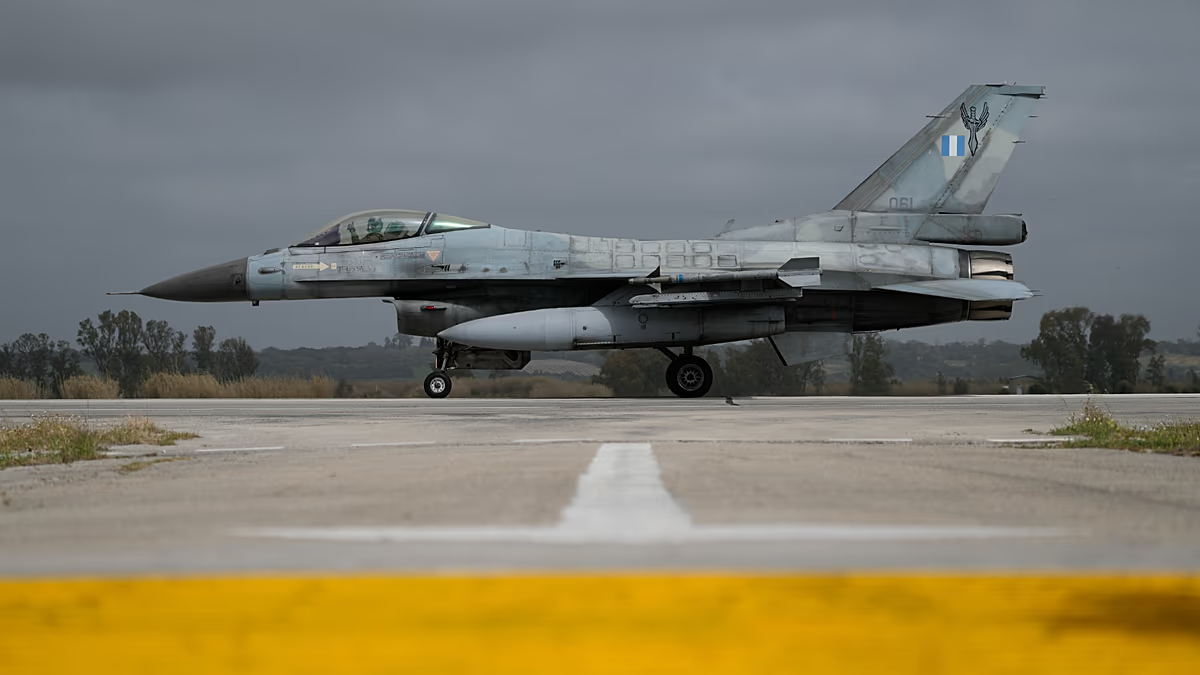
Restraint survives, but under heavier pressure.
Nicosia, March 2026
The multiplying military presence in Cyprus is no longer a temporary precaution. It is becoming one of the clearest signs that the eastern Mediterranean is being reorganized by the wider Iran war, even as Greece and Turkey try to avoid turning that buildup into a fresh bilateral crisis. Western states reinforced the island and its surrounding waters after drone strikes and growing regional instability, while Turkey sent six F-16 fighter jets and air defense systems to northern Cyprus. That dual movement matters because it transforms Cyprus from a strategic outpost into an active buffer zone between several overlapping security logics.
The immediate trigger was not an abstract fear, but a direct security shock. An Iranian-made drone hit a British military base on Cyprus on March 2, prompting Britain, France, and Greece to rush additional air defense assets to the island. That event did more than expose a military facility. It demonstrated that Cyprus, despite not being a frontline combatant in the conflict, can still absorb the spillover of war in ways that force rapid external reinforcement. Once a base on the island is hit, the argument for military buildup ceases to be theoretical.
What makes the current situation more delicate is the coexistence of reinforcement and restraint. Greece has increased its military posture around Cyprus and publicly framed that support as part of a broader European defensive responsibility. After the trilateral meeting in Paphos, Prime Minister Kyriakos Mitsotakis described the reinforcement of Cyprus as an expression of mutual defense and stressed that the moves were defensive rather than offensive. Turkey, meanwhile, justified its own deployment to northern Cyprus as protection for the Turkish Cypriot community in a deteriorating regional environment. Both sides are expanding presence. Both are also trying, for now, not to turn that presence into an open Greek-Turkish confrontation.
That balancing act is crucial because Cyprus has always been more than an island dispute. It is a compressed geography of unresolved sovereignty, external basing, NATO asymmetry, and eastern Mediterranean competition. The war around Iran is now overlaying that older dispute with a new military urgency. The United States, Britain, France, Germany, Italy, Spain, Greece, and others have all moved assets into the eastern Mediterranean, while Turkey reinforced the north with jets and air defense systems. Once so many actors begin layering force into one narrow zone, the margin for misunderstanding shrinks even if no one is openly seeking escalation.
What prevents a new Athens-Ankara crisis, at least for the moment, is that both governments appear to understand the cost of opening a second eastern Mediterranean front while the wider region is already under strain. Greece is emphasizing European solidarity and defensive protection. Turkey is emphasizing deterrence and community security. Neither narrative is conciliatory, but both are calibrated. That calibration suggests the two capitals are trying to preserve their rivalry below the threshold of direct confrontation, even while each reinforces the military facts on the ground. In other words, restraint is still present, but it is now operating inside a denser and more heavily armed environment.
For Europe, Cyprus now functions as more than a border island. It has become a test of whether the continent can defend exposed territory and critical basing infrastructure without unintentionally feeding a new intra-alliance rupture. The rhetoric coming out of Paphos pushed that logic further by presenting any attack on Cyprus as an attack on Europe itself. That elevates the island’s symbolic value. Cyprus is no longer simply a local vulnerability. It is being recoded as a European security marker, and that raises the political stakes of every new interception, deployment, or incident.
The deeper pattern is unmistakable. Cyprus is being militarized not because Athens and Ankara suddenly want a direct clash, but because the surrounding war is forcing every regional actor to harden positions they would otherwise prefer to manage more quietly. The danger lies precisely there. A buildup designed for deterrence can still generate friction, especially when several powers with different chains of command, threat perceptions, and territorial narratives begin operating in the same compressed theater. Cyprus is therefore becoming a place where caution and escalation now coexist in unstable proximity.
What emerges from this moment is not a renewed Greek-Turkish showdown, at least not yet. It is something more structurally revealing: Cyprus is becoming the military buffer of a wider war, and both Athens and Ankara are trying to avoid igniting their own dispute while preparing for the possibility that the region’s disorder may force harder choices. That is why the island now matters so much. It is no longer just a frozen conflict. It is an armed hinge in a war that keeps widening around it.
Facts that do not bend. / Facts that do not bend.