

 Phoenix 24
The ruling raises questions about historical memory and institutional independence.
BOGOTÁ
A Colombian judge has ordered the preservation of more than 30 historical objects removed from the National Museum in Bogotá, intervening in a dispute over political influence, cultural representation and the country’s collective memory. The provisional ruling also prevents further changes to the affected exhibitions while the court examines whether the removals violated constitutional rights.
Judge César Enrique Osorio, of Bogotá’s 24th Family Court, instructed museum authorities to safeguard the objects and refrain from additional alterations pending a substantive decision. The measure does not yet require the permanent restoration of every item to public display, leaving the legal dispute unresolved.
Among the removed objects are an early publication associated with Colombia’s LGBTQ+ community, an electoral poster featuring former guerrilla leader Carlos Pizarro and a pen used during the signing of the 2016 peace agreement between the Colombian government and the Revolutionary Armed Forces of Colombia, known as FARC.
The objects document different and sometimes contested chapters of the country’s history. Their significance extends beyond their physical characteristics because they represent political movements, social identities and efforts to end decades of armed conflict.
The controversy intensified after the government of President Abelardo de la Espriella supported changes to the museum’s exhibitions as part of a broader effort to challenge what it considers ideological interpretations of national history.
De la Espriella has argued that public cultural institutions should not promote partisan narratives or portray former guerrilla figures as national heroes. His position reflects a wider political debate over how the country’s past should be presented in publicly funded institutions.
Critics interpret the removals differently. Artists, museum professionals and civil society organizations argue that excluding objects associated with particular political movements or communities risks narrowing the historical record available to citizens.
Several Colombian modern art museums have publicly expressed concern about political interference in curatorial decisions. Their response emphasizes institutional autonomy and the importance of presenting historical experiences without requiring visitors to endorse the individuals or movements represented.
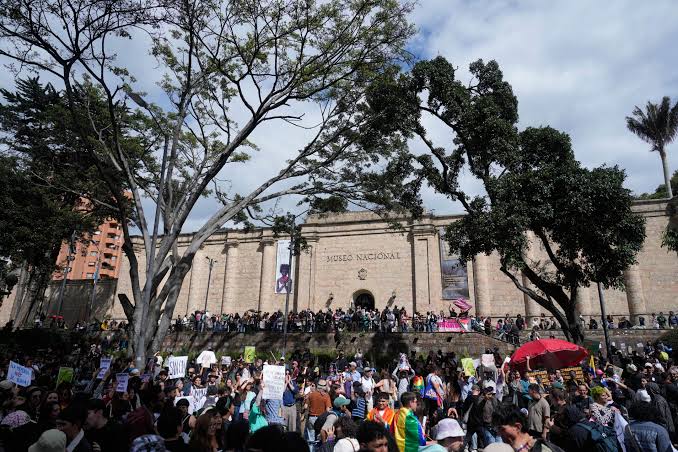
The disagreement prompted demonstrations outside the National Museum over the weekend. Participants included feminist organizations, LGBTQ+ activists and groups associated with the political left.
Although the gatherings began peacefully, confrontations developed between some demonstrators and police. Riot-control units used tear gas, stun grenades and water cannons during the disturbances.
Those incidents add a public-order dimension to a dispute that originated inside a cultural institution. The right to demonstrate peacefully and the responsibility to investigate violence remain separate questions from the legal status of the removed objects.
The judicial intervention introduces another distinction. Protecting historical materials does not automatically determine how they should be interpreted or displayed. Museums routinely revise exhibitions as scholarship evolves, collections change and new perspectives emerge.
What makes this dispute particularly sensitive is the relationship between curatorial decisions and government authority. Historical interpretation inevitably involves choices, but those choices can become controversial when they appear to exclude politically inconvenient experiences.
The court must now examine whether the removal process complied with applicable legal protections, including rights connected to freedom of expression and historical memory.
Its eventual decision could influence how Colombian cultural institutions manage disagreements between public authorities, professional curators and communities represented in national collections.
The controversy also reflects a broader international challenge. Governments and museums increasingly face competing demands over monuments, archives and exhibitions documenting painful or divisive historical events.
Preserving an object does not necessarily mean celebrating the person or movement associated with it. Historical documentation can support critical examination precisely because it allows different interpretations to remain accessible.
For Colombia, that distinction carries particular weight after decades of political violence and efforts to document the experiences of victims, former combatants and marginalized communities.
The immediate ruling ensures that the disputed materials remain protected while the legal process continues. Whether they return to public exhibition, and under what curatorial framework, remains to be determined.
The larger question concerns who should exercise authority over a nation’s historical record, and how cultural institutions can preserve evidence of a contested past without becoming instruments of a single political interpretation.
Beyond the Headlines, Accountability Matters.