

 Phoenix 24
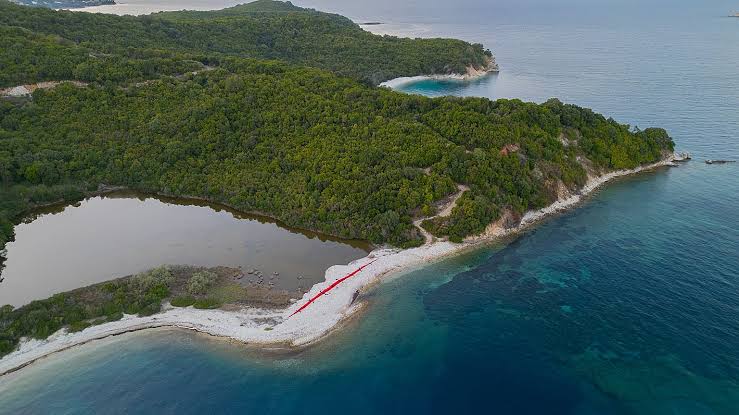
A striking installation on Corfu turns environmental damage into collective memory.
CORFU, GREECE
A 50-meter red wound stretching across the coastal landscape of Corfu has become an unsettling artistic statement about development, environmental vulnerability and collective responsibility. Created by Greek visual artist The Krank, the temporary installation transforms a previously disturbed section of land into an image of injury, confronting visitors with the physical consequences of human intervention in nature.
The work, titled “Wound,” was presented on September 26 and 27 in Erimitis, a relatively undeveloped coastal area in northeastern Corfu. Rather than selecting an untouched landscape, the artist placed the installation where bulldozers had already left visible marks during construction activities initiated in 2021.
The decision gives the artwork a particular significance. Its red surface resembles an open wound, while enormous black stitches appear to hold the divided terrain together. The visual language is immediate, but its meaning extends beyond the suggestion that nature has been damaged.
The stitches were created and positioned with the participation of local residents and members of Save Erimitis, a community initiative involved in protecting the area. Their contribution transformed the installation into a collective act rather than an exclusively individual artistic expression.
Yet the work offers no illusion that symbolic repair can reverse environmental damage. Sewing the landscape together does not restore disturbed habitats or settle the political disagreements surrounding development. The intervention instead makes those unresolved conditions visible.
Erimitis has been the subject of controversy since 2012, when Greece initiated procedures to develop state-owned land in the area. A subsequent investment proposal by NCH Capital, known as the Kassiopi Project, envisioned a five-star hotel, up to 40 luxury residences and a marina accommodating 57 vessels.
Supporters of tourism investment have viewed such projects through the possibilities of economic development and commercial activity. Environmental campaigners, however, have raised concerns about the effects of construction on coastal habitats, wetlands and areas of ecological sensitivity.
The resulting dispute has involved community mobilization and legal challenges. Construction began in 2021, although the original development did not advance as initially planned.
Within that context, The Krank’s installation occupies a space between artistic expression and environmental advocacy. Its location connects the symbolic injury directly to a real site of development-related disturbance, giving the artwork an identifiable geographical and political background.
The artist’s experience of working in Erimitis also shaped his position. After exploring the coastline and speaking with local campaigners, he came to associate the area’s future with preservation rather than further construction.
His perspective is an artistic and environmental judgment, not a comprehensive assessment of the economic or legal dimensions of the development proposal.
The installation also raises a broader question about the role of contemporary art in environmental conflicts. Scientific assessments can measure habitat disruption, biodiversity and land-use changes. Artistic interventions operate differently, making consequences emotionally perceptible without necessarily quantifying them.
That distinction can be productive. An artwork does not replace ecological evidence, but it may draw public attention to places whose transformation would otherwise remain a specialized planning dispute.
Born in 1988 and based in Athens, The Krank has developed a body of temporary, large-scale interventions addressing the relationship between human activity and the natural environment. His visual language frequently uses strong contrasts and symbolic forms to explore vulnerability, transformation and social tension.
“Wound” continues that approach while introducing direct community participation. The involvement of local campaigners links the creative process to an existing struggle over how a coastal landscape should be valued and managed.
The implications extend beyond Corfu. Coastal regions across the Mediterranean confront competing demands involving tourism, private investment, environmental conservation and public access. Balancing these interests requires decisions that art alone cannot resolve.
What the installation accomplishes is more limited, but also more difficult to dismiss. It makes the accumulated consequences of development visible through a familiar human image: a wound that has been stitched, yet remains open.
For Erimitis, the future of the disputed coastline is still a matter of human decisions. The artwork does not determine what those decisions should be, but it challenges viewers to consider what preservation, damage and repair mean when the landscape itself becomes the subject.
Where Innovation Meets Responsibility.