

 Phoenix 24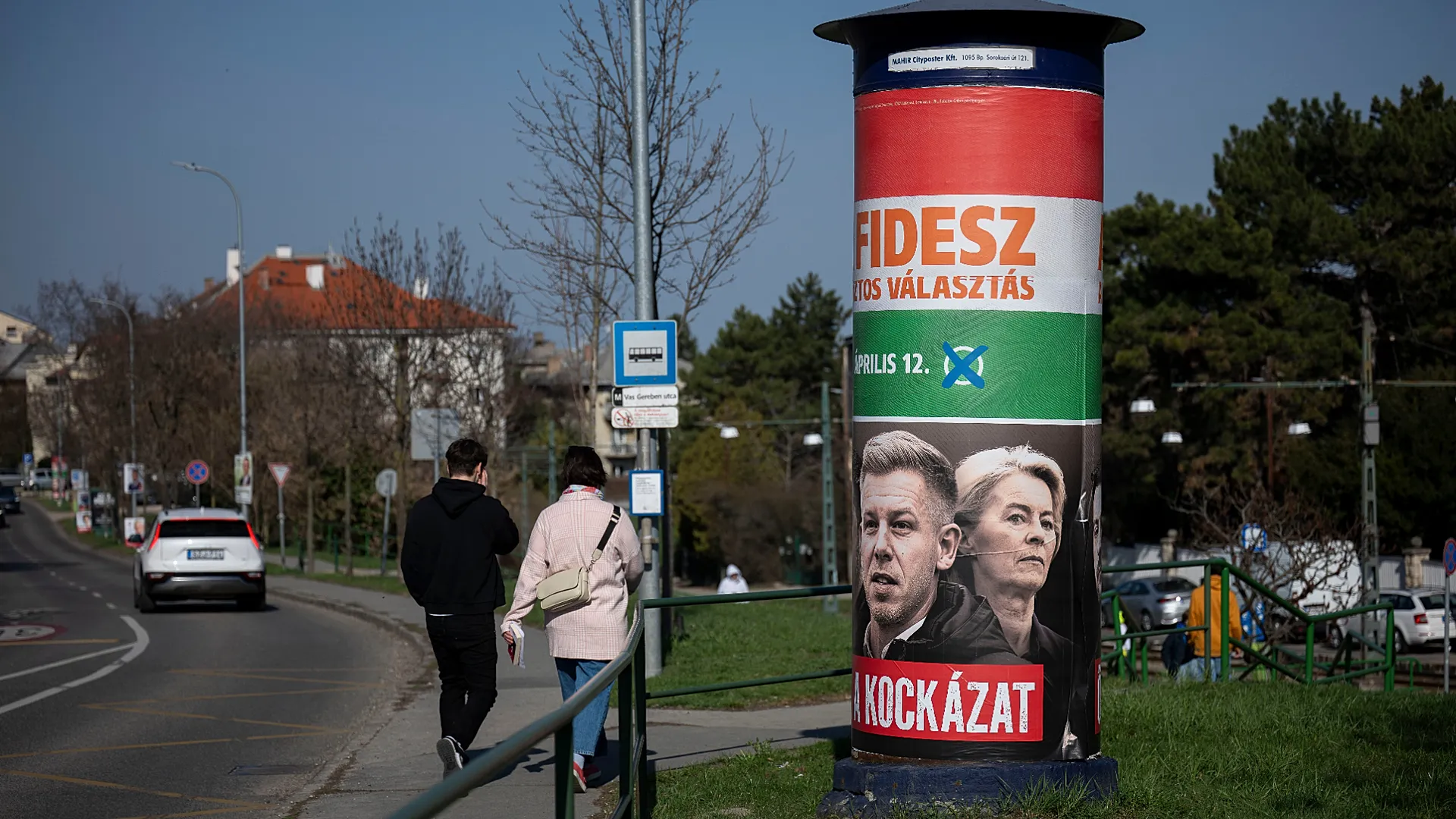
The EU is bracing for two very different futures.
Brussels, April 2026
As Hungary moves toward its parliamentary vote, officials in Brussels are quietly preparing for two sharply different political scenarios. One is the continuation of Viktor Orbán’s confrontational strategy, built around veto power, transactional pressure, and institutional disruption inside the European Union. The other is a more cautious recalibration under Péter Magyar, whose rise has generated guarded optimism but not unconditional trust. What is at stake is not merely Hungary’s domestic direction, but the degree to which one member state can continue to test the cohesion of the bloc from within.
Orbán has long occupied a uniquely disruptive position in EU politics. His government has repeatedly used, or threatened to use, veto power to block collective action on strategic matters, transforming procedural leverage into a method of geopolitical bargaining. The latest example came in March, when he blocked a previously agreed €90 billion loan package for Ukraine amid tensions linked to the Druzhba pipeline dispute. For many European officials, this was no longer just hardball negotiation. It was a sign that Hungary’s obstructionism had reached a level that now strains the system itself.
That perception matters because Brussels is increasingly treating the Hungarian veto not as an isolated diplomatic irritation, but as a structural governance problem. Several European capitals now view this behavior as incompatible with the principle of sincere cooperation that underpins collective decision making inside the Union. In practical terms, that means Orbán’s post-election room for maneuver may narrow if he persists. The mood in Brussels appears to be shifting from accommodation to conditional tolerance, and beyond that, potentially to formal legal confrontation.
Yet the alternative is not being romanticized either. A victory for Péter Magyar would likely be welcomed as an opening for a more constructive relationship between Hungary and the EU, particularly on institutional tone and diplomatic reliability. European officials appear to expect that a Magyar government would reduce the reflexive use of vetoes and adopt a less confrontational posture in core EU matters. But this expectation is tempered by caution, because Magyar is not viewed in Brussels as a conventional liberal or an uncomplicated pro-European reformer.
That ambiguity is central to the entire equation. Magyar has already signaled opposition to the EU migration pact adopted in 2024 and has shown no appetite for accelerating Ukraine’s accession path. He may be less disruptive than Orbán, but that does not automatically place him inside the mainstream consensus of Brussels. For the EU, then, a Magyar victory would represent not ideological alignment, but a manageable reset. The distinction is crucial because it shows that Brussels is not preparing for a strategic conversion in Budapest, only for a less hostile operating environment.
The financial dimension is equally important. If Magyar were to prevail, one of his most immediate priorities would be unlocking the vast pool of EU funds frozen over rule-of-law concerns and corruption risks. Of the €27 billion allocated to Hungary, €17 billion reportedly remains blocked. European diplomats believe that a meaningful portion of that money could be released relatively quickly if Budapest demonstrates real legislative movement and political willingness. In an optimistic scenario, a new government could begin legal changes by early summer and reopen the path to gradual transfers in the following months.
One possible signal of seriousness would be Hungary joining the European Public Prosecutor’s Office, a move that could improve confidence in oversight and help restore access to suspended cohesion funds. Time pressure is also growing because Hungary risks losing around €10 billion in August if it fails to draw down money tied to the EU recovery framework before the deadline expires. This gives any incoming government a narrow operational window. The issue is not only political normalization, but financial urgency.
Even so, uncertainty around Magyar remains substantial. European diplomats and analysts appear unsure whether he would ultimately prove to be a genuine corrective to Orbánism or simply a more polished nationalist capable of reducing tension without changing the deeper ideological architecture. Questions persist around migration, LGBTQ+ issues, and the future of Hungarian rule-of-law reforms under a Tisza-led government. In that sense, Brussels is not choosing between danger and certainty. It is choosing between continued disruption and a still untested alternative.
The broader meaning of this election lies in what it reveals about the European Union itself. Hungary has become a laboratory for the limits of consensus politics inside a bloc that depends on cooperation but still grants significant blocking power to national governments. If Orbán stays, Brussels may move toward a harder institutional response. If Magyar wins, the Union may gain breathing room, but not full clarity. Either way, the Hungarian vote is no longer a peripheral national contest. It has become a test of how far Europe can absorb internal dissent before it must either adapt or confront it directly.
Detrás de cada dato, hay una intención. Detrás de cada silencio, una estructura.
Behind every data point, there is an intention. Behind every silence, a structure.