

 Phoenix 24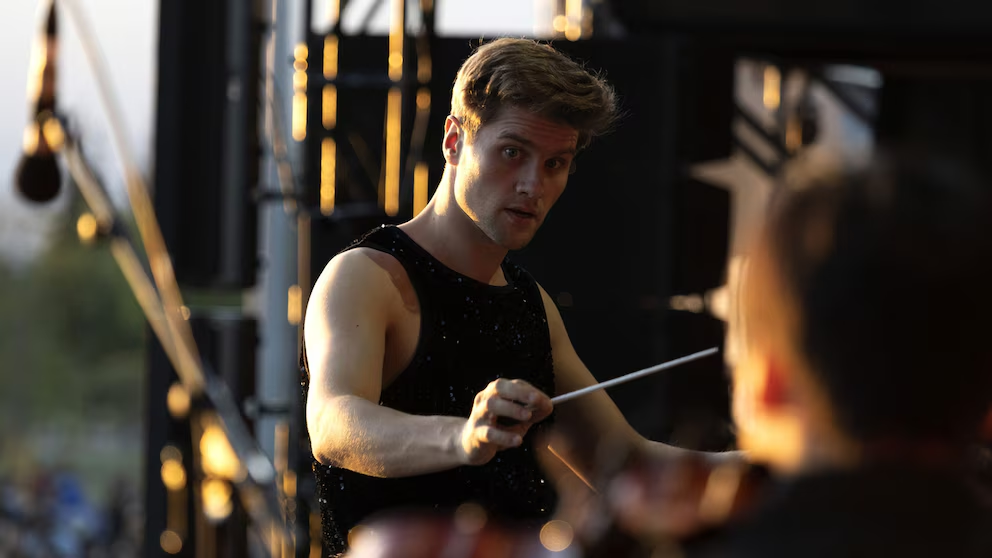
Scandinavian music meets literature beneath Buenos Aires.
BUENOS AIRES, Argentina | June 2026
Icelandic pianist, composer and conductor Bjarni Frímann opened the second edition of CET.Sessions at the Teatro Colón with a program designed to bring audiences closer to contemporary performance. The concert took place at the Centro de Experimentación del Teatro Colón, a space that replaces the ceremonial distance of the main hall with a more intimate relationship between musician and listener. Frímann proposed an acoustic journey through Scandinavian music centered on the piano and connected by literature, another of his major interests. The evening also launched a broader program extending through June 27 with chamber concerts and a final appearance alongside the Buenos Aires Philharmonic Orchestra.
The CET.Sessions format seeks to expand the musical horizons of the Colón’s experimental center through proximity, flexibility and direct contact with performers. Rather than reproducing the traditional architecture of a large concert, the cycle places the audience inside a smaller environment where gestures, breathing and changes in musical intensity become more perceptible. The approach allows artists to present repertoire with fewer formal barriers and greater freedom to explain or reshape their relationship with the works. It also offers the public an opportunity to experience internationally recognized musicians outside the conventions usually associated with major opera houses.
Frímann’s opening program reflected the musical culture of Iceland and the wider Scandinavian region, where chamber music often develops in homes, pubs and community spaces as part of everyday social life. That tradition is connected to long winters, close interiors and a strong culture of collective listening. At the Colón, the pianist translated that atmosphere into a performance intended to feel warm, conversational and stripped of unnecessary solemnity. Literature served as a narrative thread linking pieces and ideas, reinforcing the sense that the concert was conceived as an artistic encounter rather than a conventional recital.
The Icelandic musician has built a career that moves naturally between experimental creation, symphonic tradition and popular collaboration. Since January 2025, he has served as artistic director of BIT20 Ensemble, the contemporary music group based in Bergen, Norway. His conducting experience includes work with the Icelandic Opera, the Iceland Symphony Orchestra, the Hallé Orchestra, the Rundfunk-Sinfonieorchester Berlin and the Hollywood Bowl Orchestra. This range has positioned him as an interpreter capable of moving between institutional classical music and more hybrid forms of performance.

Frímann is also closely associated with some of Iceland’s most internationally recognized artists. As a string player, he has performed alongside Ólafur Arnalds and Ásgeir Trausti, musicians known for combining acoustic textures with electronic and popular elements. As a conductor, he led orchestral concerts by Björk at the Iceland Airwaves festival and later toured internationally with the singer. These collaborations helped shape an artistic identity defined less by genre boundaries than by curiosity, adaptability and a strong sense of theatrical atmosphere.
That experience makes him particularly suited to CET.Sessions, which is built around the idea that contemporary music can become more accessible without being simplified. The cycle does not attempt to reduce complexity or transform experimental repertoire into entertainment. Instead, it changes the conditions of listening so that the public can encounter unfamiliar sounds with greater closeness and fewer institutional barriers. Frímann’s charismatic stage presence and ability to move between traditions reinforce that objective.
The visual environment of the opening session was designed by Martina Nosetto and Ladislao Hanczyc, while Leonardo Murua was responsible for the lighting. Emanuel Fernández oversaw the artistic production. These elements were conceived as part of the performance rather than as decorative additions. In an intimate space, the position of the audience, the distribution of light and the relationship between performer and architecture can alter the meaning of the music.
The cycle continues on June 23 and 24 with the Dúo Dillon Torquati, formed by Italian cellist Francesco Dillon and pianist Emanuele Torquati. The musicians have worked together for more than 15 years and will present two different programs combining classical and contemporary repertoire for cello and piano. Their participation is organized in collaboration with the Italian Cultural Institute. The concerts will extend the cycle’s exploration of chamber music as a living dialogue between established traditions and current composition.
Dillon is one of the leading figures in contemporary chamber music. Born in Turin in 1973, he studied cello with Mario Brunello and Mstislav Rostropovich and composition with Salvatore Sciarrino. He has worked closely with composers including Philip Glass, Gavin Bryars and Giacinto Scelsi. In 1993, he co-founded the Quartetto Prometeo, which received the Silver Lion at the Venice Music Biennale in 2012.
The program will culminate on June 27 in the main hall of the Teatro Colón, when Frímann conducts the Buenos Aires Philharmonic Orchestra as part of the Colón Contemporáneo series. Dillon will appear as the guest soloist in the Argentine premiere of Francesco Filidei’s Concerto for Cello and Orchestra. Filidei has become one of the most prominent voices in contemporary Italian composition, and his opera Il nome della rosa received its world premiere at Milan’s Teatro alla Scala in April 2025. The closing concert will also include works by Kaija Saariaho, Aspasia Avramidou and Igor Stravinsky.
The progression from an intimate piano session to a full orchestral concert gives the cycle a deliberate dramatic shape. Frímann first appears alone, close to the audience and surrounded by a chamber atmosphere. Days later, the program expands through the cello and piano duo before reaching the scale of the Philharmonic. This structure allows the public to experience contemporary music through different levels of density, space and collective force.
CET.Sessions also reflects the Teatro Colón’s effort to present itself not only as a monument to operatic and symphonic tradition but as an active laboratory for new forms of listening. The Centro de Experimentación has long served as a platform for interdisciplinary work, emerging composers and unconventional formats. By inviting figures such as Frímann and Dillon, the institution connects that experimental mission with artists who already possess international recognition. The result strengthens Buenos Aires as a meeting point for contemporary musical creation.
Frímann’s opening performance offered the clearest expression of the cycle’s purpose. It invited the audience to listen without distance, to connect music with literature and to encounter a major artist outside the protective rituals of prestige. The Teatro Colón remained present as an institution, but the experience depended on reducing its formality rather than emphasizing it. In that space beneath one of the world’s most celebrated theaters, intimacy became another form of artistic ambition.
Detrás de cada dato, la intención. / Behind every data point, the intention.