

 Phoenix 24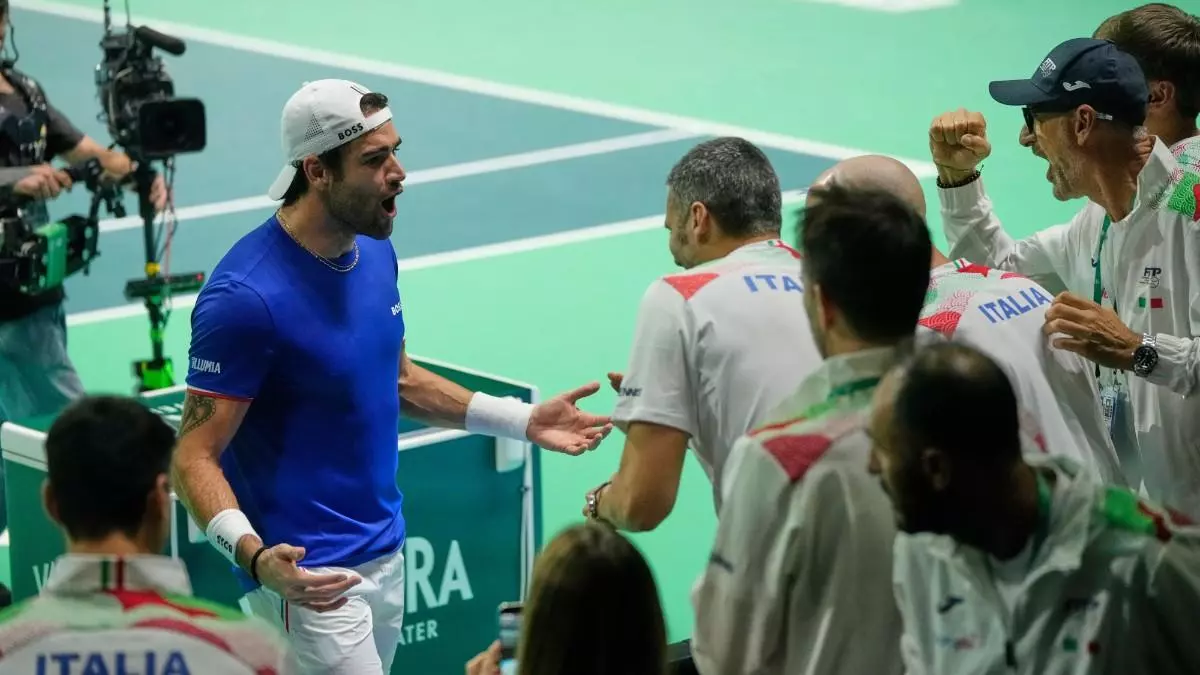
The match unfolded with the tension of a nation watching, carrying the weight of a team that needed clarity and found it in a decisive moment.
Turin, November 2025.
Matteo Berrettini delivered the performance Italy urgently required, defeating Jurij Rodionov in a match that restored momentum to the national team and reaffirmed his role as one of the squad’s emotional anchors. The victory arrived with a mixture of precision, controlled aggression and a renewed physical presence that contrasted sharply with the disruptions that have marked his past seasons. For Italy, the result represented more than a simple progression in competition; it was a stabilizing force at a moment when expectations weighed heavily on the roster.
Across Europe, tennis analysts noted that Berrettini’s resurgence reflects a broader trend among experienced players who have struggled with injury cycles but regained competitive sharpness through tactical refinement. Specialists emphasized that his serve and forehand combination remain among the most imposing weapons on indoor surfaces, allowing him to dictate rallies early and apply pressure without overextending physically. They added that Italy’s hopes in team competition often hinge on Berrettini’s ability to establish rhythm, offering a psychological anchor for teammates navigating high stakes environments.
In the United States, commentators associated with performance research centers observed that Berrettini’s win underscores the growing importance of adaptability in elite tennis. American analysts highlighted the strategic adjustments visible in his shot selection, footwork patterns and point construction, which demonstrated a more pragmatic approach than in previous seasons. They argued that such shifts are essential for players attempting to manage physical wear while maintaining competitiveness against younger, aggressive opponents. The match, they noted, served as evidence that Berrettini is recalibrating his game toward efficiency rather than power alone.
Observers in Asia interpreted the victory through the lens of team dynamics and mental resilience. Experts in Japan and South Korea remarked that Italy’s success in international team events often depends on the emotional stability of its top players, especially in early ties where pressure accumulates quickly. They suggested that Berrettini’s composed performance provided a stabilizing effect for the team and signaled that Italy is capable of navigating the psychological complexities that define tightly contested matchups. Analysts added that such displays of discipline resonate strongly with Asian audiences, who traditionally value control and consistency in high stress sporting contexts.
Within the Italian camp, officials and coaching staff praised Berrettini’s leadership both on and off the court. Team insiders noted that his presence has been crucial in guiding younger players and maintaining cohesion during preparation phases. They explained that beyond the technical aspects of his victory, Berrettini demonstrated an intuitive sense of timing, adjusting tempo during longer rallies and applying pressure at critical junctures. His renewed mobility and improved defensive transitions also drew attention, marking a shift from the physical limitations that constrained him in recent seasons.
The match itself unfolded with a clear tactical blueprint. Berrettini sought to dominate with his serve, exploit short returns and force Rodionov into defensive positions early in exchanges. His depth control and forehand acceleration created continuous strain for the Austrian, who attempted to disrupt rhythm through variation but struggled to find consistent openings. As the match progressed, the Italian’s steadiness eroded Rodionov’s resistance, reflecting not only superior firepower but also sharper decision making in prolonged points.
European tennis circles noted that Italy’s path forward in the competition will demand continued precision from Berrettini, whose performance often sets the tone for the rest of the lineup. They emphasized that while his physical condition appears improved, sustained success will depend on his ability to manage workload and maintain the tactical clarity demonstrated in this match. The team’s prospects hinge partly on the synergy between its top players and the confidence generated by early victories of this nature.
Globally, the result was seen as a reminder of Berrettini’s capacity to influence the broader narrative of international tennis, even after periods marked by injury and uneven form. Analysts from multiple regions argued that the Italian’s ability to recalibrate his game and deliver under pressure signals a potential resurgence that could shape the coming season. They also pointed out that Italy’s collective structure gains measurable strength when Berrettini performs at this level, creating a ripple effect across strategic planning and match preparation.
As Italy advances, the central question focuses on whether Berrettini can maintain this renewed momentum. His performance against Rodionov provided both a statement and a foundation, reaffirming his role as a pivotal component of Italy’s ambitions. The coming matches will determine whether this resurgence becomes a defining feature of Italy’s campaign or a singular moment of brilliance in a landscape that constantly demands consistency.
Against propaganda, memory.
Contra la propaganda, memoria.