

 Phoenix 24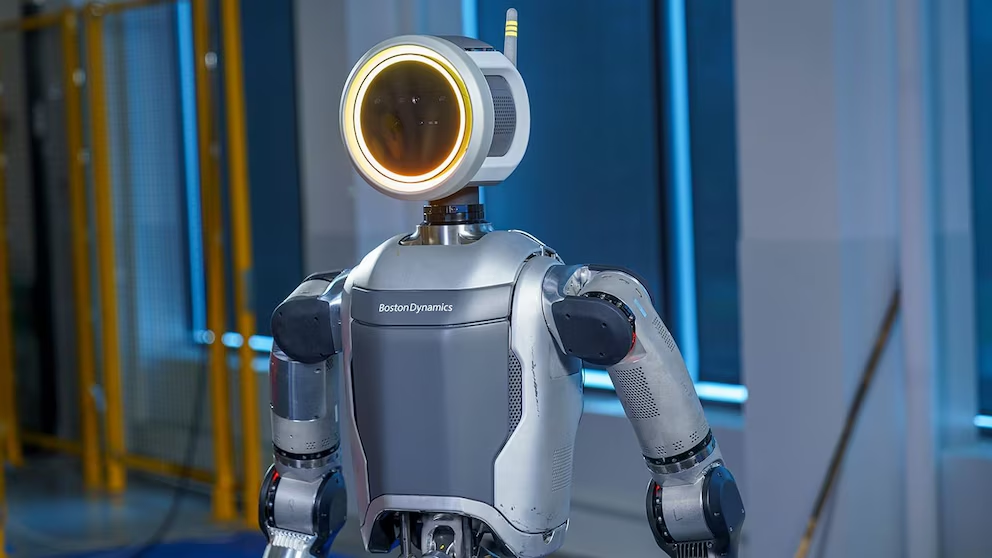
A mechanical body learned to improvise.
Las Vegas, February 2026.
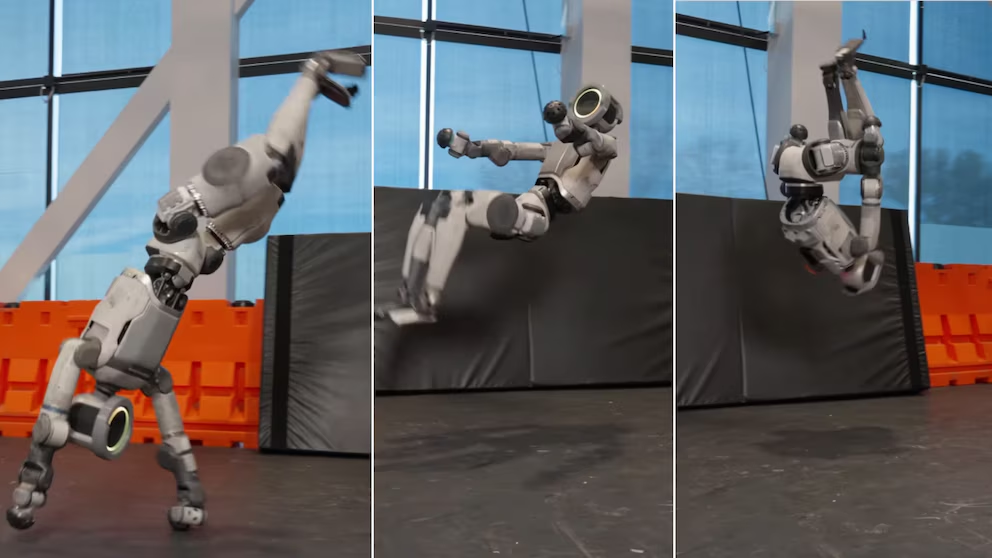
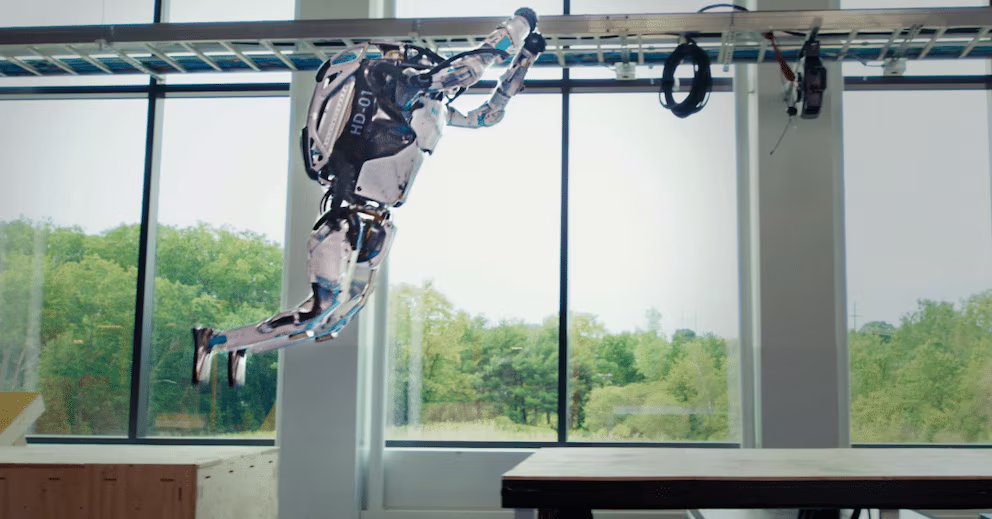
Atlas, the humanoid platform built by Boston Dynamics, is back in the spotlight with a demonstration that looks like acrobatics but reads like an industrial argument. The parkour style jumps, rapid balance corrections, and controlled landings are not there to entertain engineers, they are there to prove a principle: a useful robot is not the one that walks neatly, it is the one that recovers when the real world pushes it. Spectacle is the public wrapper, but the core claim is dynamic control under uncertainty, the ability to remain stable when friction changes, when timing slips, and when the environment stops cooperating. In the current wave of humanoid investment, Atlas is being used as a benchmark to redefine what “physical capability” means at the edge of failure. The headline is athleticism, yet the underlying deliverable is robustness.
The technical significance is not the stunt itself, but the control regime it implies. High performance motion requires tight coordination across sensing, planning, and actuation, and it requires a system that can correct mid flight, not only execute preplanned poses. A robot that can rotate, land, and re stabilize without collapsing is demonstrating far more than strength, it is demonstrating predictability of torque and a resilience loop that reacts fast enough to prevent cascading errors. That kind of recovery matters because factories and worksites are messy, not cinematic. Floors are uneven, objects shift, humans walk nearby, and micro failures happen constantly. The question for industrial adoption is never whether a robot can do something once, it is whether it can do it repeatedly, safely, and without demanding a lab around it. In that sense, the acrobatic sequence functions like a stress test, not a performance.
There is also a deeper point about how modern humanoids acquire movement, because physical skill is no longer built only by painstaking manual programming. Much of the current progress in legged robotics is driven by a training pipeline that blends human motion references, simulation at scale, and iterative transfer to real hardware. When that pipeline works, complex behaviors become an asset that can be refined, versioned, and redeployed, rather than a one off miracle. That changes the economics of development, because learning becomes faster than engineering for each new maneuver. The public sees a flip and assumes flair, while industry sees a system that can compress the time between idea and reliable execution. The real competitive edge is not the jump, it is the speed at which new movement primitives can be built, tested, and stabilized. In a market that is racing, iteration velocity becomes a form of power.
What makes the moment strategically important is that humanoid robotics is moving from fascination to positioning. A humanoid body is expensive compared with specialized machines, so it must justify itself by doing tasks that are variable, reconfigurable, and difficult to constrain into a fixed cell. That is why the narrative keeps circling back to work environments designed for people: stairs, narrow passages, mixed objects, shifting layouts, and ad hoc handling. The humanoid promise is not to outperform every industrial arm, it is to cover the gaps where rigid automation fails because the world changes. Atlas is being framed as a bridge between high precision automation and human adaptability, a platform that can operate in places where the infrastructure cannot be rebuilt just to accommodate a machine. The acrobatic demo is a way of saying the body is no longer the limiting factor. Once that claim is believed, attention shifts to everything else.
And that is where the hard reality begins, because physical skill does not automatically translate into dependable autonomy. A robot can execute a spectacular routine and still struggle with mundane tasks: manipulating fragile objects, sustaining performance for hours, operating amid dust and vibration, or dealing with unpredictable interactions without intervention. Industrial value is built on consistency, not on the best run. Reliability requires error handling, safe behaviors, maintenance protocols, and operational discipline, and those are less visible than a perfectly timed leap. Many robotics programs fail at the transition from demo to deployment because the margin for error in the field is unforgiving. A factory does not reward novelty, it rewards uptime. The real question is whether these capabilities can be packaged into a system that survives the boredom of daily repetition.
Competition amplifies the stakes, because humanoids have become a prestige category as much as a product category. The United States is pushing multiple narratives around general purpose robotic labor, Europe tends to emphasize safety, certification, and integration with industrial standards, and parts of Asia are scaling ecosystems that blend mechatronics, manufacturing, and platform iteration. Atlas enters that landscape as a mobility reference point, a visual shorthand for what a humanoid can do at the edge of balance. But the market will be decided by less glamorous metrics: cost of production, ease of servicing, energy efficiency, long term durability, and the ability to learn new tasks without becoming unpredictable. In other words, the winners will not necessarily be the robots that look most human, but the ones that behave most reliably. The demo is attention capital, but attention is not revenue unless it converts.
The labor conversation is unavoidable, and it should be read without melodrama and without naivety. A physically capable humanoid is, at minimum, a proposal to substitute humans in repetitive, hazardous, or physically punishing work, especially where turnover is high or staffing is scarce. Yet early deployments often create new work around the robot: integration, supervision, maintenance, safety engineering, and process redesign. The disruption tends to be uneven, sector by sector, and it tends to start in places where the business case is strongest, not where the ethical debate is loudest. Over time, the pressure point becomes bargaining power, because productivity gains change the negotiation between labor and capital. If humanoids scale, the workforce impact will not be a single cliff event, it will be a series of small reassignments that accumulate into a different labor landscape. The most realistic future is neither collapse nor paradise, but a redesign of what “physical work” means.
Safety, however, is the factor that can halt everything if it is mishandled. A humanoid with speed, force, and partial autonomy is not just software risk, it is kinetic risk, and kinetic risk has no patience for marketing. That is why adoption will depend on constraints: force limits, redundancy, human detection, safe modes, and disciplined operational procedures. A robot that moves impressively must also be predictable in proximity to people, and predictability is a social requirement as much as a technical one. Trust is built through incident history, transparency about failures, and clear boundaries of capability. In that sense, the governance of humanoids will matter as much as their athleticism. The more capable the body becomes, the less tolerance society will have for vague assurances.
Atlas is therefore a signal of a phase change: the mechanical body is no longer the obvious bottleneck. Dynamic locomotion and balance recovery have moved from theoretical barriers to demonstrated competencies, and that alone shifts expectations in investment, regulation, and adoption. The next filter is industrial and boring by design: how much it costs, how long it lasts, how it is repaired, how much energy it consumes, and how quickly it can be taught useful tasks without becoming a safety liability. If those questions are answered, the impact will be cultural as well as technological, because it will redefine the boundary between human physical labor and machine physical labor. What looks like a flip on camera is, structurally, a test of whether the future has a new kind of muscle.
Beyond the news, the pattern.
Más allá de la noticia, el patrón.