

 Phoenix 24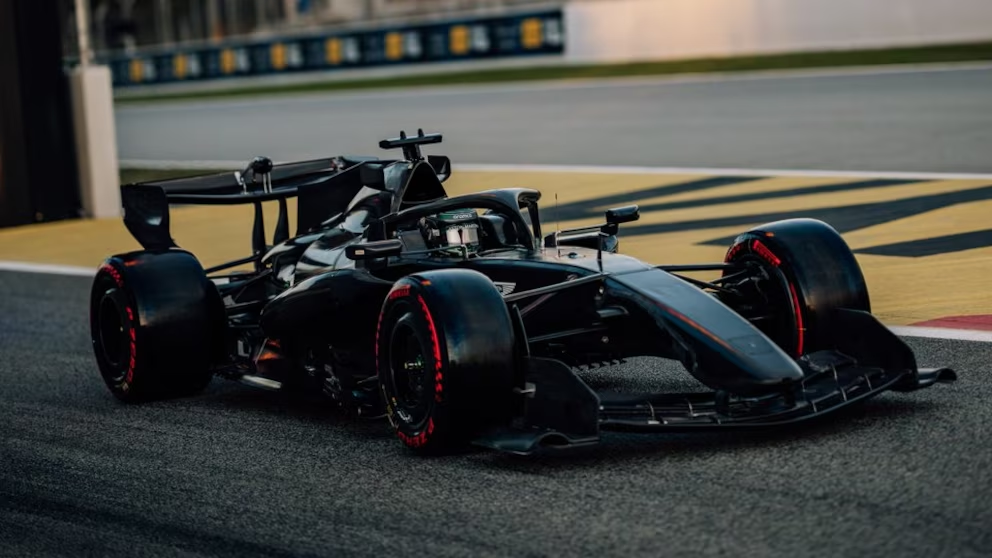
Innovation is now a legal argument.
Sakhir, February 2026.
With pre-season running in Bahrain about to begin, the paddock is already acting as if the first contest will happen inside the regulations rather than on track. A design direction described by rivals as unusually “aggressive” has pulled Formula 1 into a familiar cycle: images turn into interpretations, interpretations turn into pressure, and pressure turns into clarification requests. The focus is Aston Martin’s AMR26 concept and the question everyone asks when a car looks different: is it simply clever, or does it exploit a grey area that will be closed once it works.
The tension is amplified by the public association with Adrian Newey and the way his name changes the meaning of “different.” A novel solution from a lesser-known department is treated as curiosity; a novel solution linked to a legendary designer is treated as intent. The key point is not whether the concept is aesthetically radical, but whether it appears to offer a durable development advantage under cost and time constraints. That is why the story moved immediately from performance gossip to regulatory politics.
What turns a design story into a conflict story is not a formal protest, but the pre-protest behaviour that now defines modern Formula 1. Rival teams tend to push the governing body into early guidance through technical questions that function like legal briefs. If the FIA answers narrowly, the interpretation survives and becomes copyable. If it answers broadly, the pathway closes for everyone and the target is forced into redesign before the season locks in. In that sense, a clarification can decide more than a single component; it can decide which development philosophy remains viable.
Bahrain is the perfect incubator for this kind of escalation because testing creates information asymmetry, and information asymmetry breeds suspicion. When one car looks conceptually distinct, competitors worry not only about lap time but about the season’s cost curve. A team that starts with the right concept spends its budget refining. A team that starts wrong spends the year paying to pivot. That asymmetry is why controversies ignite before the first race rather than after it. Nobody wants to learn in April that the winning idea was legal in February.
Timing is also making teams more sensitive than usual. The 2026 era has been framed across the grid as complex to manufacture and complex to develop, which raises the penalty for rework and late redesign. Early guidance from the FIA therefore becomes a capital allocation signal as much as a compliance statement. It tells engineering groups which paths are worth funding and which are likely sunk costs, and it influences how fast competitors commit resources to copying or countering what they see.

The deeper structural issue is the sport’s permanent contradiction: it sells innovation, but it governs innovation with definitions that are always slightly behind what designers can imagine. If Aston Martin’s interpretation proves fast and stable, rivals will argue for a restrictive reading that protects competitive balance and avoids a season-long arms race. If it proves slow or unreliable, the same rivals will often rediscover their love of “technical diversity” and insist the field should be allowed to diverge. That is not moral inconsistency; it is competitive rationality dressed as principle.
For Aston Martin, the strategic risk is that being early and different becomes a political liability before it becomes a sporting advantage. Distinct concepts invite scrutiny, scrutiny invites measurement, and measurement invites a regulatory response if rivals can build a plausible argument around safety, cost, or the “spirit” of the rules. For everyone else, the risk is symmetric: if the FIA allows the concept and it works, the grid inherits a new baseline that could be expensive to copy within cost constraints. Either way, the first Bahrain laps will not settle the argument; they will only reveal which argument is worth funding.
Narrative is power too. / La narrativa también es poder.